
If your English Word handbook is named ‘final’ but still has crossed-out words, underlined additions and margin comments, which parts belong in the Assamese employee handbook?
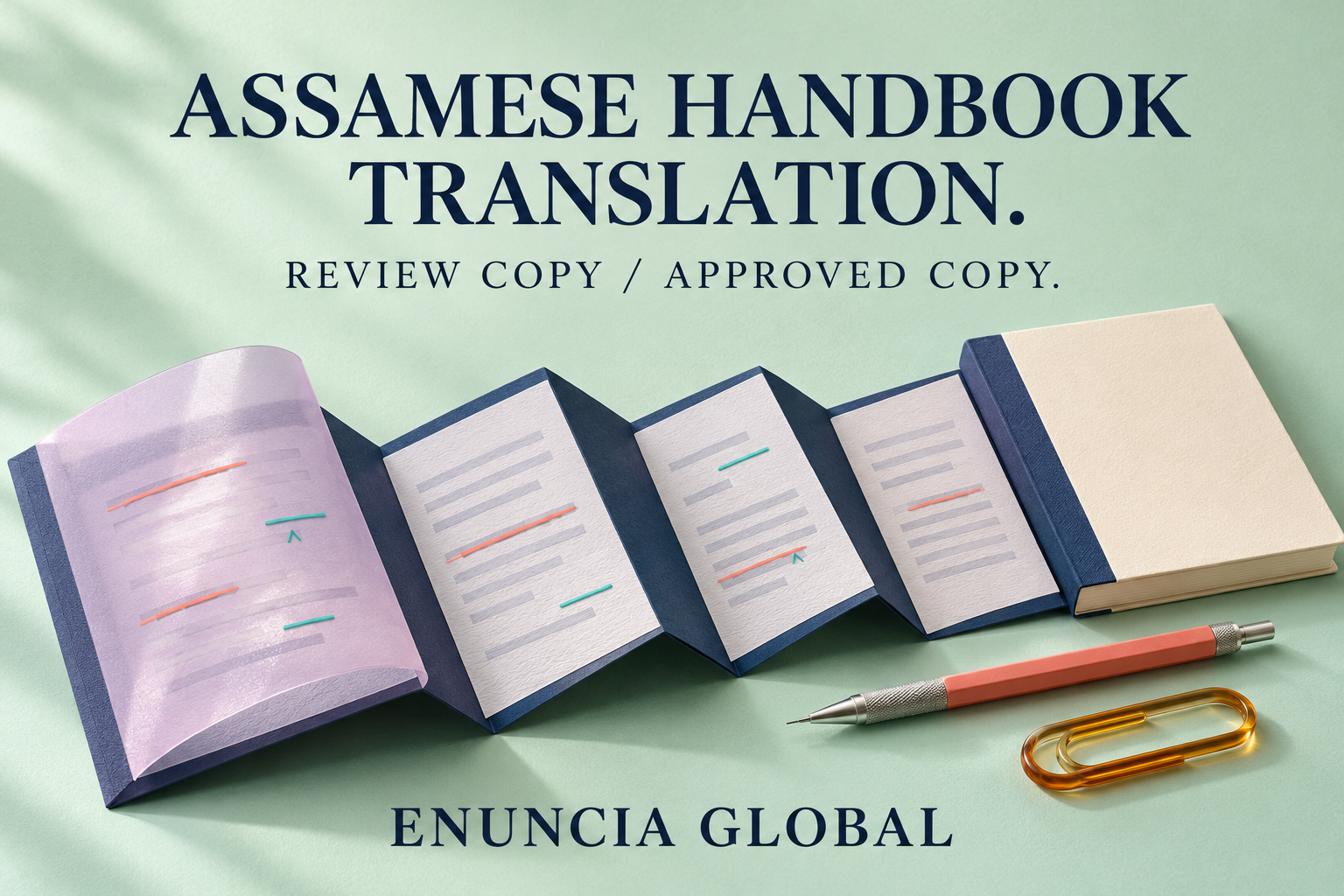
It is also helpful to understand which version of the source document is current and whose words have been authorized in which areas for translation. Marked up copies of the source will be provided as authorized review context. We will need to agree on how to treat adds, deletes and comments in the review prior to copying into the employee’s version of the handbook.
Find out what the English file actually says
In a hypothetical example, a comment beside the heading “Office travel” asks, “Does this include branch visits?” The policy owner needs to clarify the intended rule or identify what is unresolved. Agree which text is authorised to translate, without making up an answer for the employee copy.
Keep translation questions separate from policy decisions. Do not automatically put internal review comments or unresolved policy questions into the employee-facing handbook. A margin remark is not approved policy text.
In the Microsoft tracking guidance it is explained that disabling tracking in no way deletes previously tracked changes. No Markup hides them. In Microsoft change-review guidance it is distinguished between hiding changes and accepting/rejecting them. The policy owner is the one that decides on the approved wording for the source text.
In your request, you don’t have to strip all comments from the file before requesting a quote. Attach the file with comments as is, and clearly indicate which comments / edits need to be translated as the authorized source.
Translate the instructions, not the debate around them
Will the Assamese handbook be read to employees as part of their induction or will employees be pointed in the direction of the handbook by their managers?
Specify department, role or system specific spellings that require approval where necessary. Identify if job titles or system names should remain in English. Confirm who the translated Assamese document is intended for and translate accordingly to that audience not the location of the employees.
Be sure to retain approved limitations, exceptions, dates, numbers and references to internal documents and policies. Similar terms and phrases used to describe different roles and departments can create confusion and it is best to check with the policy owner to confirm meaning. Translation does not establish employment-law compliance so do not try to resolve apparent conflicts in this manner.
Does the translation of all tables, headers and footers as well as words and graphics in the handbook get covered? These are easy to miss when only a PDF of the handbook is supplied to the translator. Supply the editable file and agreed references; scope layout, graphics and review rounds separately.
It would also be useful to clarify whether the requirement is for an editable Assamese version of the document, a bilingual version of the document for review purposes, or even just a list of questions which have arisen during translation and require answer. An English tracked-change history is not automatically a clear record of the Assamese translator’s choices. Source comments are not employee-facing content unless specifically agreed.
Check the copy employees will read
Open up the actually formatted Assamese file against the approved English master on the agreed viewing setup. Read it! Check for missing characters and poorly wrapped lines. Open up all the tables and check that all the table cells are beneath the correct headings. Check that no content is being cut off by any page breaks. Do not sacrifice a policy condition to make a box look nice.
Language reviewer checks completeness, clarity and faithfulness against the approved English. Policy owner reviews content of translation (wording of policy); Layout reviewer reviews format of translated file.
If the hypothetical “Office travel” question (“Does this include branch visits?”) is resolved after the first translation draft, review the affected Assamese passage and pair the updated source and target versions clearly. This does not automatically mean the entire handbook has to be retranslated.
Files that you use to work on a Policy (i.e. working files) must always be kept separate from copies distributed to employees. Prior to distributing a release copy to employees, the Policy owner must check for any remaining tracked changes / comments / hidden text etc. as well as any document properties. Any outstanding revisions must be resolved by the authorized person and all unapproved comments/review remarks must be removed from the release copy. A clean screen appearance or use of an automated document inspector does not necessarily guarantee privacy.
Prepare your Assamese handbook enquiry
Please send us the current authorised English version of the document(s) from which you need the translation (e.g. Word files) plus the marked up files for the sections you require review. Also please include file version#, date, word count etc and any other information that Enuncia needs to take into account for any changes or comments. We also need to know who the intended audience is, any specific terminology that needs to be used and a desired completion date allowing for reasonable time for review.
Confirm who approves the source and translated work, and who prepares the release copy. Agree the required editable Assamese document, bilingual review copy, query log or final formatted release. Use an agreed authorised sharing route. Do not include unrelated staff records, signatures, logins, credentials or secrets. Enuncia Global can assess the material and language requirements through our Assamese Translation Services in India and Business Translation Services. Email us on info@enuncia.global or complete our Get Free Quote form.