
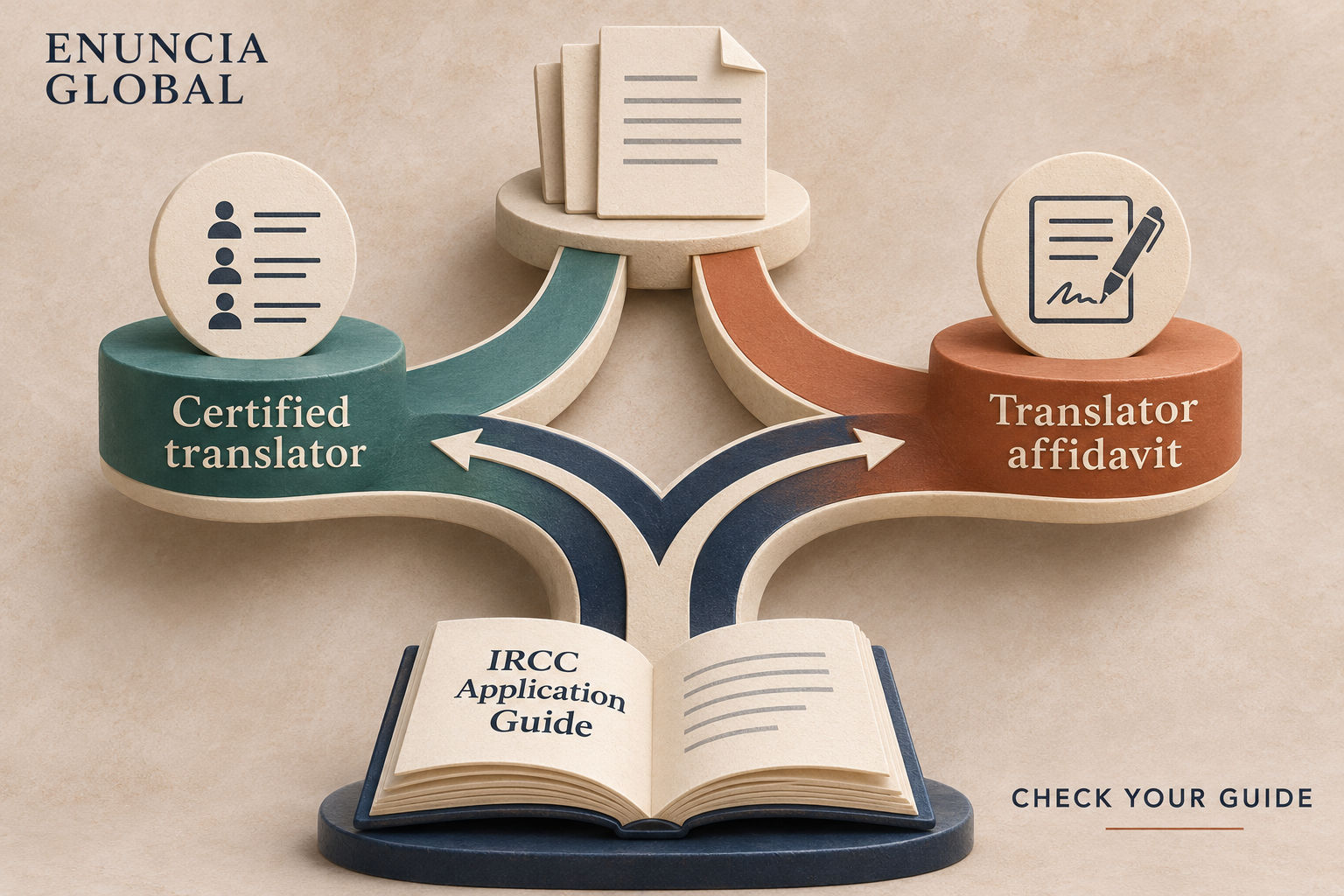
“Certified” is one of those words that can be misleading in the context of Canadian immigration. Many translation companies will advertise that they provide “Certified” translations. A translator may also sign a Statement of Accuracy in relation to a translation that he or she has completed. However, under IRCC’s Guide 5218 (Translation), a Canadian certified translator is defined as a translator who is a current member in good standing of a provincial or territorial organization of translators and interpreters in Canada.
The translation section of Guide 5218 deals with the amendment of specific existing immigration documents. These are not all the Canadian immigration or citizenship applications. Read the current version of the instructions for the program that you are actually using and compare with the requirements in this section of Guide 5218.
Why the translator's status changes the paperwork
For documents not already in English or French, Guide 5218 requires an English or French translation and, where applicable, the translator’s affidavit. The guide allows a person fluent in the source language and the chosen translation language (English or French), or a Canadian certified translator, to do the work, subject to its restrictions. If the above individual is not a Canadian certified translator, an affidavit is required (prepared by the above individual) stating their language ability and that the translation is accurate.
To verify whether a person is able to complete a translation for you, check their status in the relevant instructions (i.e. who was the person who translated your documents and what is their status under the appropriate instructions). As noted above, it is the affidavit requirement that is the distinction that matters for a translator outside the defined Canadian certified category.
Who swears the translator’s affidavit?
Where Guide 5218 requires an affidavit, the translator swears to their language proficiency and translation accuracy before an authorized person, such as a notary public, a commissioner of oaths, or a commissioner of taking affidavits in Canada (where so authorized by the appropriate provincial or territorial authority) or a Notary Public in a foreign country where local authority to administer an oath has been verified. The Affidavit would contain statements regarding the translator’s ability to work in languages, as well as the accuracy of the translation.
The affidavit to be completed by the translator to be sworn before an authorized person differs from a certification of a copy of a document. Such an affidavit can not be sworn by the applicant on behalf of the translator, but only by the translator him/herself.
As per Guide 5218, translations are to be completed by individuals other than the applicant and the applicant’s defined family members (i.e. parents, guardians, siblings, spouses, common-law or conjugal partners, grandparents, children, aunts, uncles, nieces, nephews and first cousins) even where they are fluent in English and/or French. Check the current version of the required documents for the program for which the translation is being completed for the most up-to-date list.
Check the second page too
Suppose you need to amend an existing immigration record. In this imagined example, a supporting foreign-language record has a typed personal name on the first page and a later handwritten endorsement on the second. Leaving out that second page could lose the explanation for an amendment. This is a particular example, not a required two-page format for all supporting documents.
A) First get a complete readable copy of all pages, front and back, of the supporting record, including later endorsements.
B) Translate the completed document(s) and complete the required translator documentation for the chosen Route. If the translator is not a Canadian certified translator (as defined in this guide) then an affidavit of language ability and of accuracy will also be required from the translator under this guide. The affidavit must be sworn in the presence of an authorized person.
C) Keep source amendments visible in the full translation. If another version arrives later, review it before treating existing translated work or an affidavit as covering the changed material.
The given name may have been represented differently in an earlier record than it is in the later identified passport or identity documents. Preserve each source record being submitted and translate it in full. However, other identity evidence may or may not be required by the relevant IRCC program and/or authority and the translation of identity documents alone does not establish identity.
Build a packet someone can actually follow
Index the translated documents and their original counterparts within the file in question. Verify that any required affidavit has been sworn by the translator in front of the appropriate authorised person (listed in Guide 5218 for all locations) and that the contents of the statement actually pertain to translator’s abilities and the accuracy of the work in question and NOT the success of the application in question.
Note that other programmes may have their own online upload slots and document naming requirements. Use the organization’s private index for translated documents without creating a second filing requirement or assumption that all applications will be processed through online services.
Check if any of the source records updated by their issuing authority also need updating of the translation and of the required affidavit.
Enuncia Global can review your readable source(s) and the translation instructions for your chosen Route(s) as well as check on the status of the individual translators involved and see if an Affidavit is also required for submission. The various programs have their own filing requirements, and it is IRCC who evaluates the evidence submitted in support of an application for immigration. The translation packet submitted does not determine the outcome of the application for immigration.