
German Translation Services in India
This page can still help with a specific german requirement. For the broader India-wide german translation route, including documents, certified files, business work, legal material, medical records, transcription, subtitles, interpretation, and quote review, start with the main German page.
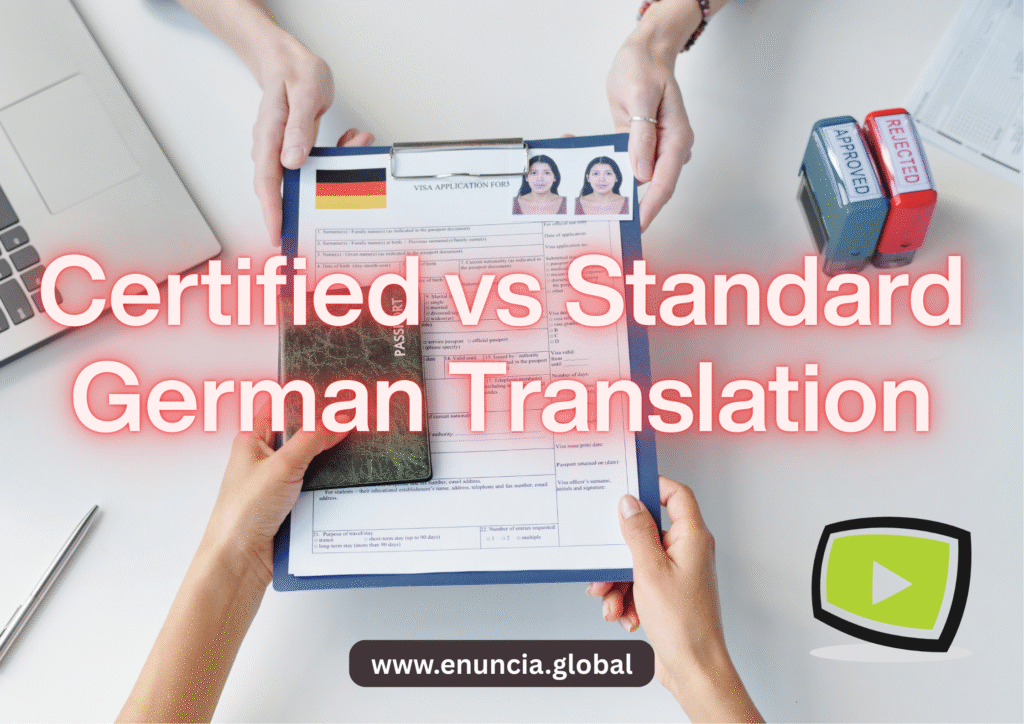
Not all German translations are meant for the same purpose.
One of the most common problems we see is not poor translation quality, but using the wrong type of translation for the situation. A document is translated accurately, professionally, and on time—yet it is still rejected.
The reason is simple: the document required a certified translation, but a standard translation was submitted instead.
Understanding the difference early can save time, cost, and unnecessary resubmissions.
What Is a Standard German Translation?
A standard German translation is a professional translation intended for general understanding and use, not for official submission.
It focuses on:
- Accuracy of meaning
- Natural readability
- Clear communication
Standard translations are commonly used for:
- Internal business documents
- Emails and correspondence
- Reports and presentations
- Manuals and guides
- Academic or research material
- Informational content
In these cases, the document is meant to be read, not formally verified.
There is no declaration of responsibility attached to a standard translation.
What Is a Certified German Translation?
A certified German translation is a formal, accountable translation intended for official or legal use.
In addition to the translated content, it includes:
- A signed certification statement
- A declaration that the translation is accurate and complete
- Identification of the translator or translation agency
- Confirmation of responsibility for the translation
This certification allows authorities to rely on the translation without reading the original German document.
Certified translation is about acceptance, not style.
Why Authorities Care About Certification
Courts, embassies, universities, and government departments process documents in many languages. Officers reviewing submissions are not expected to assess translation quality themselves.
Instead, they rely on certification to:
- Assign responsibility
- Ensure procedural compliance
- Treat the translation as an official record
A standard translation—even if perfect—does not meet this requirement unless it is formally certified.
When a Standard German Translation Is Enough
A standard translation is usually sufficient when:
- The document is for internal use
- No authority is reviewing or verifying it
- The purpose is understanding, not submission
- The document is not legally binding
Examples include:
- Internal contracts for review only
- Business communication
- Research or academic reading
- Marketing or informational material
In these cases, certification adds cost without adding value.
When Certified German Translation Is Required
Certified translation is required when a German document is submitted to:
- Courts or tribunals
- Embassies or immigration authorities
- Universities or credential evaluation bodies
- Government departments
- Regulatory authorities
Common examples include:
- Birth, marriage, and divorce certificates
- Court judgments and affidavits
- Police clearance certificates
- Academic degrees and transcripts
- Immigration and visa documents
- Legal contracts submitted officially
If the document affects legal status, rights, or eligibility, certification is usually required.
A Common Mistake: “We’ll Certify It Later”
Many applicants start with a standard translation and plan to “certify it later” if needed.
This often fails because:
- The original translation may be incomplete
- Stamps, seals, or annotations may have been omitted
- Formatting may not match official expectations
- The certifying party cannot verify someone else’s work
In many cases, the translation must be redone to meet certification standards.
Certified vs Notarised: Another Source of Confusion
Certification and notarisation are not the same.
- Certified translation confirms accuracy and completeness
- Notarisation confirms the identity of the person signing the certification
Some authorities require only certification. Others require both. Submitting one instead of the other is a common reason for rejection.
How Rejections Usually Happen
Rejections rarely say, “Your translation is wrong.”
They usually say:
- “Certified translation required”
- “Please resubmit with proper certification”
- “Document does not meet submission requirements”
By the time this happens, deadlines are often tight.
How to Decide Which One You Need
Ask one simple question:
Will this document be reviewed by an authority that cannot read German?
If the answer is yes, certified translation is likely required.
If the document is for reading, understanding, or internal use only, standard translation is usually sufficient.
When in doubt, it is safer to clarify before translating.
How Enuncia Global Handles This Distinction
We do not assume every document needs certification.
Before starting work, we:
- Understand where the document will be used
- Identify whether certification or notarisation is required
- Recommend the appropriate translation type
This avoids unnecessary cost—and prevents rework later.
Final Thought
Certified and standard German translations serve different purposes.
Using a standard translation where certification is required almost always leads to rejection. Using a certified translation where it isn’t required often leads to unnecessary expense.
Knowing the difference early keeps your process smooth and predictable.
Need Help Deciding What You Need?
If you’re unsure whether your German document requires certified or standard translation, it’s better to clarify before submitting.
👉 Learn more about our German Certified Translation Services
📩 Share your document for review
📞 Speak with our team about the correct approach
German Translation Details for India-Wide Requests
German files may be connected with Germany, Austria, Switzerland, embassies, universities, engineering, healthcare or corporate use. Enuncia Global uses this context to quote German certified and official-use work more carefully, rather than treating the page as a generic language listing.
German compounds, umlauts, formal titles, sworn-translation requirements and industry terminology should be controlled. This matters for India-wide customers because the final receiver may be an embassy, university, employer, court, hospital, company, immigration office, production team or public audience.
Files and Review Points
Common German requirements include certificates, visa documents, contracts, manuals, medical records, business papers. These file families are not equal in effort. A certificate may need close layout and certification, while a website page or subtitle file may need tone, timing and reader comfort.
The review usually checks umlauts, passport spelling, compound terms, course names, legal clauses, certification route. If a scan is cropped, an audio line is unclear, a name differs from a passport or a receiver has issued a checklist, those details should be shared before the final version is prepared.
German Use-Case Notes That Change the Quote
A short German certificate, a multi-page legal packet and a recorded interview can all look like one language request in an enquiry form. Enuncia Global separates them during intake because the reviewer, output format and risk points are different.
For example, certificates, visa documents, contracts usually need close comparison against the source. Work involving manuals, medical records, business papers may need tone, terminology, speaker labels, subtitle timing, glossary notes or an editable delivery format.
The customer should also mention whether umlauts, passport spelling, compound terms are already confirmed. If course names, legal clauses, certification route are uncertain, the team may ask for a clearer scan, reference spelling, previous translation or short explanation before delivery.
This is the depth that was missing from many older language pages. It helps the page answer real buyer questions and reduces the chance that Google sees the page as another repeated language template.
What Customers Should Send
- The complete source file or recording, not only a cropped sample.
- The target language, final country or authority, and whether certified translation is required.
- Any reference spelling for names, institutions, product terms, places or previous translations.
- The required output format, such as PDF, editable Word, transcript, SRT/VTT subtitle file, website copy or hard copy.
This extra brief helps Enuncia Global keep German translation services in India focused on the actual file and final use. It also gives searchers a practical reason to use this page instead of a thin language-name page.