
In order to get a quote for Bengali PO file translation we would need: 1) A current editable PO file (or files) to do the translation work with; 2) The approved source release that the PO file(s) in question belong to; and 3) Sufficient context (e.g. screenshots) of the interfaces where the short strings of the PO files in question are used. Does that also mean you need the translated PO file(s) + query log for your developers to integrate into their workflow, or do you also want these to be separately assessed for technical integration and runtime testing as well as translation?
One English word can do two different jobs
Consider a hypothetical example of an online web application for managing tickets. A button to edit a ticket might read Open and the status of an unfinished ticket right next to it might also read Open. Exported to a spreadsheet, the two strings look identical but in the application, one of them does something and the other describes a state. It’s important to make sure the Bengali words chosen for such cases are used correctly.
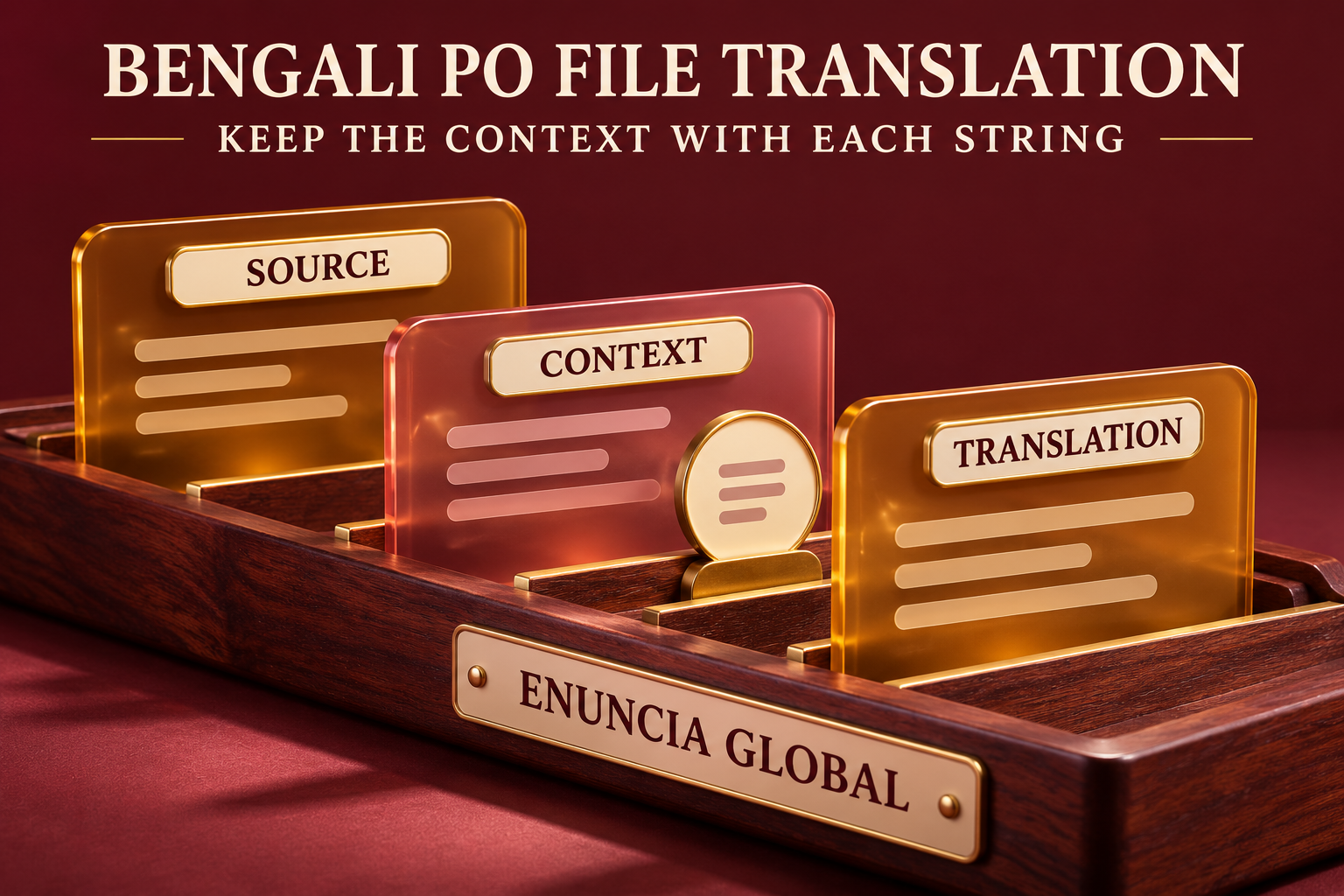
You should preserve the structure of the editable PO catalogue (e.g. in GNU context guidance for PO entries, msgctxt is used to distinguish messages which have the same msgid). It is also a good idea to agree on which fields are in scope for translation before you get a quote for translation. GNU PO entry guidance explains the structure of each entry: original msgid, translated msgstr and optional comments, source file references and flags.
Context as described by GNU gettext is used to distinguish messages that have the same msgid. Thus an empty msgctxt is not the same as a missing msgctxt. Keep the msgctxt with the respective message and do not merge identical English words for different contexts. A few screenshots, termionology from application and product, as well as notes on tone etc. of how long a message may be, can help the translator to choose the correct wording in Bengali.
Catalogue entries can be at different stages
PO catalogue entries can be at different stages (e.g. new strings w/o translation, old Bengali wording, changes to approved English source for affected entries) so match up the file w/ the intended release version first.
Special care must be taken when processing Flags and plural rules.
Fuzzy entries: GNU workflow flag guidance for fuzzy translates to ‘this translation may now be wrong’ so needs to be reviewed before clearing flag (this doesn’t mean delete entry or clear flags in bulk just to make the file look finished).
Plural forms: GNU plural entry guidance needs to be matched to the Bengali locale, the plural rules in place and all the relevant cases to be translated. This also needs to preserve the source, the headers and other developer-managed structure as this is not ordinary prose to translate. Preserve source msgid_plural and supply the required indexed msgstr target cases as agreed.
Variables and markup: ensure you have a proper contract with your developer regarding the exact representation of placeholders, product codes, ID’s, numbers and other markup in your translations, and do not replace any of the agreed upon tokens with something used in another project.
State clearly the intended audience for Bengali and the relevant regional locale name (not language name). Don’t make any assumptions about this.
Check the Bengali inside the actual application
Filling all msgstr slots in your favorite editor does not make your software ready for release. Bengali characters may even wrap differently in the rendered UI than in the application’s source code. They can get cut off inside small UI widgets like buttons and form fields. And they can even clash with other dynamic UI values that looked fine in your application’s source code.
Use an authorised test view or approved screenshots with dummy data. Do not use real customer records, passwords or production secrets. Check the affected buttons, status messages, help text and error messages: all characters should render completely with the chosen fonts, without being cut off mid-word or phrase.
Test the required plural cases and dynamic values with appropriate sample numbers. If a longer Bengali phrase needs more room in a narrow label or column, agree a suitable wording or layout adjustment. Do not remove a meaningful condition or warning just to save space.
Back to that hypothetical “Open” example. Does the button read as an action and the ticket status as a condition? Review both in their actual locations, not only as two matching English words.
Agree on the handoff before requesting a quote
We would like to receive the current editable PO catalog for Bengali software string translation as well as the English source version for the PO entries. It would also be very helpful to know the approximate number of words or entries to translate. We would also like to know about the target Bengali speaking audience and their locale. Can you provide screenshots or other context? Are there any approved terms for specific software terms? What are the agreed plural, variable and formatting requirements? Are there any special privacy / access restrictions that we should be aware of for the files to be translated?
1. Do you need the updated PO file and the query log for the handoff?
2. Please list the handoff items (in detail), the responsible parties for the string insertion, the language sign-off and the technical testing (separate assessment).
3. Does this fit into your time frame? We would like to assess the possible language work for you and outline the specific deliverables and time frame for Bengali Translation Services in India and Business Translation Services. Contact us at info@enuncia.global or Get Free Quote and outline the handoff for us.