
Start the glossary with the terms buyers and reviewers need to recognise consistently: product families, model names, repeated attributes and technical labels. Add context and an approval owner so that the glossary records usable decisions rather than disconnected word pairs.
A catalogue combines commercial descriptions with structured product information. The same expression may appear in headings, comparison tables, captions and specifications. Agreeing its treatment early gives reviewers a common reference when those occurrences are translated.
Start with a small working glossary
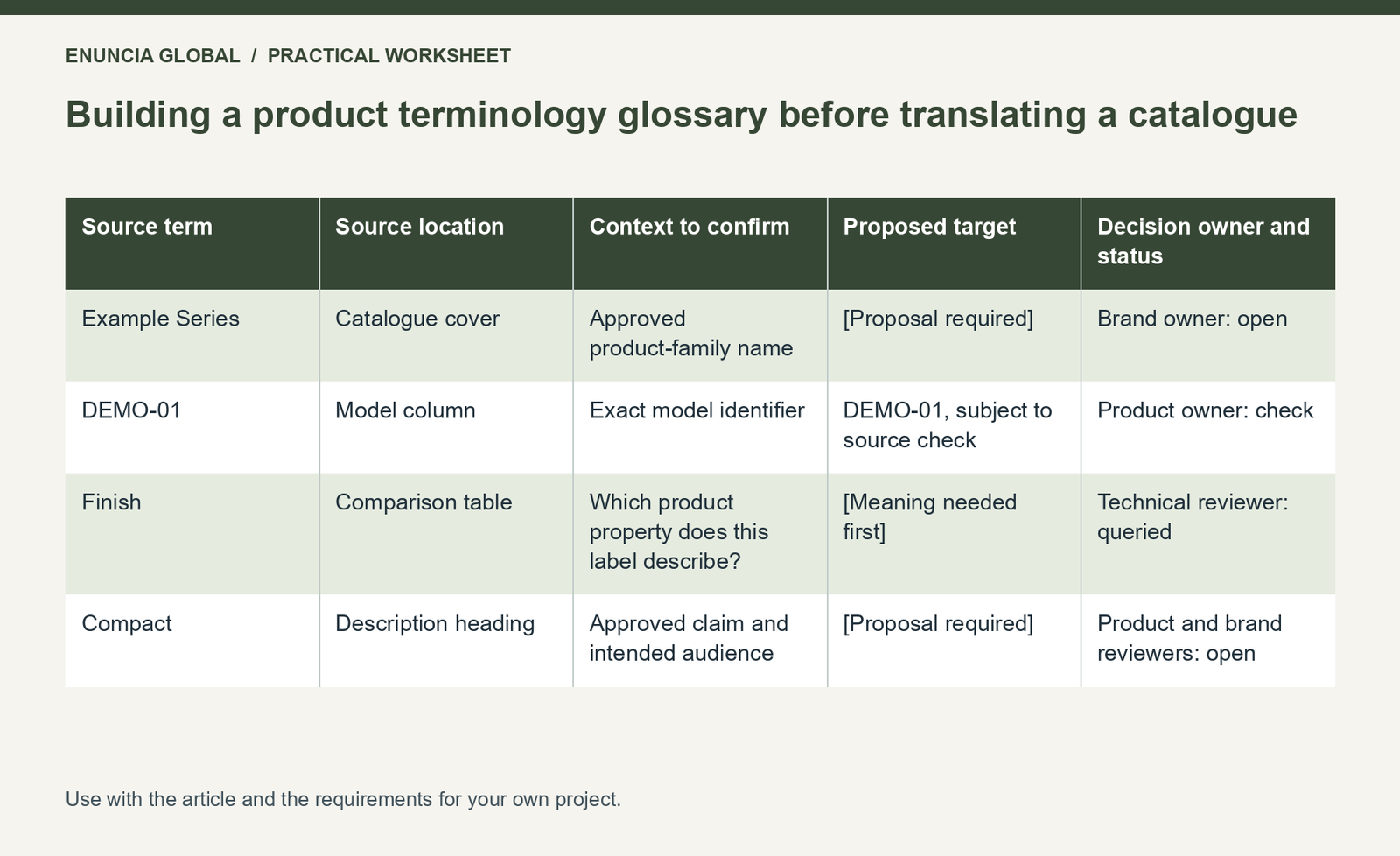
The entries below are illustrative placeholders. The target-language choices remain open until the appropriate reviewers answer the questions.
| Source term | Source location | Context to confirm | Proposed target | Decision owner and status |
|---|---|---|---|---|
| Example Series | Catalogue cover | Approved product-family name | [Proposal required] | Brand owner: open |
| DEMO-01 | Model column | Exact model identifier | DEMO-01, subject to source check | Product owner: check |
| Finish | Comparison table | Which product property does this label describe? | [Meaning needed first] | Technical reviewer: queried |
| Compact | Description heading | Approved claim and intended audience | [Proposal required] | Product and brand reviewers: open |
Choose the first entries by impact
Look for repeated terms, terms that distinguish one product from another, and terms that have caused uncertainty in previous internal reviews. Do not assume that the longest or most technical-looking words are the only important ones. A short attribute label can carry a meaningful distinction in a comparison table.
| Entry | Context to capture | Decision to record |
|---|---|---|
| Product family name | Catalogue heading and brand reference | Translate, retain or use an approved local form |
| Model identifier | Exact code and variant relationship | Preserve the identifier accurately |
| Repeated attribute | Table heading and intended meaning | Approved target label and any abbreviation |
| Technical expression | Specification or explanatory passage | Rendering approved by the technical reviewer |
| Marketing phrase | Audience and placement | Adaptation approved for that use |
These categories help organise the work. They do not prescribe how every brand or product term should be handled.
Keep identifiers separate from descriptions
Model numbers, part codes and other identifiers need accurate preservation. Do not treat them as ordinary prose or change them to make a target-language description look more natural. Check leading zeros, separators and variant suffixes against the source.
For descriptive text, provide enough context for the translator to understand the product. A term in a short table heading may need a different presentation from a full explanatory sentence, while still preserving the same intended meaning.
Name the people who can approve choices
Technical reviewers can clarify product meaning. Brand or marketing reviewers can approve audience-facing style. Identify how conflicts between those requirements will be resolved. The translation team should not have to infer whose comment takes priority.
Give each entry a status and decision date. Label inherited glossaries as references until their relevance to the current catalogue is confirmed. An old approved term may belong to a different product generation or audience.
Test entries in real layouts
Insert proposed terms into representative headings, table cells and captions. Check whether they remain clear within the available space. If an abbreviation is needed, record its approved use rather than allowing different reviewers to shorten the term independently.
Do not remove a meaningful product distinction solely to fit a narrow column. Consider the layout and wording together, and route any substantive change to the appropriate owner.
Maintain the glossary through revisions
When a product name or attribute changes, identify the affected catalogue sections and update the glossary status. Review occurrences in context rather than applying an unchecked global replacement. Keep the source version and approved terminology decisions connected.
For a quotation, supply the current catalogue, product references, existing terminology resources and the review arrangement. State whether the deliverable includes only translated text or also layout work. A small, well-supported glossary gives the project a useful starting point without pretending that every terminology decision can be settled before the source is read.
Request a quotation with your document type, language pair and written requirements.