
The same terminology discussion should not need to restart every month. When a recurring translation project keeps receiving the same corrections, first check whether the decisions are recorded in a form the next team can use. An email saying “please use the previous wording” is difficult to apply if several earlier versions exist.
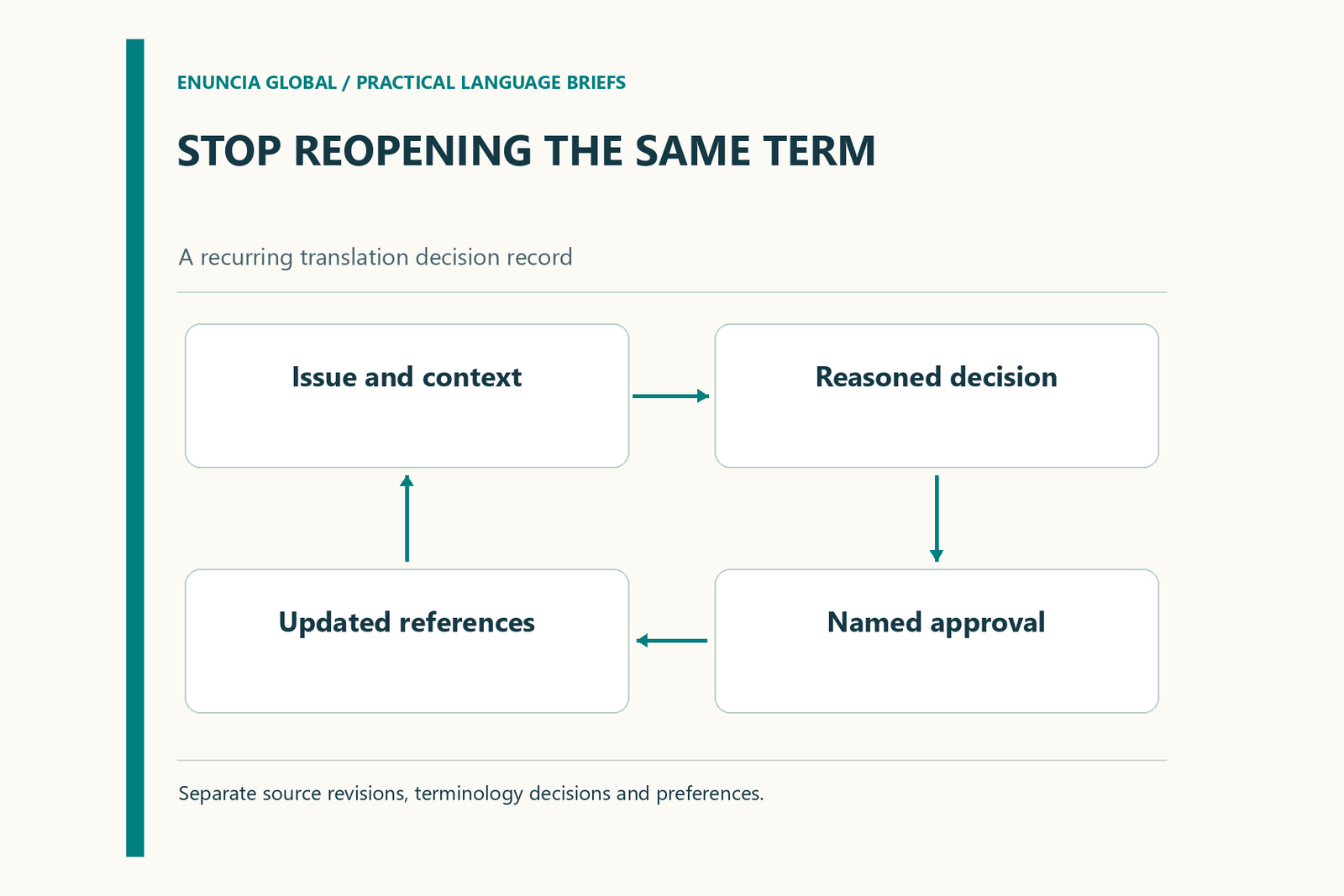
The practical improvement is a controlled change record: what was approved, where it applies and who can change it. This does not promise automatic quality or a particular saving. It gives translators and reviewers a shared basis for the next edition.
Separate three kinds of feedback
A source revision changes the material being translated. A terminology decision establishes a preferred rendering for a defined context. A stylistic preference changes how the text sounds without necessarily correcting its meaning. Record these separately so that a preference from one reviewer does not become an unexplained universal rule.
When feedback is disputed, keep the original passage and the proposed alternative visible. Ask the content owner to name the decision-maker. Repeatedly forwarding conflicting comments merely moves the disagreement into the next production cycle.
Recurring-change tracker
Use one row per decision. The entries below are fictional process examples, not claims about a client project.
| Reference | Type of change | Decision to record | Scope of application | Next-cycle check |
|---|---|---|---|---|
| Term 01 | Terminology | Approved product label | Named product family | Apply in headings and captions |
| Style 02 | Preference | Agreed form of address | Customer-facing notices | Keep internal memos separate |
| Source 03 | Revision | Updated department name | Current source edition | Check old references in appendices |
| Query 04 | Unresolved | Two possible technical terms | One specification section | Obtain specialist decision before reuse |
Add the approver, date and supporting reference to the working version. Avoid storing a preferred word without the context that explains when it is suitable.
Make the glossary a decision record
A useful glossary can contain the source term, approved translation, context example and prohibited alternative where necessary. Keep it short enough that reviewers can maintain it. Start with recurring disagreements and high-visibility names rather than importing every word from an old document.
Assign someone to approve additions and issue versions. When a term changes, identify which current files need updating. The glossary should explain the decision to the next person, not merely show that someone edited a spreadsheet.
Brief the next edition using differences
Send the new source, the previous approved source and translation, and a change list. Explain whether unchanged sections require review again. If the layout or audience has changed, state that too; a stable paragraph can appear in a different context.
Keep new source material distinct from corrections to last month's translation. This helps the team assess the work and avoids treating every difference as an error. Ask questions about uncertain scope before production begins rather than leaving them for final review.
Close the cycle with usable evidence
After approval, capture the final filenames and update the tracker with resolved decisions. Note items still open, including who owns them and whether they block reuse. Keep the approved version accessible through the agreed project route.
Before the following month, review a small set of previously troublesome passages against the tracker. If the same issue returns, investigate whether the reference was unavailable, ambiguous or applied outside its intended context. Bring the current files and decision log to a translation scope review. That creates a concrete conversation about continuity instead of relying on an unmeasured promise that the next batch will need fewer edits.
Request a quotation with your document type, language pair and written requirements.