
As an example, a birth certificate may look complete in English but on the reverse side there are corrections which have been omitted from the translated document. So it is important to read the source documents in their original language and then the translated documents. The officer does not have to make assumptions as to why a name change was included in one version of the documents but not in another.
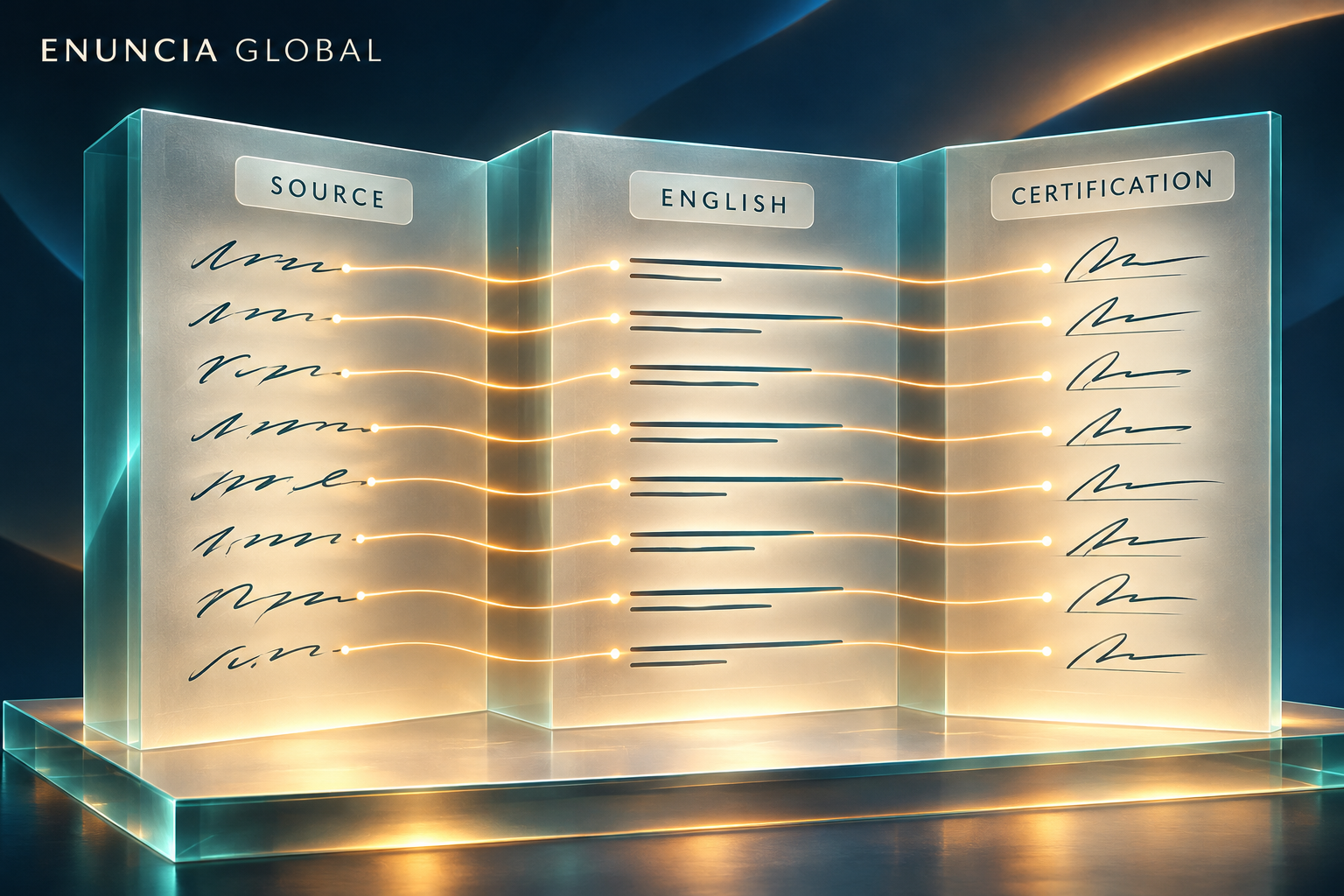
Under 8 CFR 103.2(b)(3), foreign-language material submitted to USCIS must have a full English translation certified as complete and accurate, with the translator also certifying competence to translate from the foreign language into English. The current Form I-485 instructions require that the translator provide a signed certification including his/her printed name and contact information, as well as the signature date. These identification details are from that form’s instructions. Check the current instructions for the particular form you are submitting with your application.
What does “full” mean when the paper is messy?
This could mean for example that for an imaginary example of a birth certificate with front and back pages a translation of the front pages only would result in a different record than the one that has been provided in the submitted material (e.g. the later name correction in the handwritten entries on the back pages of the material provided would not be noted).
All parts of the original document must be translated including any marginalia and the smallest print. Any part of a stamp that cannot be read should be located in the source and noted as unreadable in the translation; do not add marks to an original certificate. Do not make something up in order to make the documents more readable.
A cropped edge or faint signature is not a problem for the translation but rather a problem with the source image that needs to be fixed by getting the best copy of the original material.
Certification and authentication
Remember, the translator’s certification has two main parts: (1) certification of the translation, and (2) certification of the translator’s language ability. Certification of a translation or a translator does not mean that the underlying evidence (i.e. the birth certificate) has been authenticated or that proof of a family relationship has been established or that immigration benefits will be granted. Those are all questions for USCIS to decide based on the underlying evidence.
Authenticity of the notary’s signature on the translator’s certification is a separate matter from authentication of the foreign-language document itself and should not be a requirement for all translations filed with USCIS. This can be a matter to investigate on a case-by-case basis and is clearly not satisfied by a nice logo or seal on the translator’s certification. Nor does signature authentication replace the translator’s completeness, accuracy and competence statement.
When distributing a large number of documents such as a birth certificate, an amendment, and a family register with their corresponding translations, organize the originals with their corresponding translations and create an index with all the original sources and their corresponding translations. Source-page references help the next reader pair translated passages with the originals, even if the English text takes a different amount of space.
Names, numbers and the temptation to improve them
Where names appear on the documents, they should be translated consistently and accurately using a traceable method of transliteration. The name as it appears in the applicant’s passport may differ from that found on their local-language documents. If the spellings differ, ask about supporting evidence or correction of a wrong record by its issuer. Do not invent a universal requirement to declare that discrepancy on the translator’s certification, or silently replace the source spelling.
All numbers (e.g., registration numbers, serial numbers, dates and corresponding references to dates) shall be exactly reproduced from the source document(s). Translators must not create facts that appear to be useful to the subsequent application (e.g., instead of “guardian” a translator must not refer to the person’s parent(s) even when it appears to be more convenient). Areas of doubt and unreadable portions of a source document paragraph or sentence must also be accurately identified as such rather than attempting to translate unknown information and risking error.
There may be a cover sheet or bilingual title page, but that does not mean the whole document was completed in English. Also, foreign-language handwritten comments or notes in the margins, as well as wording on seals in the submitted records must be covered in the full translation as well and not be left out because they are in foreign languages and the headings are in English.
A final version should stay final
The translator’s certification should relate to the final translated text. Keep previous versions of translations for your records, and do not affix a certification from a previous version to a different version of translation. Instead, refer to the current form’s instructions.
Follow the specific form’s current instructions for additional copies etc. and for any other evidence required for paper or online filing. Make sure the reader can locate the translated text within the source documents even if printed in very small text. The layout of the translation does not have to exactly replicate all of the source’s decorative details. Just maintain the relationships between the parts and follow the instructions for the particular form.
Enuncia Global carefully prepares and organizes the packets containing the translated documents for easy reference. The certification does not in itself guarantee that the underlying evidence will be accepted by USCIS or that the application will be approved.