
Start an enquiry with the document type, language pair, intended use and approximate file size or page count. Confirm the intended recipient and transfer channel before sending personal records. Then ask which files are needed to assess the work and whether a limited sample is sufficient for that initial stage.
The information needed for an early scope discussion may differ from the complete source material required to carry out a translation. Make that distinction explicit. A redacted sample can help describe a job, but missing text may prevent a provider from giving a reliable scope or completing the work.
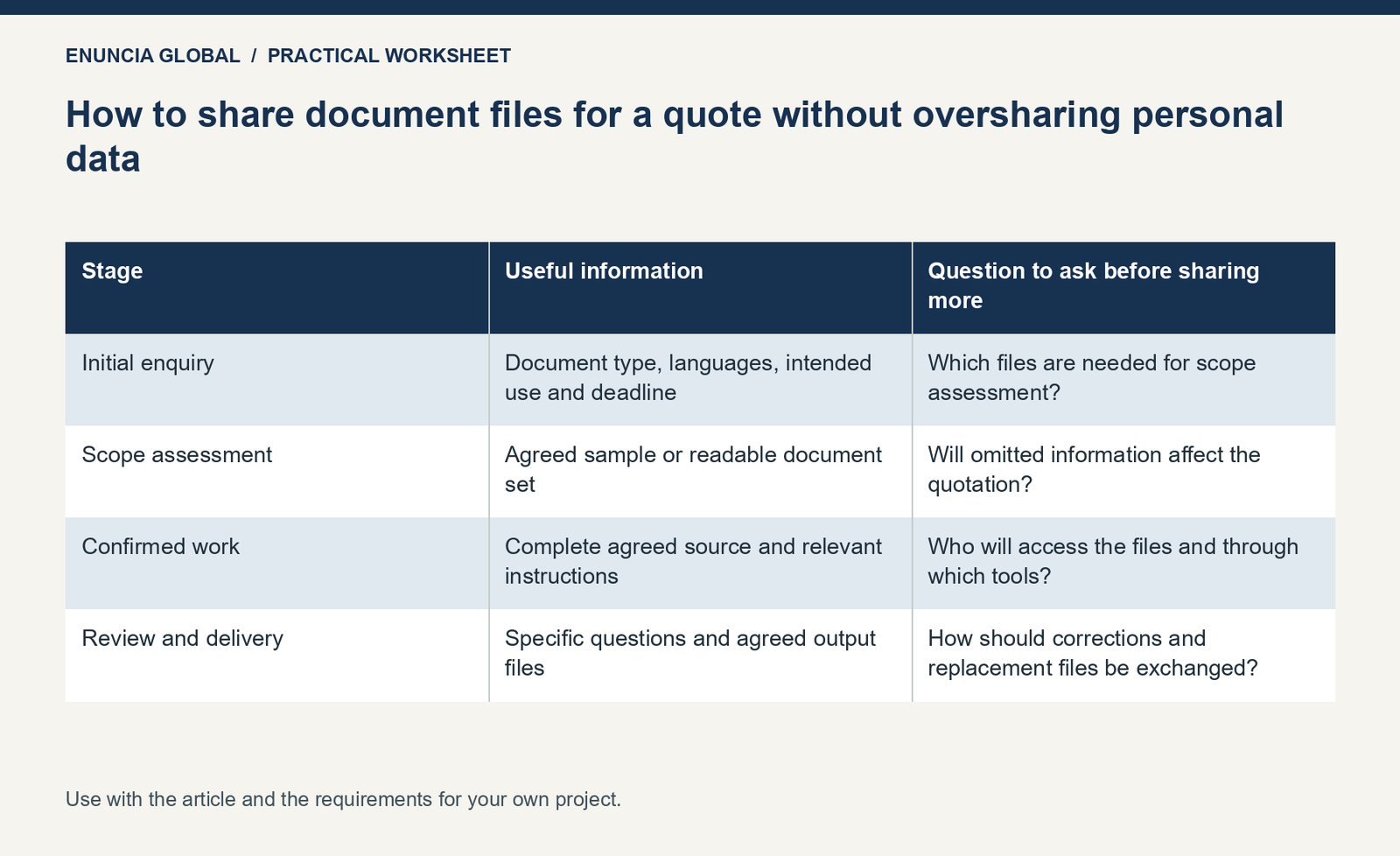
Use stages in the enquiry
| Stage | Useful information | Question to ask before sharing more |
|---|---|---|
| Initial enquiry | Document type, languages, intended use and deadline | Which files are needed for scope assessment? |
| Scope assessment | Agreed sample or readable document set | Will omitted information affect the quotation? |
| Confirmed work | Complete agreed source and relevant instructions | Who will access the files and through which tools? |
| Review and delivery | Specific questions and agreed output files | How should corrections and replacement files be exchanged? |
This table describes a conversation to have with the provider. It is not a statement that every provider uses these stages or that a particular channel has been audited.
Keep personal records out of public comments
You can ask whether a language pair or document type can be assessed without posting a certificate, passport or bank statement. Describe the task in general terms. Avoid including names, identity numbers, account details or document photographs in a public comment thread.
Check the background of an image as well as the main page. Another document, an address label or a screen visible behind the file can disclose information you did not intend to share. A short written description is often enough to begin the conversation.
Agree what a sample does and does not show
If you are considering a redacted sample, ask which sections the provider needs to see for the stage under discussion. Removing values may hide layout complexity, handwriting or repeated fields that affect the work. Label a limited sample clearly so that it cannot be mistaken for the full source.
Do not assume that placing a dark box over text removes the underlying information from a digital file. Use an appropriate redaction method and check the resulting copy before sharing it. Keep the unaltered original separate. If you are uncertain how to redact a file, ask for suitable assistance before sending it.
Any quotation based on a partial sample should state the limits of that assessment. Ask what needs to be reviewed again when the complete source becomes available.
Ask about access and permitted tools
Discuss who will receive the files, whether subcontractors or reviewers are involved, and which transfer or processing tools are permitted for your job. If your organisation has specific restrictions, provide them before the files are transferred so that the provider can confirm whether it can work within them.
Ask how long files are expected to be retained and how a deletion request is handled. Record the agreed terms. Do not treat a logo, a general confidentiality statement or an assumed software feature as proof of a specific arrangement.
Keep the handoff traceable
Use clear filenames and identify replacement versions. Send queries about a particular field with its document and page reference rather than repeatedly circulating the entire bundle to new recipients. Check the recipient list before each transfer.
For an enquiry to Enuncia Global, begin with the task description and written recipient requirements. Confirm the file-sharing arrangement and the material needed for scope assessment before sending the complete personal document set.
Request a quotation with your document type, language pair and written requirements.