
Send the corrected document with a clear explanation of what changed and which earlier version it replaces. Ask the translation provider to assess the affected work and confirm a revised scope or delivery plan before treating the new file as incorporated.
A replacement attachment alone leaves too much unresolved. The team may already have translated, reviewed or formatted part of the earlier source. A change to one field can also affect a repeated reference elsewhere. The aim of change control is to make those dependencies visible.
Identify the controlling source
Use a version label that the sender, translator and reviewer can all recognise. Record the document title, filename, date received and person authorising the replacement. Avoid relying on “latest” or “final” when several files carry those words.
Keep the source correction separate from an instruction to the translator. If an issuer has replaced an official record, identify the replacement. If the original has not changed and you are asking about a possible error, describe it as a query. Do not present a preferred correction as something printed on the source.
Write a short change notice
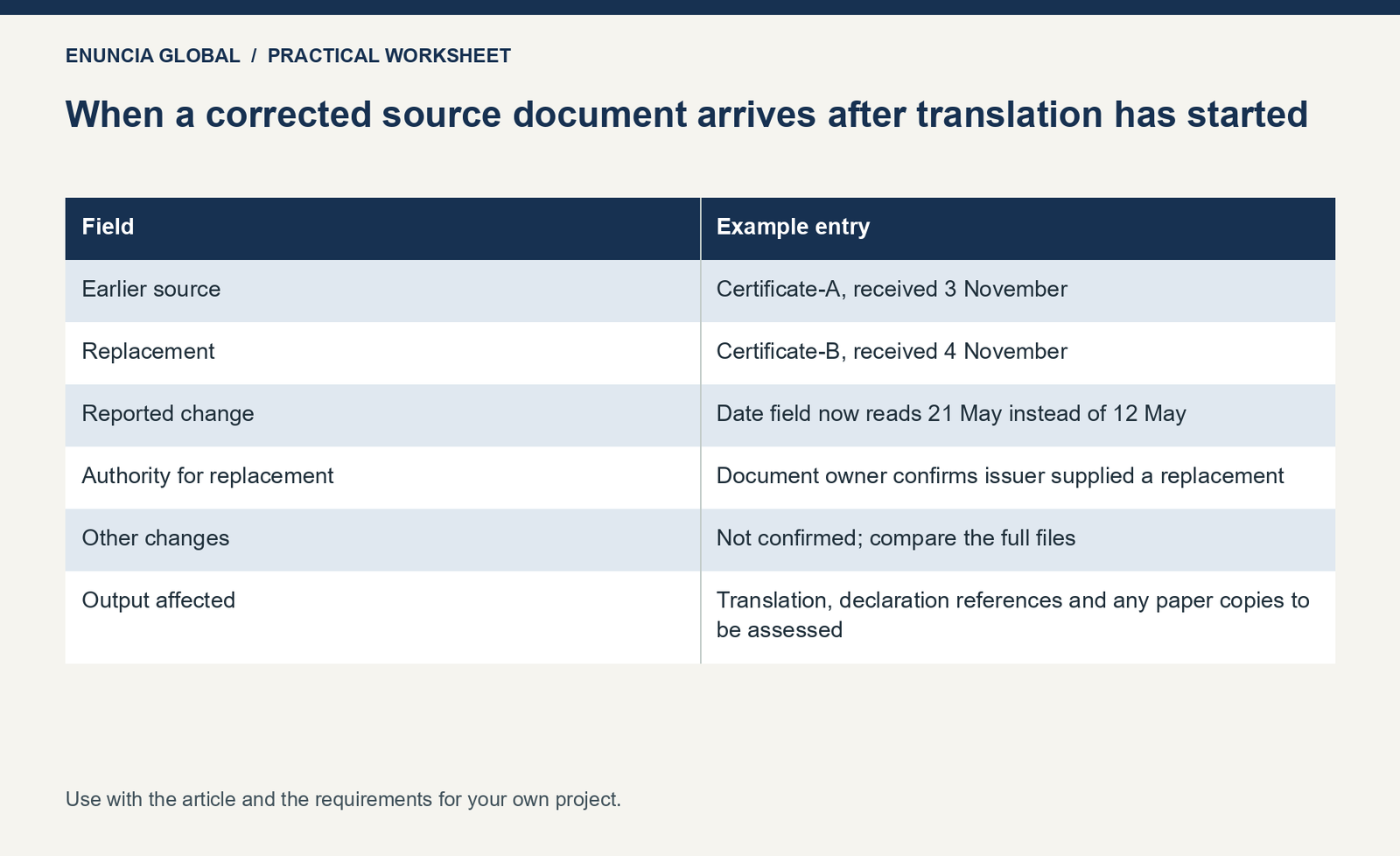
The following fictional example shows the information a reviewer needs:
| Field | Example entry |
|---|---|
| Earlier source | Certificate-A, received 3 November |
| Replacement | Certificate-B, received 4 November |
| Reported change | Date field now reads 21 May instead of 12 May |
| Authority for replacement | Document owner confirms issuer supplied a replacement |
| Other changes | Not confirmed; compare the full files |
| Output affected | Translation, declaration references and any paper copies to be assessed |
The example does not establish that a particular correction is valid. It demonstrates how to hand over a change without asking the translator to infer the source history.
Ask for an impact check
The provider should be able to identify which translated passages, tables, references and formatted outputs need review. Do not assume that a small visible change means no other work is required. Equally, do not assume that every replacement means the entire job must be restarted. The relevant question is what changed and how that change affects the agreed deliverables.
Ask whether the replacement alters the quotation, review process or delivery date. Have the answer recorded before the work continues under a different understanding. This article does not imply a fixed correction charge, a free revision entitlement or a standard turnaround.
Keep comments and source revisions distinct
A reviewer may suggest a different term without changing the source. That is a translation comment. A new clause in the source is a source revision. A corrected identifier from the issuer is another type of change. Keeping these categories separate helps the team route each question to the person who can resolve it.
If several reviewers are involved, appoint one person to consolidate their instructions. A translator should not have to choose between incompatible comments from different senders.
Close the change through the delivered files
Compare the final output against the replacement source and the change notice. Check the amended field, every repeated occurrence, any cross-reference and the final file label. Open the PDF after export so that a corrected value has not introduced a layout problem.
Record which version was delivered and whether an earlier copy should be treated as superseded. If an earlier translation has already been submitted, ask the receiving organisation how to provide a replacement; do not assume that emailing a new file to the translation provider updates an external application.
For a live job, send the new source and a concise change notice through the agreed channel. That gives the team a concrete basis for checking the work and confirming what happens next.
Request a quotation with your document type, language pair and written requirements.