
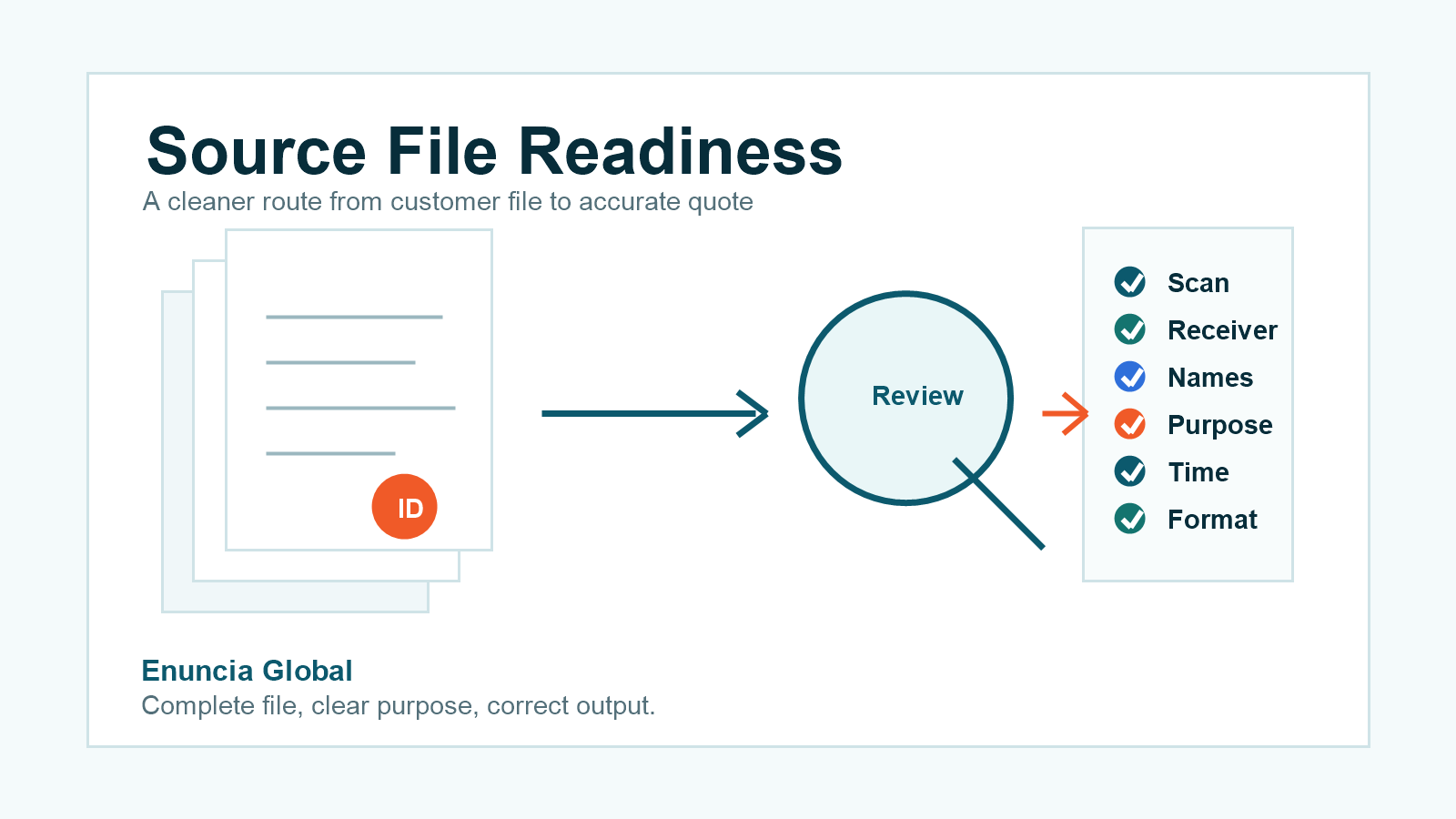
Most translation delays begin before translation begins. The source file arrives as a cropped screenshot, one page is missing, the receiver instruction is unclear, the passport spelling is not shared, or the customer asks for a certified file when the final use actually needs a bilingual table, subtitles, a formatted PDF, or a plain reading copy. This checklist is designed to prevent that avoidable rework before a quote is confirmed.
Use it for certificates, contracts, academic records, HR papers, business documents, medical summaries, handwritten notes, website strings, audio recordings, video files, subtitle requests, and layout-heavy documents. The aim is not to make the customer do the translator’s job. The aim is to give the project team enough context to quote the right service, ask the right questions, and avoid confident-looking work that later fails the real use case.
The six checks that decide whether a file is ready
A translation source file is ready when six pieces of context are visible together: the complete source, the receiver instruction, accepted name spellings, final purpose, real deadline, and output format. If any one of these is missing, the translation can still be linguistically accurate and still create rework.
| Readiness check | What to send | Why it changes the job |
|---|---|---|
| Complete source | All pages, full margins, reverse sides, attachments, stamps, handwritten notes, tables, QR codes, seals, and signatures. | The translator and reviewer can see what the final reader may compare against the original. |
| Receiver instruction | Embassy checklist, university email, court note, HR requirement, client style guide, platform rule, or internal brief. | The same document may need a certified copy, a readable explanation, a close layout match, or a workflow note. |
| Name spelling | Passport spelling, old translation, application form, previous certificate, company registration spelling, or preferred glossary. | Names are often more important than elegant wording because a reviewer compares them across documents. |
| Purpose | Visa, admission, employment, litigation, onboarding, product launch, patient communication, training, subtitles, or internal review. | The purpose decides how literal, formal, annotated, or reader-friendly the output should be. |
| Deadline | Submission date, appointment date, delivery expectation, correction window, notarization or courier timing if applicable. | A deadline should include review and correction time, not only the first-draft handover. |
| Output format | Word, PDF, bilingual table, formatted certificate, subtitle file, transcript, spreadsheet, web copy, or print-ready layout. | Formatting can take more planning than the translation itself when tables, screenshots, subtitles, or certificates are involved. |
A practical traffic-light test before quotation
Use a simple red, amber, and green test. Green means the quote can usually be framed clearly. Amber means the team can estimate but should ask a follow-up question before production. Red means the customer should fix the source or confirm the route before work starts.
- Green: every page is readable, page order is clear, names match the reference spelling, the receiver is known, and the output format is stated.
- Amber: the file is readable but has unclear stamps, missing reverse-side notes, mixed spellings, uncertain purpose, or a deadline that does not include review time.
- Red: pages are cropped, important fields are hidden, the customer does not know where the translation will be submitted, or the request combines translation, certification, apostille, attestation, layout, and courier needs without a sequence.
The traffic-light label should not be used to reject a customer. It should be used to choose the next question. A red file may become usable after one clearer scan. An amber file may become green after the customer forwards a receiver email. The value is in identifying the uncertainty before the translation is treated as routine.
Why the receiver matters more than the keyword
Two customers may search for the same translation service and need very different deliverables. A birth certificate for an immigration file should preserve names, dates, issuing authority details, seals, and page structure. A website paragraph should sound natural to the intended reader. A contract may need clause numbering and defined terms protected. A training video may need timestamps, speaker labels, subtitle length, and reading speed checked.
That is why the first project question should be: who will use this translated file, and what will they compare it with? If the receiver is an embassy, court, university, employer, hospital, regulator, client, vendor, media platform, or internal reviewer, the output must support that person’s review path. A neat translation that ignores the review path can create more work than a rough file with the right context attached.
When transliteration or script handling is part of the job
Some projects need more than translation from one language to another. They need transliteration decisions, accepted spellings, or careful handling of marks and signs in the source. For example, an old record, Sanskrit passage, name list, temple document, academic citation, or manuscript excerpt may require the team to decide whether the customer needs translation, transliteration, summary, annotation, or a conservative note about unclear readings.
The Library of Congress Sanskrit and Prakrit romanization table is an example of why this should not be improvised. It records systematic treatment for Devanagari Sanskrit and Prakrit, including rules that affect how consonants and vowel signs are read in transliteration. Unicode references for Devanagari Extended and Vedic Extensions also show that specialized marks can exist beyond ordinary modern text handling. A customer does not need to study those charts before requesting a quote, but the project brief should flag when the source contains specialist marks, older printing, manuscript notes, or non-standard typography.
The safe instruction is simple: do not silently normalize a name, verse, citation, seal, or handwritten mark. Ask what reference spelling or output style the receiver expects. If the source itself is uncertain, mark the uncertainty rather than presenting a confident guess as final text.
The original customer checklist
| Question | Good answer | If not known |
|---|---|---|
| Where will the file go? | The final receiver is named, such as a university, embassy, HR team, lawyer, publisher, hospital, client, or platform. | Say the broad purpose and ask whether a close certified copy or readable working copy is needed. |
| Is the source complete? | Every page is present, including backs, annexures, instruction pages, seals, stamps, and marginal notes. | Send what is available and clearly say what may be missing. |
| Which spelling should names follow? | Passport, prior translation, company record, application form, or accepted spelling reference is shared. | Ask for the spelling preference before final delivery. |
| What output is required? | Certified PDF, editable Word, bilingual table, layout match, transcript, subtitle file, spreadsheet, or web copy. | Explain how the file will be used so the team can recommend the output. |
| Are there special marks, scripts, or unclear portions? | They are photographed clearly and noted in the brief. | Ask for a feasibility check rather than ordering a confident final translation immediately. |
| What is the real deadline? | The submission date, review window, correction time, and courier or notarization need are separated. | Give the appointment or submission date first and let the team plan backwards. |
A short enquiry template for a clean quote
Customers do not need to write a long project brief. A clear six-line note is usually enough to prevent the first round of avoidable questions. Send the files with a message that says what the document is, where it will go, which language direction is needed, which spelling reference names should follow, what output format is expected, and when the reviewed final file is actually required. If the source contains unclear handwriting, stamps, seals, overwritten text, non-standard marks, or missing pages, mention that before asking for the price. That lets the team quote the translation task and the source-risk review separately when needed.
- Document: birth certificate, contract, academic record, video, transcript, website file, handwritten note, or another source type.
- Receiver and purpose: embassy, university, court, employer, client, hospital, platform, publisher, or internal team.
- Output: certified PDF, editable Word file, bilingual table, layout-matched file, transcript, subtitle file, spreadsheet, or web copy.
- References: passport spelling, earlier translation, company record, glossary, style guide, application form, or old approved document.
- Timing: submission date, appointment date, review window, correction buffer, and delivery route if hard copy handling is involved.
This template also protects unusual jobs. It tells the project team whether the work is mainly language translation, document-route support, formatting, transcription cleanup, subtitle timing, terminology control, or a combination that needs sequencing before delivery is promised.
What to avoid when sending files
- Do not send only a cropped phone screenshot when the stamp, margin, seal, or registration number may matter.
- Do not assume a certified translation, notarization, apostille, and attestation are the same step.
- Do not modernize a spelling, expand initials, or translate a name differently from a passport or earlier accepted record without saying so.
- Do not ask for a final layout without sharing whether the receiver expects the translation to mirror the source.
- Do not hide uncertainty. A partly unreadable scan should be treated as a source-quality issue, not as a writing challenge.
How this helps Enuncia quote the right work
A strong enquiry lets the team separate the language task from the document route. Translation, certification wording, formatting, bilingual layout, transcript cleanup, subtitle timing, glossary control, notarization guidance, apostille-related planning, courier delivery, and web localization are different tasks. They may belong together, but they should not be priced or promised as if they were one vague service.
When Enuncia receives the full source, receiver instruction, spelling references, purpose, deadline, and output requirement, the discussion becomes practical. The customer can be told what is ready, what needs clarification, and which step should happen first. That protects the customer from paying for work that does not fit the final use. It also protects the translator from being asked to guess what the missing context should have been.
Related Enuncia routes
- Certified translation services in India
- Document translation services
- Legal translation services
- Subtitling services
- Transcription services
- Apostille and document route guidance
Before you ask for a quote
Send the file, the receiver instruction, the required language direction, the spelling reference for names, the purpose, the deadline, and the required output format. If the source is old, handwritten, marked, cropped, or partially unreadable, say that at the start. A careful quote begins with the file route, not just the word count.