
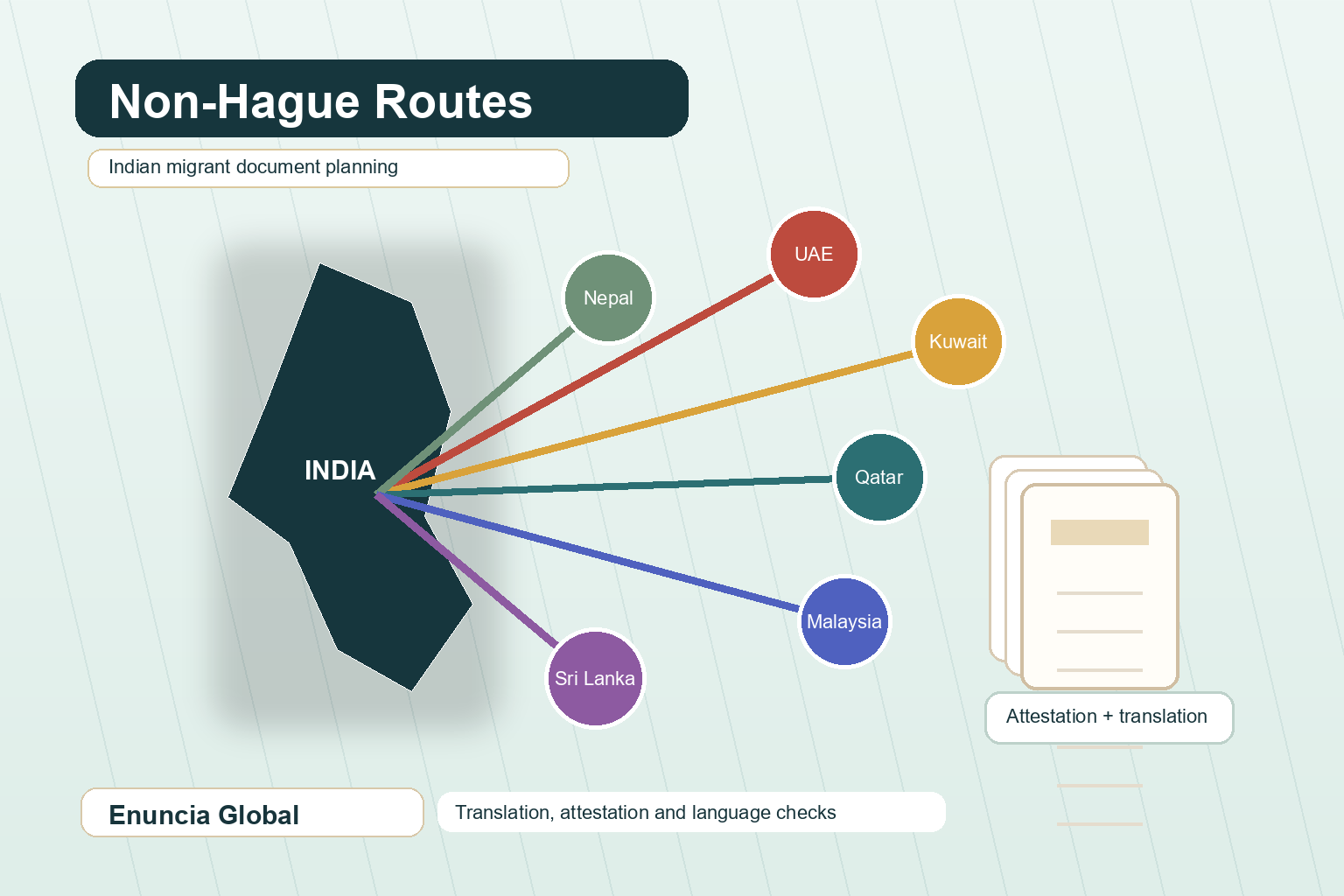
Indian migrants often prepare degrees, PCCs, birth certificates, marriage papers, employment letters, tax records and identity documents for use abroad. The first question is not only “which language should this be translated into?” It is also whether the destination follows the Apostille route or needs another authentication route.
This ranking uses the United Nations International Migrant Stock 2024 destination-and-origin workbook for India-origin migrant stock, then cross-checks destinations against the official HCCH Apostille Convention status table. Migrant stock is not the same as one-year migration flow, but it is a useful signal of document demand because it shows where large India-origin communities are resident.
Top ten India-origin migrant destinations outside the Apostille route
| Rank | Destination not in the Apostille route | Main official/document languages to check | UN 2024 India-origin migrant stock | Document-planning implication |
|---|---|---|---|---|
| 1 | United Arab Emirates | Arabic; English is common in employment, business and education documents | 32,48,545 | Apostille may not be the acceptance route; check attestation, embassy, consular or local receiving-office instructions before translation delivery. |
| 2 | Kuwait | Arabic; English is common in employment and business documents | 12,31,094 | Apostille may not be the acceptance route; check attestation, embassy, consular or local receiving-office instructions before translation delivery. |
| 3 | Qatar | Arabic; English is common in employment and business documents | 7,36,955 | Apostille may not be the acceptance route; check attestation, embassy, consular or local receiving-office instructions before translation delivery. |
| 4 | Nepal | Nepali; Maithili, Bhojpuri and other local languages may appear | 4,12,190 | Apostille may not be the acceptance route; check attestation, embassy, consular or local receiving-office instructions before translation delivery. |
| 5 | Malaysia | Malay / Bahasa Melayu; English, Chinese and Tamil may appear | 1,39,751 | Apostille may not be the acceptance route; check attestation, embassy, consular or local receiving-office instructions before translation delivery. |
| 6 | Bhutan | Dzongkha; English is common in education and official-facing documents | 48,810 | Apostille may not be the acceptance route; check attestation, embassy, consular or local receiving-office instructions before translation delivery. |
| 7 | Myanmar | Burmese / Myanmar language | 28,256 | Apostille may not be the acceptance route; check attestation, embassy, consular or local receiving-office instructions before translation delivery. |
| 8 | Maldives | Dhivehi; Thaana script for written documents | 15,642 | Apostille may not be the acceptance route; check attestation, embassy, consular or local receiving-office instructions before translation delivery. |
| 9 | Sri Lanka | Sinhala, Tamil; English is common in official-facing documents | 10,957 | Apostille may not be the acceptance route; check attestation, embassy, consular or local receiving-office instructions before translation delivery. |
| 10 | United Republic of Tanzania | Swahili, English | 7,744 | Apostille may not be the acceptance route; check attestation, embassy, consular or local receiving-office instructions before translation delivery. |
Languages to plan for in non-Hague destinations
The language column helps decide whether the translation should be into English, Arabic, Malay/Bahasa Melayu, Nepali, Dzongkha, Burmese, Dhivehi, Sinhala, Tamil, Swahili or another language requested by the destination authority. It should be checked with the receiving office because non-Hague workflows often combine translation, attestation and embassy-facing document rules.
What changes when the destination is not an Apostille country?
For a non-Hague destination, do not build the file around apostille assumptions. The likely route may involve state-level authentication, MEA attestation, embassy or consular attestation, employer instructions, university instructions, or another local receiving-office process. The exact route depends on the destination and document type.
A Police Clearance Certificate for one Gulf country, a school certificate for Nepal, a marriage record for Sri Lanka and an employment record for Malaysia can all require different handling. A translation provider should therefore ask for the destination country, receiving body, document purpose and the original-language file before finalising the wording or certificate format.
Document types Indians commonly prepare for these countries
| Document group | Examples | Translation risk to control |
|---|---|---|
| Identity and civil status | Birth certificate, marriage certificate, single status certificate, divorce decree | Name order, parent names, dates and place names must match passports and supporting records. |
| Employment and migration | PCC, experience letter, salary slip, tax document, contract | Employer names, designation, pay periods and authority references must be preserved. |
| Education | Degree, transcript, mark sheet, school certificate | Subject names, grading notes, institution names and award titles must remain traceable. |
| Business and legal | Company papers, POA, affidavits, court records | Parties, registration numbers, notarial references and clauses must not be paraphrased casually. |
How to prepare a non-Hague document brief
- Name the destination country and receiving authority.
- Attach the full document, including seals, reverse pages and notarial pages.
- Share the passport spelling or approved English spelling for names.
- Tell the translator whether the document is for work, family, education, company, civil registry or immigration use.
- Ask whether the translation must be certified, notarised, attached to the original, or delivered separately.
Why some familiar countries are not in this list
The United States, United Kingdom, Canada, Australia, Saudi Arabia, Oman, Singapore, Germany, Italy and several other high-demand destinations appear high in India-origin migration data, but they are in the HCCH Apostille table, so they are not part of this non-Hague ranking. Bahrain is also in the HCCH table, so it was excluded even though it appears above Malaysia in the UN destination data.
Thailand appears in the HCCH table with a future entry-into-force date of 28 February 2027. Because this article is framed around countries that are not part of the Apostille route, Thailand is not included in the top-ten non-Hague list above; document users should still treat it as a special check item until the Convention is in force.
Related Enuncia resources
- Translation services for immigration, work and document files.
- Apostille and attestation workflow guide for official documents.
- Get a document quote with country, purpose and deadline.
Need help with non-Hague country document translation?
Send a clear scan or brief, the destination country or audience, the receiving authority if known, and your deadline. Enuncia Global can review the language, translation and document-preparation route before quoting.
Get Quote · Call +91 93150 56112 · WhatsApp +91 93150 56112 · Email info@enuncia.global
One Response