
Nepali language and document guide
Indian Nepali, Nepal Nepali and Gorkhali: What Changes in Documents and Translation?
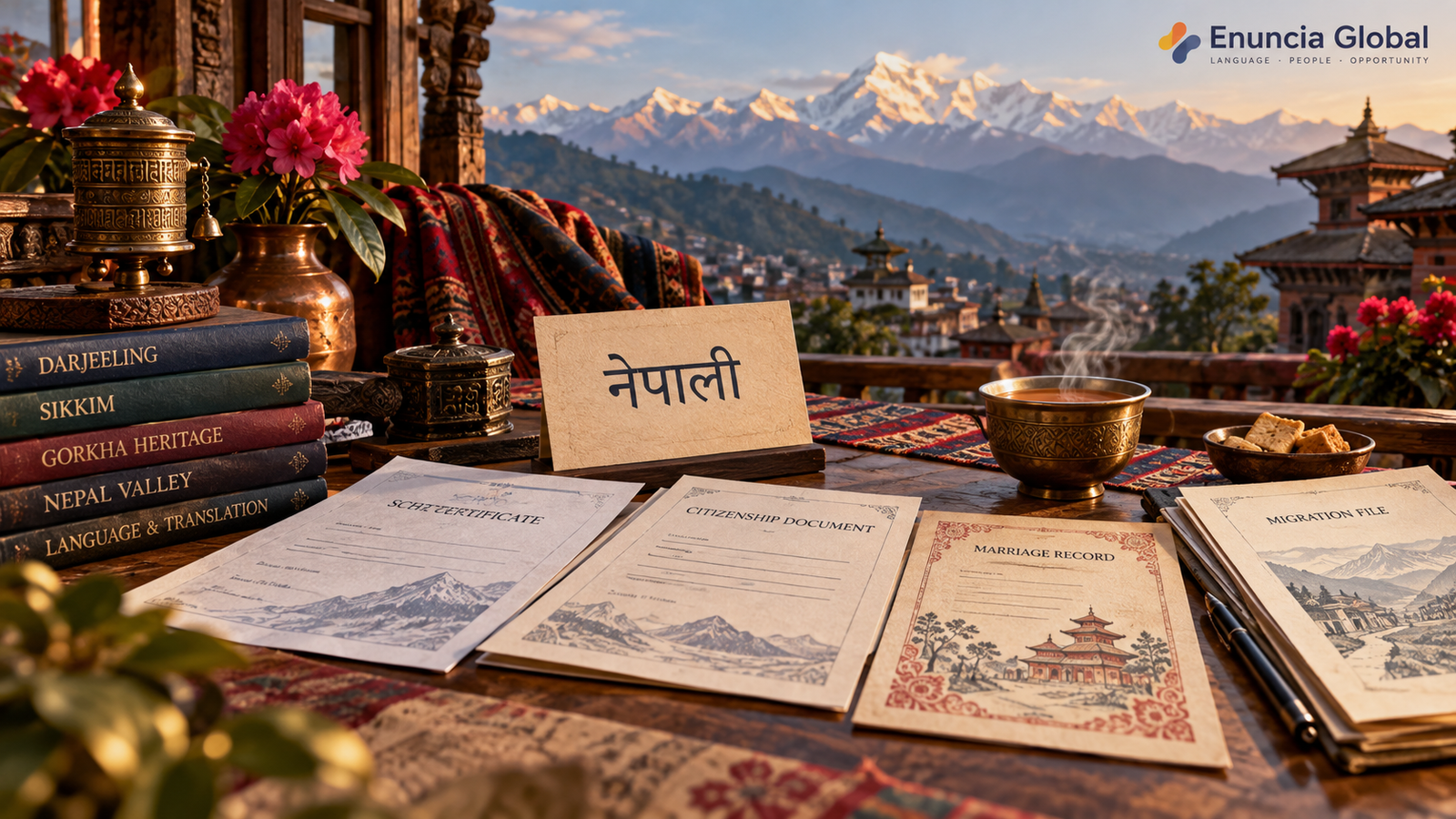
Nepali document translation looks simple because the script is familiar to many Indian readers, but identity terms, origin, authority names and document conventions can change the way a record should be read. Indian Nepali, Nepal Nepali and Gorkhali are connected language territories, yet the document context must be handled carefully.
Why the name of the language matters
Nepali, Nepal Nepali, Indian Nepali and Gorkhali can appear in searches, conversations and records in overlapping ways. For a translator, the practical question is not to argue identity; it is to understand the document’s origin, issuing authority, intended use and reader. A school certificate from Darjeeling, a citizenship document from Nepal, a court paper from India and a family record for immigration may all require different contextual handling.
Script and spelling in Nepali documents
Nepali is commonly written in Devanagari. Names must be transliterated into English with care because the same name may already exist in a passport, Aadhaar, PAN, visa record, school file or older English certificate. A translation should not create a new identity spelling casually. It should either follow the accepted English spelling or clearly represent the source where no prior English version exists.
Indian Nepali records and Gorkha identity contexts
Indian Nepali-speaking communities are present in places such as Darjeeling, Sikkim, Assam, Uttarakhand and other parts of India. The term Gorkha or Gorkhali may carry community and identity significance. In official document translation, these terms should be handled respectfully and only according to the source text. If the source says Nepali, translate Nepali. If it uses a community or institutional term, preserve it accurately.
Nepal-origin records and authority wording
| Record type | Translation sensitivity | Common purpose |
|---|---|---|
| Citizenship or identity record | Authority name, district, dates, citizenship number and names | Immigration, KYC, employment or family file |
| Academic certificate | Institution names, levels, marks, board/university terms | Admission, evaluation or job application |
| Marriage or birth record | Relationship terms, parent/spouse names, place names and registration details | Marriage, visa, dependent or legal file |
| Affidavit or legal paper | Declarant, oath wording, notarial references and attachments | Court, embassy or administrative submission |
Document translation risks
One Devanagari spelling may map to more than one English spelling.
Nepal-origin and India-origin authorities should not be described as if they are the same.
Community terms should be translated only as the source supports.
Checklist before ordering Nepali translation
- Share all pages, including seals and reverse-side notes.
- Tell us whether the document is from Nepal, India or another location.
- Send existing English spelling from passport or official ID if available.
- Explain the purpose: visa, marriage, study, employment, court, business or KYC.
- Ask for a name-consistency note if several documents use different spellings.
Send the file before you submit it anywhere
For translation scope, certification wording, formatting and delivery planning, call +91-931-505-6112, WhatsApp +91-931-505-6112, email info@enuncia.global, or use Get Free Quote.
FAQs
Are Nepali and Gorkhali the same for translation?
They are closely related terms in many contexts, but identity and origin matter. A document should be described by its actual source, issuing authority and intended use.
Can Devanagari Nepali names be translated into English directly?
Names should be transliterated carefully and checked against passports, certificates and prior records to avoid mismatch.
What documents need Nepali to English translation?
Common files include citizenship records, academic certificates, birth or marriage records, affidavits, employment documents and legal papers.
Document acceptance, apostille, legalization and translation requirements can change by receiving authority. The practical checks above help the reader prepare a file before submission; the receiving authority’s instruction remains decisive.