
French language reference
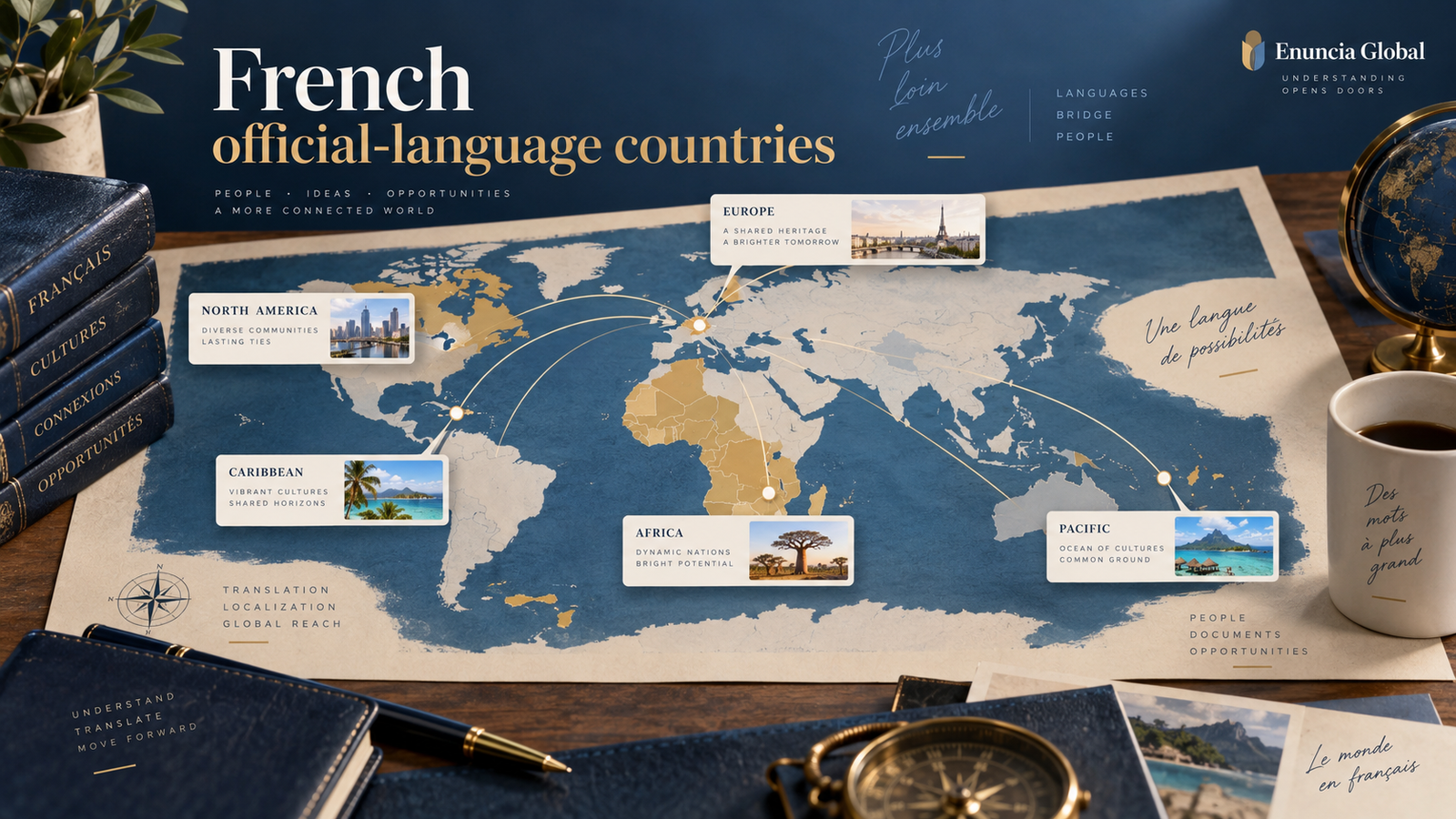
French is an official or co-official language in countries across Europe, Africa, North America, the Caribbean, the Indian Ocean and the Pacific. For translation buyers, the practical point is not only geography: the country affects document language, certification wording, apostille or legalization route and the receiving authority’s expectations.
How to read this list
This guide lists sovereign countries where French is official or co-official at national level. Francophonie membership is broader than official-language status, so the two should not be confused. For document translation, the official-language status helps anticipate French paperwork, but the receiving authority still decides what language and certification it accepts.
Europe
| Country | French status | Document note |
|---|---|---|
| France | Official | Civil, legal, academic and business records commonly appear in French. |
| Belgium | Co-official | Language can depend on region and authority. |
| Luxembourg | Co-official | French often appears with Luxembourgish or German contexts. |
| Monaco | Official | French is central for public and legal documents. |
| Switzerland | Co-official | Documents may be French, German, Italian or Romansh depending on canton. |
Africa
| Country | French status | Document translation note |
|---|---|---|
| Benin | Official | Civil, education and business records commonly require French-to-English handling for international use. |
| Burkina Faso | Official | Authority names, place names and civil-record wording should be preserved carefully. |
| Burundi | Official | French may appear with Kirundi context, so names and local authority labels need attention. |
| Cameroon | Co-official | French and English context can vary by document origin and authority. |
| Central African Republic | Official | French administrative terms should be translated without losing issuing-office detail. |
| Chad | Co-official | French may appear with Arabic context; document route and target language should be confirmed. |
| Comoros | Co-official | French records may coexist with Comorian and Arabic contexts. |
| Republic of the Congo | Official | Civil, legal and business records need country-specific authority wording. |
| Democratic Republic of the Congo | Official | Large administrative geography makes place-name and issuing-authority checks important. |
| Côte d’Ivoire | Official | Accents, civil-status terms and registry references should be preserved. |
| Djibouti | Co-official | French may appear with Arabic context in official files. |
| Equatorial Guinea | Co-official | French context should be checked alongside Spanish and Portuguese language possibilities. |
| Gabon | Official | French public, legal and corporate records need clear English field mapping. |
| Guinea | Official | Civil and education records require careful names, dates and authority translation. |
| Madagascar | Co-official | French may appear with Malagasy context; local terms should not be generalized. |
| Mali | Official | French administrative records need issuing-office and date consistency checks. |
| Niger | Official | Civil, academic and legal documents need full-page review including seals. |
| Rwanda | Co-official | French may appear with English, Kinyarwanda or other official-language contexts. |
| Senegal | Official | French civil and education records often require English translation for overseas use. |
| Seychelles | Co-official | French may appear with English and Seychellois Creole context. |
| Togo | Official | French administrative terminology should be preserved with source-field clarity. |
North America and the Caribbean
| Country | French status | Document note |
|---|---|---|
| Canada | Co-official | Federal and provincial context matters, especially Quebec. |
| Haiti | Co-official | French and Haitian Creole context should be distinguished. |
Indian Ocean and Pacific
| Country | French status | Document note |
|---|---|---|
| Seychelles | Co-official | French may appear with English and Seychellois Creole contexts. |
| Vanuatu | Co-official | English, French and Bislama language context can matter. |
Translation planning by country
French official-language countries do not all use the same administrative terms. A birth record from France, school document from Senegal, company paper from Belgium, court paper from Cameroon and immigration document from Canada may all be in French, but the issuing authority, legal vocabulary and certification route can differ.
Checklist before using French documents
- Identify the issuing country and authority.
- Check whether the receiving authority wants English, French or another language.
- Confirm apostille, attestation, notarization or certified translation requirements.
- Preserve accents, names, registry references and official titles.
- Translate attachments, seals and reverse-side notes where relevant.
Send the file before you submit it anywhere
Call +91-931-505-6112, WhatsApp +91-931-505-6112, email info@enuncia.global, or use Get Free Quote. Share the source document, destination country, receiving authority and deadline so Enuncia Global can quote the right translation, formatting and certification scope.
FAQs
Is French official in every Francophonie member country?
No. Francophonie membership and official-language status are different. This article focuses on countries where French has official or co-official status.
Does French official status mean documents need French translation?
Not always. The receiving authority decides the accepted language and certification route.
Can Enuncia translate French documents from African countries?
Yes. Share the issuing country, document type and receiving authority so terminology and certification can be planned correctly.
Requirements can change by receiving authority, country and document type. Treat this guide as preparation support and confirm final instructions with the authority receiving the file.