
The late query from the editor of a hypothetical translated recipe arrives. The ingredient list for the recipe apparently omits the word ‘divided’ next to the butter, and step one has been amended to melt the full amount of butter for the recipe to start, instead of reserving some of it for the glaze to be made in step five of the method. Each of the sentences in the amended recipe read well on their own but together have been ‘edited’ in unexpected ways.
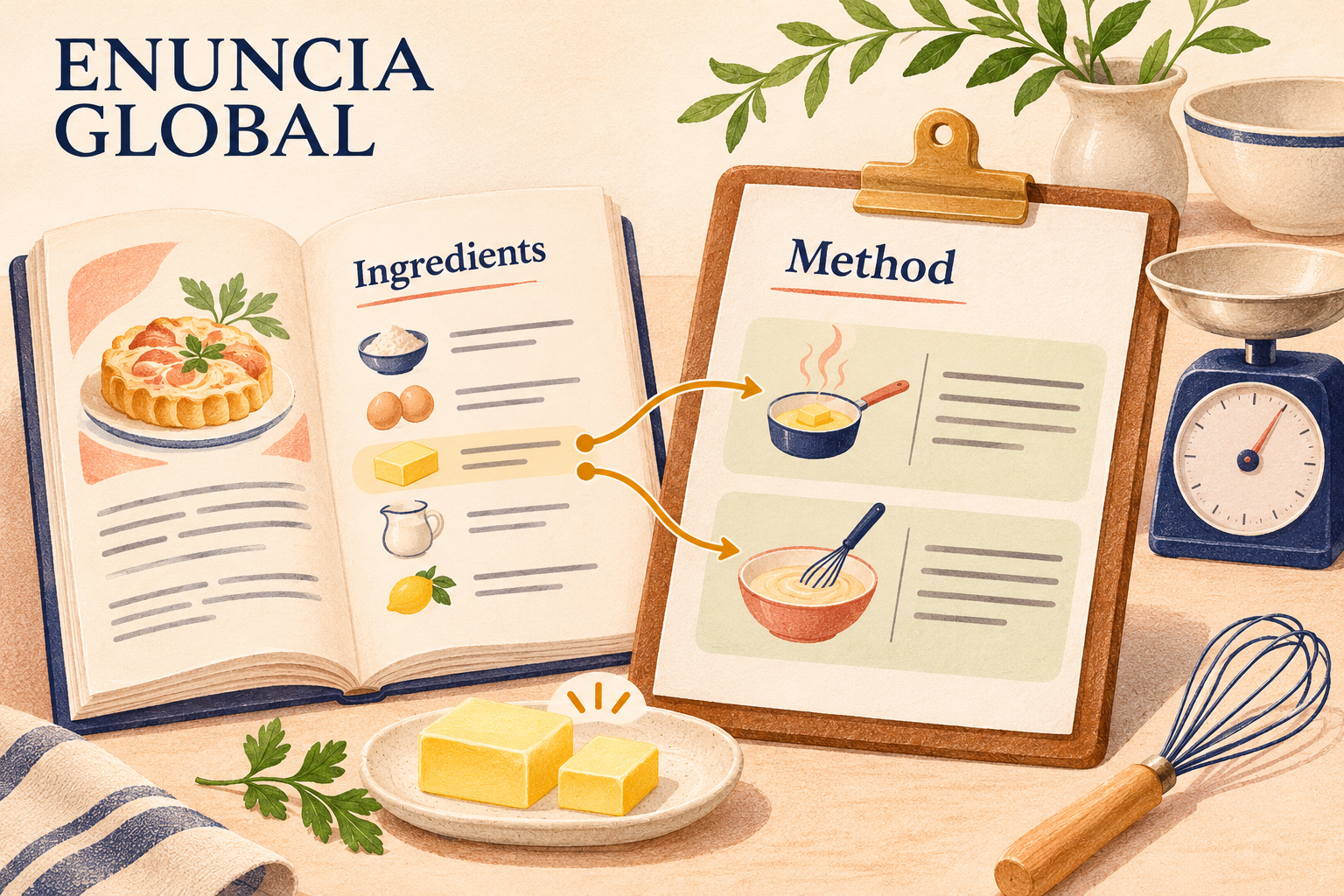
Trace ingredients and qualifiers through every step
Read the ingredient list and method one step at a time, starting from top to bottom. Trace through all the steps, and pay particular attention to situations where you reserve half of something, add things in stages, or put something aside to use as a garnish later. Note how later steps refer back to the ingredient names, and make sure that any shortened form of name used to refer to them in later steps clearly point back to the right line in the ingredient list above.
Just as a trace of an ingredient’s name must follow it through all steps of a method, a preparation qualifier such as ‘chopped’, ‘peeled’, ‘drained’, ‘unsalted’, ‘softened’ must be traced to the exact corresponding ingredient it modifies. When naming produce that is well known by different names in different regions, such as ‘aubergine’ or ‘eggplant’, it is essential to use the most familiar term in order to avoid confusing the reader who is familiar with the local name but not with an imported term.
If an ingredient in the source language is not available in the target language market and the translator is unsure of an alternative, s/he must query the editor for help on this. The translator should not arbitrarily change an ingredient to something that is more readily available in the target language market and unapproved notes in brackets by the translator are to be avoided as they can affect how the reader perceives the ingredient. Only the recipe owner can approve substitutions or additional notes. The bilingual food writer may be able to spot potential problems with the translated recipe but he/she has no authority to make changes to the recipe.
Lock down source files, measurements, and editorial authority
Before you even think about translation, it is important to know which version of the original document or files (e.g. author’s manuscript, web version of a recipe, test-kitchen notes, designer’s working proof) will be the ‘master’ version. It’s not the translator’s job to sort out ambiguities or ‘improve’ the original in the target language – that’s someone else’s job. If a recipe changes whilst it’s in progress, make sure that all language reviewers are sent the updated version of the revised recipe. Just because something is labeled as ‘final’ in a shared folder, doesn’t mean that all necessary changes from the week before have been incorporated.
Agree upon a set of rules which will apply to your reader as well as the numbers on the page (i.e. the measurements) and settle upon your target market very early on. This will also help to settle the matter of whether you keep original units or convert between US customary and metric, as well as establish your ‘house’ conventions for the use of fractions and for the use of abbreviations.
Note that mass and volume are different things. So converting from cups to grams is not a simple matter of multiplying by a single number for the whole book. The weight of one cup of flour is not the same as the weight of one cup of honey. King Arthur Baking provides a chart of the weights of their ingredients. The chart note says that readers should use the weight printed in the recipe for that particular ingredient whenever the chart differs from that number due to rounding. So in that publisher’s workflow the figure in the recipe itself always takes precedence over the chart.
Yields, times, temperatures, step order and preparation qualifiers are all to be translated and left unchanged unless specifically approved for change by the recipe owner. If an ingredient list says to use a certain amount but the method refers to a different amount then flag up for the recipe owner’s approval and record the change in the log kept against the master files.
Proof the final pages (translated copy in layout) – ingredient list and method side by side – for all fractions, decimals, units, etc. and awkward line breaks.
Proofing: Also make sure to proof the final translated copy in the design as you would with regular translation, checking for fractions, decimal points, for unit symbols to be correct, for awkward line breaks that could cause short qualifiers to be read as part of the ingredient below it, checking photo captions and cross-referenced page numbers after fitting the translated text to the layout. (A spreadsheet can’t tell you that a fraction has broken across two lines of a narrow column. Check the page too.)
Keeping production separate on your schedule is also worth remembering. While linguistic review can pick up on things such as incorrect ingredient names or missing qualifiers, it cannot verify whether the adapted or converted recipe actually works in a real kitchen. The recipe owner is best placed to decide whether cooking trials are required, who should carry them out and who should approve any subsequent changes to the recipe.
If you are commissioning a translation of a cookbook or recipes, please feel free to send Enuncia Global the approved recipes, the references to the ingredients, the languages to be translated into, information about the markets, the design files for the book and the contact for the culinary decisions. We will make sure to flag up any ambiguities in the original text instead of making incorrect decisions on behalf of the original editor.