
Create a document inventory before asking providers to price a large legal file set. The inventory should distinguish unique documents, duplicates, exhibits, attachments and uncertain items. It should also identify the languages, available file formats and intended recipients of the translated output.
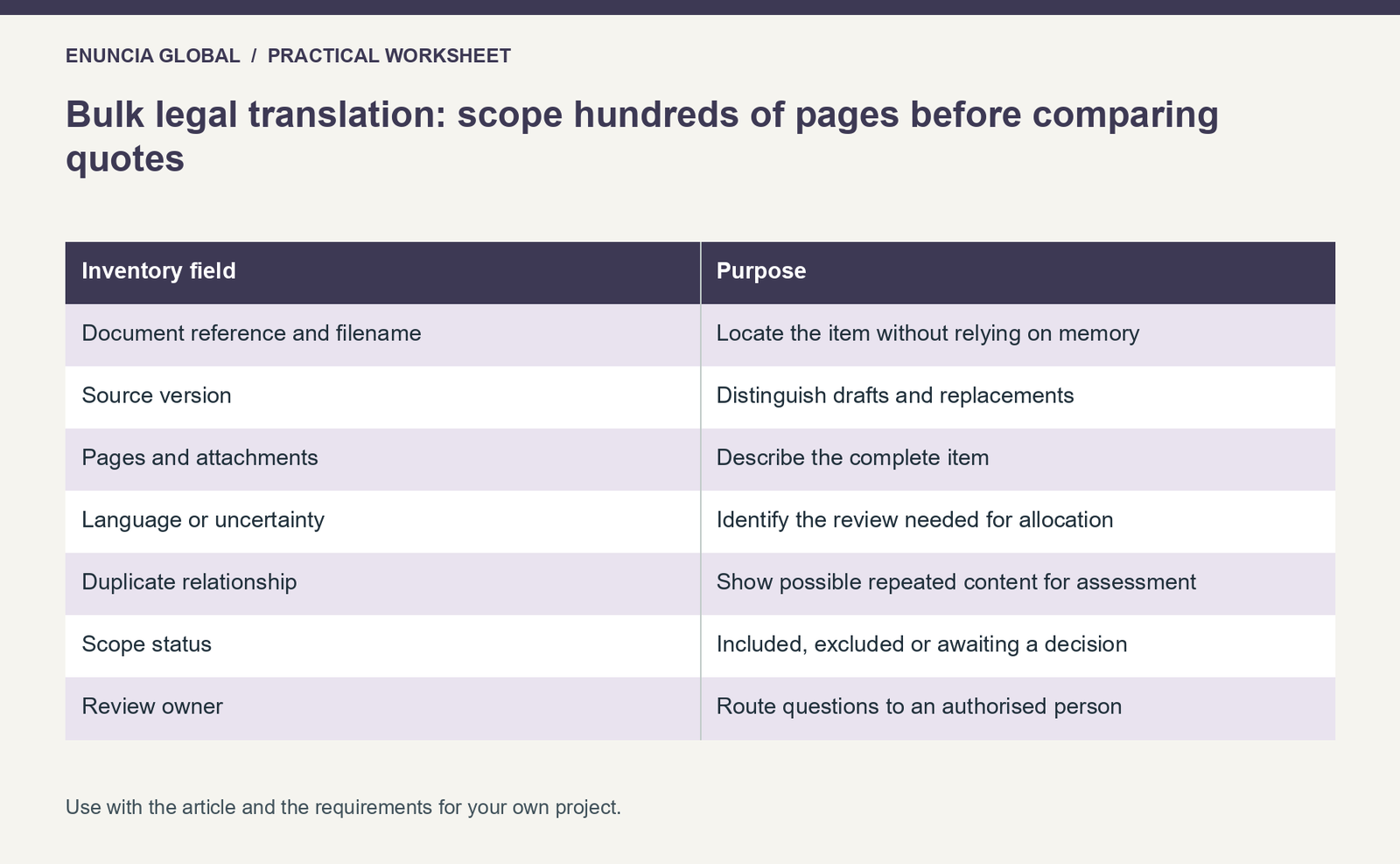
A folder containing hundreds of pages is not yet a defined translation scope. Some pages may be repeated, some may contain handwritten additions and others may be referenced but missing. Those differences matter when a provider assesses the work and plans review.
Start with the file list
Assign an internal reference to each document and retain its original filename. Record visible page counts and language information without guessing at unreadable or mixed-language content. Mark encrypted, damaged or inaccessible files for follow-up.
| Inventory field | Purpose |
|---|---|
| Document reference and filename | Locate the item without relying on memory |
| Source version | Distinguish drafts and replacements |
| Pages and attachments | Describe the complete item |
| Language or uncertainty | Identify the review needed for allocation |
| Duplicate relationship | Show possible repeated content for assessment |
| Scope status | Included, excluded or awaiting a decision |
| Review owner | Route questions to an authorised person |
Avoid deleting apparent duplicates before they are assessed. Two copies may differ by a stamp, note, signature or revision. A duplicate label should point to the comparison question, not conceal it.
Separate translation from supporting requests
Record any requested declarations, affidavits, certification wording, formatting, paper copies or other supporting services as distinct scope items. Provide the receiving organisation's instructions. Ask the supplier to identify what it can provide and what needs separate confirmation.
This makes quotations easier to compare. A lower total may reflect a different document set, review arrangement or delivery format. Match the scope before treating the price difference as a like-for-like comparison.
Identify dependencies and priorities
If some documents are needed before others, identify the priority set and the reason for that sequence. Ask whether staged delivery is feasible and how revisions will be coordinated across the batches. Do not assume that dividing a folder into equal page counts creates equally demanding work packages.
Provide a realistic route for resolving queries. A large file set can generate questions about missing pages, ambiguous abbreviations and conflicting versions. Name the person who can obtain answers from the relevant document or legal owner.
Agree the review structure
Clarify who reviews the translation and who makes legal or commercial decisions. Ask how terminology, identifiers and cross-references will be kept consistent across the set. If several reviewers participate, establish how their comments will be consolidated.
Record the expected deliverables: editable files, PDFs, bilingual layouts, separate document files or an assembled pack. Explain any required naming convention or index. These are quotation inputs, not details to add after the work is priced.
Make completion measurable
At delivery, reconcile the output with the agreed inventory. Check every included item, page sequence and attachment. Record unresolved queries and confirm which source version each output reflects. Open the rendered files, particularly tables, exhibits and page transitions.
Do not treat a folder's existence as proof that the entire scope is complete. A delivery register should identify the actual files and their review status.
For a bulk enquiry, send the inventory, representative readable files, intended use and recipient instructions through the agreed channel. Ask for the quotation assumptions to be stated explicitly, including how changes to the source set will be assessed. That gives procurement and the legal team a clearer basis for comparing proposals.
Request a quotation with your document type, language pair and written requirements.