
An assessment question should test the intended knowledge or skill, not the learner's ability to untangle an avoidable wording problem. Before translating a quiz, provide the learning objective, answer logic and feedback as well as the question text. Those references help the reviewer understand what must remain unchanged in meaning.
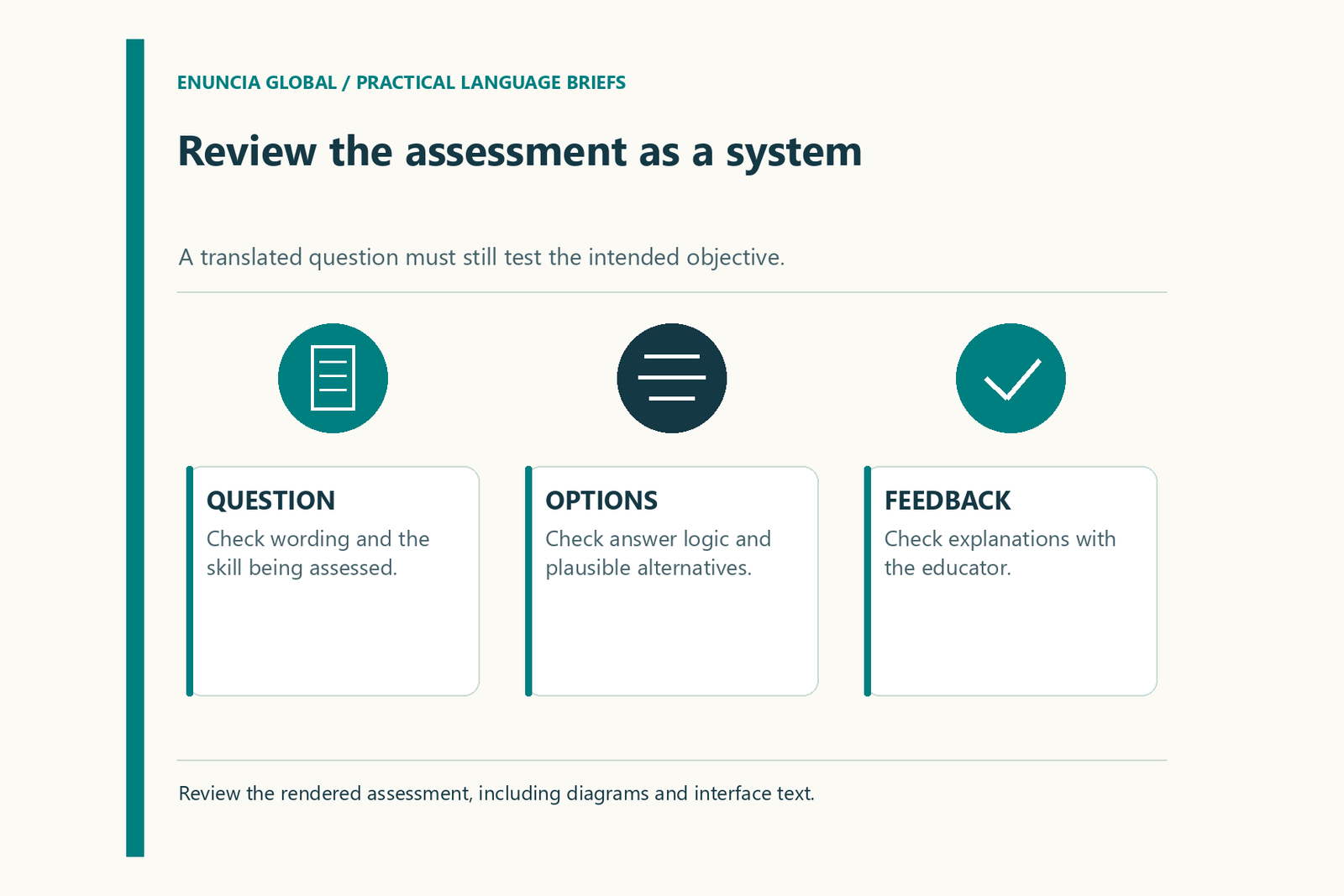
Keep educational validation with the responsible educator or subject owner. A fluent translation does not by itself establish that an item measures the same thing or that the answer key is correct. The brief should name who will make those decisions and how proposed adaptations will be reviewed.
Include the complete item
Supply the stem, answer options, correct-answer reference, scoring instructions and feedback shown after each response. Include images, diagrams and any instructions that apply to several questions. Identify whether an item depends on a lesson example or terminology introduced earlier.
If the source contains an ambiguous question or two plausible answers, raise that before translation is approved. The language team should not silently repair the assessment according to its own interpretation of the learning objective.
Assessment review checklist
Use one checklist per representative item type. The fields are a review aid, not a psychometric validation method.
| Element | Question to resolve | Reviewer to name |
|---|---|---|
| Learning objective | What knowledge or skill should this item assess? | Educator or subject owner |
| Question wording | Is the intended task clear in the target language? | Qualified language reviewer |
| Answer options | Do the distinctions and intended answer logic remain intact? | Language and subject reviewers |
| Feedback | Does each response explain the correct reasoning? | Learning-content owner |
| Visual material | Does the item still refer accurately to the diagram or example? | Subject and production reviewers |
| Interface | Are labels, selection states and limits usable? | Learning-platform owner |
| Adaptation | What changed beyond direct translation, and why? | Authorised assessment owner |
Record unresolved questions and the version assessed. A checked box without a named scope does not explain what was actually reviewed.
Flag features that may need adaptation
Identify wordplay, cultural references, grammatical clues or examples tied to a particular context. Explain whether adaptation is permitted and who approves it. The answer should not become obvious because one translated option differs in style or structure from the others.
Keep any proposed change separate from the source translation record. A revised example may be appropriate, but the educator needs to decide whether it preserves the intended challenge. Do not hide an adaptation inside a general “language correction” label.
Test the item in its delivery environment
Review the translated question on the actual learning screen or a representative preview. Check whether answer options, feedback and diagrams are visible and correctly associated. If the platform imposes a limit, obtain that requirement from its owner rather than shortening text without understanding the consequence.
Use a representative set of item types before extending the approach to the full assessment. Include the difficult examples, not only a straightforward introductory question. Record the decisions that will guide the remaining work.
Approve the matched lesson and quiz
Check that the assessment uses the terminology and instructions of the approved learning material. When a lesson changes, identify whether its questions, answers or feedback need another review. Keep the source, translated items and answer key linked by version.
Bring this checklist to an e-learning localisation enquiry. It turns a list of quiz strings into a reviewable assessment brief, while preserving the educator's responsibility for the learning objective and validity of the final questions.
Request a quotation with your document type, language pair and written requirements.