
Document legalization guide
Apostille or Embassy Attestation? The India Document Route That Saves Rework
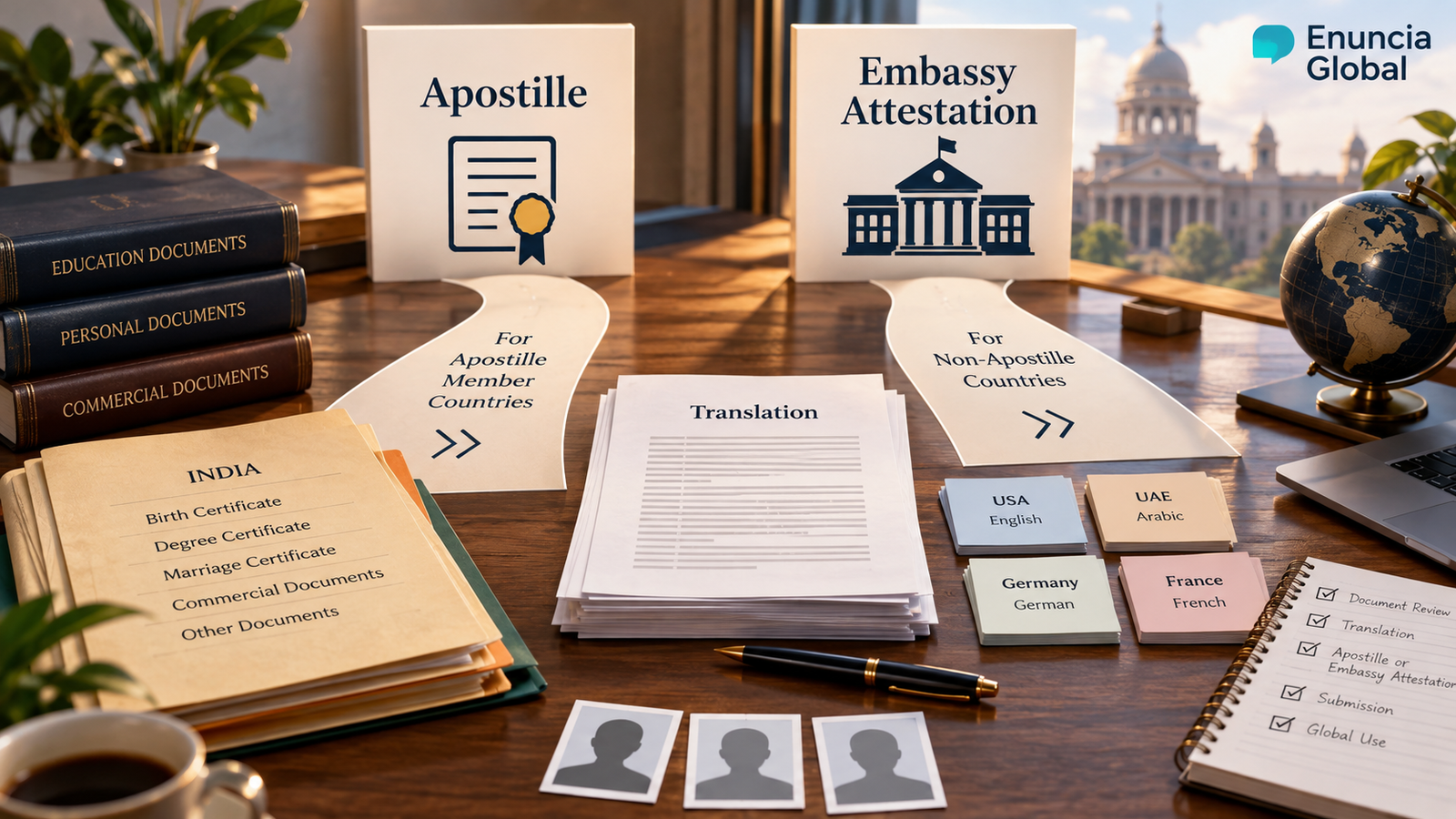
The fastest way to waste time in an international document file is to choose the wrong route first. Apostille, embassy attestation, state authentication, notarization and translation are related steps, but they do not mean the same thing. The right route depends on the destination country, document type and receiving authority.
The core difference between apostille and embassy attestation
Apostille and embassy attestation both help a document travel across borders, but they apply in different country routes. India’s Ministry of External Affairs explains apostille for documents used in Hague Apostille Convention member countries, while normal attestation is used for countries where apostille is not accepted. The Hague Conference status table is the official place to check current participation.
Translation is a separate layer. An apostille can make the origin of a public document acceptable for the route, but it does not make the content readable in another language. A university, employer, immigration office, court or business counterparty can still ask for a translated version.
When apostille is usually the right route
Apostille is generally relevant when the destination country is a party to the Apostille Convention and the document type is eligible for that route. Indian personal documents such as birth, death, marriage, affidavit and power-of-attorney documents, and educational documents such as degree and diploma certificates, commonly appear in apostille workflows according to MEA guidance.
When embassy attestation becomes relevant
Embassy or consular attestation becomes relevant when the destination is not an apostille route or where a receiving authority asks for a country-specific process. This is common in some employment, residence, family, company and education files. The country, document type and authority instruction decide the route.
Where translation fits in the sequence
| Situation | Translation question | Buyer action |
|---|---|---|
| Indian certificate for a Hague country | Will the receiving authority read English, or require translation into its language? | Check destination instruction before final submission. |
| Indian certificate for a non-Hague country | Will embassy/consulate ask for Arabic, French, Portuguese or another language? | Confirm route and language before ordering. |
| Foreign document for Indian use | Does India-side authority need English translation even if the document is apostilled? | Prepare translated file with source and apostille attached if required. |
| Private document | Does it first need notarization or an official declaration before authentication? | Clarify eligibility before translation packaging. |
Country-language planning for Indian documents
Apostille planning should be paired with language planning. Germany may require German or English depending on authority; France may require French; Brazil may require Portuguese; UAE processes commonly involve Arabic or English depending on file type; Cape Verde may involve Portuguese; Vietnam may involve Vietnamese; and many universities accept English but can still ask for certified translation of non-English source documents. The translation brief should capture country, authority, language and document type together.
Pre-submission checklist
- Write the destination country and receiving authority.
- Check whether the country is on the current Hague Apostille Convention status table.
- Identify whether the document is personal, educational, commercial or private.
- Ask whether translation is required, and into which language.
- Keep original, apostille/attestation, translation and certification pages in a clean order.
- Never assume apostille replaces translation.
Send the file before you submit it anywhere
For translation scope, certification wording, formatting and delivery planning, call +91-931-505-6112, WhatsApp +91-931-505-6112, email info@enuncia.global, or use Get Free Quote.
FAQs
Is apostille accepted everywhere?
No. Apostille is tied to countries where the Hague Apostille Convention applies. For non-apostille destinations, embassy or consular attestation may be needed.
Does apostille translate the document?
No. Apostille authenticates origin/signature details; it does not convert the document language. A receiving authority can still ask for translation.
Should translation happen before or after apostille?
The correct sequence depends on the authority and document. Some cases need original document authentication first; others also require certified translation handling. Confirm the destination before proceeding.
- Ministry of External Affairs apostille and attestation guidance
- HCCH Apostille Convention status table
Document acceptance, apostille, legalization and translation requirements can change by receiving authority. The practical checks above help the reader prepare a file before submission; the receiving authority’s instruction remains decisive.