
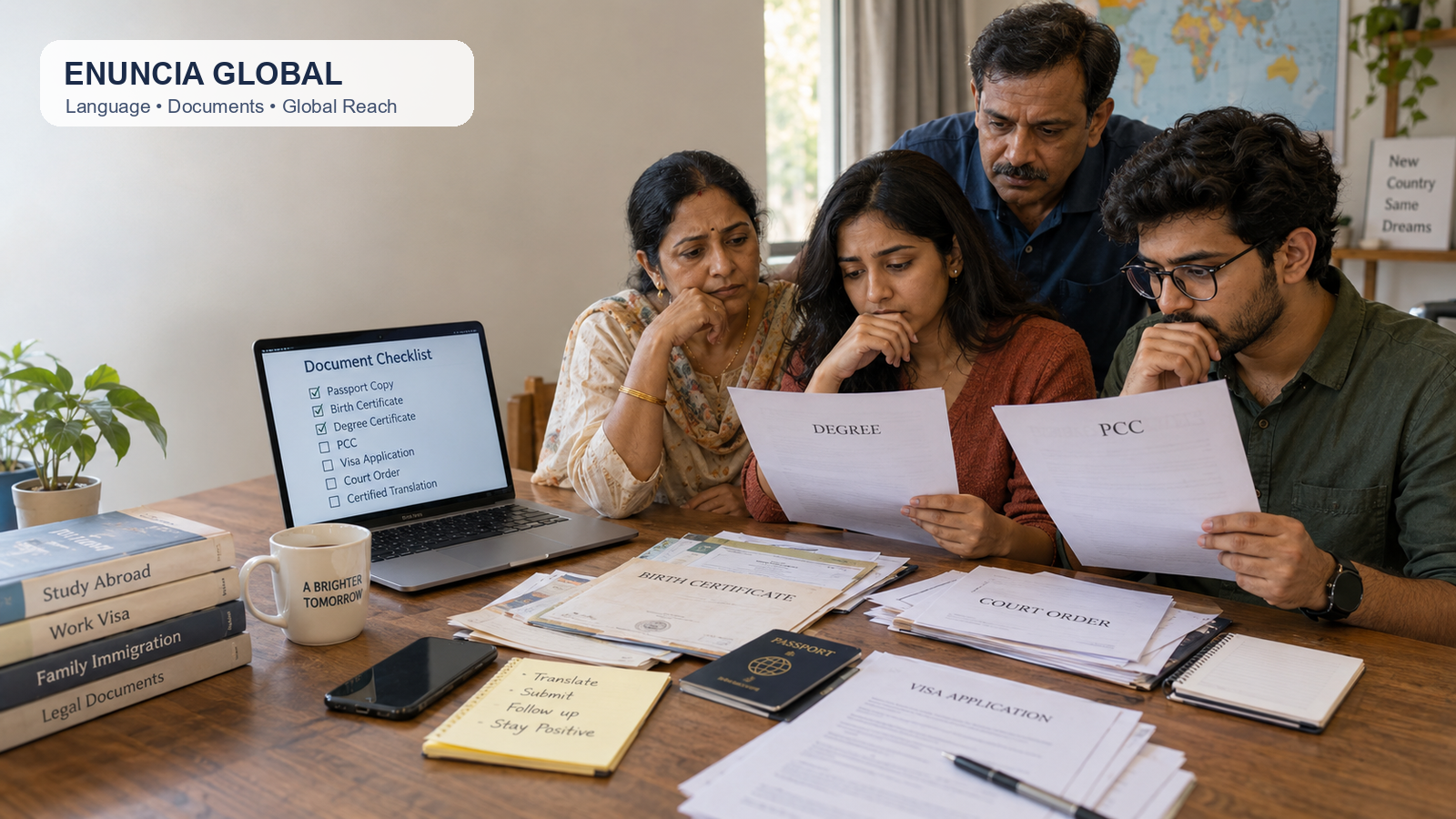
Why Certified Translation Matters for Indian Immigration and Legal Files in 2026
Certified translation matters because modern immigration and legal files are built on evidence. A person may have the right birth record, marriage certificate, degree, salary slip, police certificate or court order, but if the receiving authority cannot read it confidently, the document loses practical strength. In India, many official records are issued in Hindi, Bengali, Tamil, Telugu, Marathi, Malayalam, Kannada, Gujarati, Punjabi, Urdu and other Indian languages. As Indian professionals, students and families move across borders, certified translation becomes the bridge between Indian paperwork and foreign review systems.
Immigration files need consistency
Immigration officers, employers and universities compare details across multiple documents. Names, dates, places, relationships, document numbers and issuing authorities must line up. A translated birth certificate should not create a new spelling that conflicts with the passport. A translated marriage certificate should not change the relationship language. A translated police clearance certificate should retain the issuing office, issue date and identity details. Certified translation helps the receiver understand who translated the file and how it relates to the source.
Legal files need traceability
Legal document translation is different from general language work. Court orders, affidavits, divorce decrees, powers of attorney, contracts, witness statements and property documents carry procedural meaning. A small shift in wording can change how a reader understands obligation, status, custody, ownership, authority or finality. A strong legal translation keeps structure, clause logic, names, dates, exhibit references, stamps and signatures clear. It also flags unclear handwriting or missing text instead of pretending the source is complete.
Indian language records need local knowledge
Indian files often combine language, administration and family context. A Tamil marriage record, Bengali birth certificate, Hindi affidavit, Marathi police record, Malayalam academic certificate or Punjabi revenue document may carry terms that do not map neatly into English. The translator has to understand the document’s function, not only the vocabulary. This is why certified translation for Indian immigration and legal files should be handled by people who know how Indian documents are structured and how foreign authorities tend to review them.
Many Indian records also include handwritten endorsements, seals, partly visible stamps, old spellings and bilingual fragments. A careful translation keeps readable parts clear and marks unreadable parts responsibly. That honesty protects the applicant because it prevents a polished English page from pretending to contain information that was never legible in the source.
Certification does not replace official rules
Applicants sometimes assume that a certified translation automatically satisfies every authority. That is risky. Some receiving bodies may ask for notarization, apostille, embassy legalization, sworn translation, original documents or specific translator declarations. Certified translation is an important part of the file, but the submission should be planned around the receiving authority’s instruction. For Indian documents, the Ministry of External Affairs and eSanad ecosystem are relevant for many attestation and apostille workflows, while translation requirements may still come from the foreign authority receiving the file.
What clients should send
The best translation quote starts with complete information. Send the document scan, target language, source language, country of use, receiving authority, deadline and any format instruction. If names differ across documents, mention the preferred passport spelling. If a seal, stamp or handwritten note is unclear, send a better scan if available. If a document is part of a court or immigration package, explain the purpose so the translator can preserve the right details.
Clients should also mention whether the file will be submitted online or physically. Online portals may require compressed PDFs and clean page order, while physical submission may require print-ready formatting and certification pages. If multiple family members are applying together, the translation set should use one consistent style for names, addresses and relationship terms across all documents.
Common files that deserve extra care
Police clearance certificates, divorce decrees, birth certificates, marriage certificates, single status certificates, tax records, salary slips and academic transcripts deserve extra care because they are often cross-checked against other evidence. A salary slip may be compared with a bank statement, a tax record with an employment letter, a marriage certificate with a passport, and a birth certificate with a family affidavit. If translation changes the order of a name, drops a stamp reference or rewrites an authority name loosely, the receiver may ask unnecessary questions.
Certified translation also helps Indian applicants keep one clean record of what was submitted. When a family is applying for residence, study, work or dependent visas, the same translated documents may be requested again at a later stage. A well-prepared translation with consistent terminology can therefore save time beyond the first submission. It gives the applicant, consultant, lawyer and receiving authority a stable version to refer to.
Enuncia Global support
Enuncia Global handles certified translation, legal translation, immigration translation, court-facing translation, embassy document translation and multilingual Indian language translation. The goal is to produce a document that is readable, faithful and submission-aware. For a quote, WhatsApp/call +91 9958625455, email info@enunciaglobal.com or use the Get Quote form with your deadline and authority details.
Frequently Asked Questions
Do I need certified translation for every document? Only when the receiving authority asks for it or when the document has legal, immigration, academic, employment or business value.
Can Enuncia Global handle urgent files? Urgency depends on language, length, legibility and certification requirements. Share the scan and deadline before confirming.
What should I send for a quote? Send the document, source language, target language, country of use, receiving authority and deadline.