
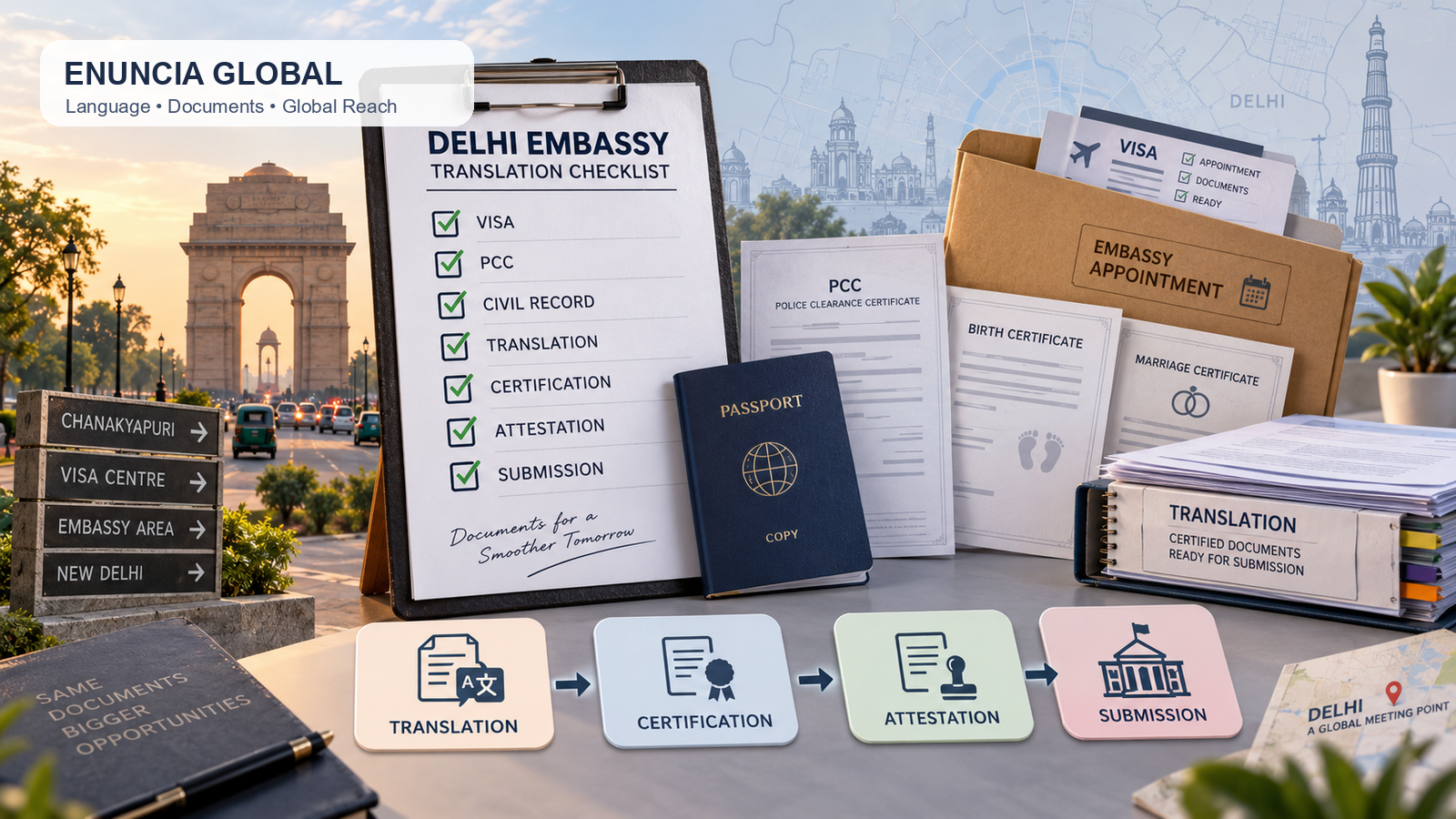
Delhi Embassy Translation Checklist: Visa, PCC and Civil Documents That Must Match Before Submission
Embassy translation in Delhi is rarely about a single document. Most applicants submit a package: passport, birth certificate, marriage certificate, police clearance certificate, bank record, employment proof, academic record, affidavit, divorce decree, adoption paper, medical record or invitation letter. One weak translation can slow the whole file because embassies, visa centres and foreign authorities compare names, dates, seals and relationships across every page. This checklist is written for applicants who want their visa document translation to be clean before submission.
Start with the receiving authority
The first question is not “how many pages?” It is “who will read this translation?” A Schengen visa file, a family reunification file, a foreign university file and a work permit package may all need certified translation, but the tolerance for format, certification wording and supporting documents can differ. Applicants should save the instruction page from the embassy, visa centre, court, university or employer before ordering translation. If the authority asks for notarization, apostille, sworn translation, certified translation or translator declaration, the translation package should follow that instruction.
Check names before translation starts
Name variation is one of the most common reasons for avoidable confusion. Indian documents may show initials, father’s name, spouse’s name, expanded middle names, changed surnames or spellings that differ from the passport. A Hindi, Urdu, Bengali, Tamil, Telugu, Marathi or Punjabi document may require transliteration into English. The translation should match the passport where appropriate, but it should also remain faithful to the source. If the source has a different spelling, that difference should be handled visibly rather than silently changed.
Police clearance certificate and civil documents
PCC translation needs particular care because the document may carry police station names, district names, issue dates, certificate numbers and identity details. Civil documents need the same discipline. Birth certificates, marriage certificates, divorce decrees and death certificates must preserve registration details, issuing authorities, locations and family relationships. If a seal is visible but partly unreadable, the translator should mark it carefully instead of inventing the text.
Document readiness checklist
Before sending a file for embassy translation in Delhi, confirm that every page is scanned fully, including the reverse side. Check that stamps and signatures are visible. Share passport spelling for each applicant. Mention the country of submission, visa category and deadline. If an apostille or notary page is attached, include it in the translation request. If the embassy has provided exact wording, share it at the beginning.
Why this matters
Embassy staff and visa processing teams are trained to look for consistency. A translated marriage certificate that gives a different date format from the affidavit, or a birth certificate that uses a different name order from the passport, can create avoidable questions. Good translation does not guarantee acceptance, but poor translation can weaken a file that otherwise has the right documents.
Red flags to fix before you book an appointment
Applicants should slow down if a document scan cuts off the seal, if the passport spelling differs from the civil certificate, if a marriage certificate uses a local-language name that has never been transliterated before, or if an affidavit mentions a relationship differently from the supporting certificate. These problems are easier to correct before translation than after submission. If the document was issued outside Delhi, the translation team should still be told where it will be submitted, because the purpose controls the formatting and certification requirement.
Another red flag is mixing unofficial summaries with certified translation. A summary may help the applicant understand the document, but it should not replace a faithful translation for embassy use. The final file should show all material content in a way that the officer can compare with the scan. If an appendix, reverse page, apostille sheet or notarized declaration is part of the submission, it should be handled in the same workflow.
Best order for Delhi applicants
The cleanest order is simple: collect every document, check the receiving authority’s instruction, scan both sides, resolve name spelling doubts, translate, review the translated names and dates, then print or upload according to the instruction. This order prevents last-minute panic at visa centres and embassy counters. It also helps the translator prepare one consistent package instead of scattered single-page files.
Enuncia Global helps Delhi NCR applicants with certified translation for embassy, visa, PCC, civil, academic, employment and legal files. For a quote, WhatsApp/call +91 9958625455, email info@enunciaglobal.com or use the Get Quote form with the receiving authority and deadline.
Frequently Asked Questions
Do I need certified translation for every document? Only when the receiving authority asks for it or when the document has legal, immigration, academic, employment or business value.
Can Enuncia Global handle urgent files? Urgency depends on language, length, legibility and certification requirements. Share the scan and deadline before confirming.
What should I send for a quote? Send the document, source language, target language, country of use, receiving authority and deadline.