
Japanese manufacturing translation
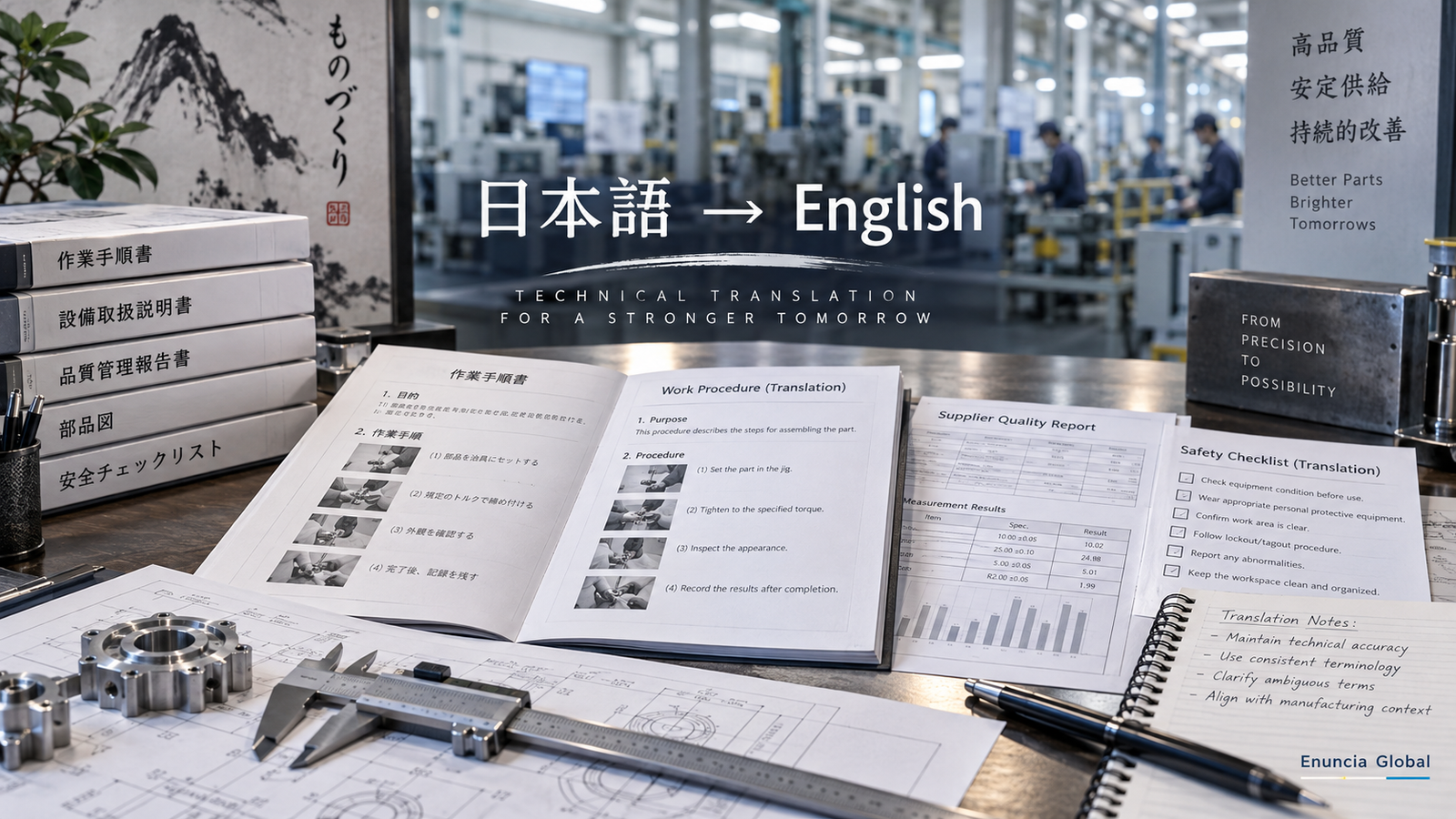
Japanese to English technical translation is not a literary task. Manufacturing teams need exact steps, warnings, part names, inspection language, supplier notes, measurement units and revision controls. A small mistranslation in an SOP, manual or quality report can affect training, production, safety or supplier accountability.
Manufacturing uses
Japanese to English technical translation supports manufacturing teams that work with Japanese machinery, suppliers, manuals, training files, quality reports, SOPs, drawings and safety documentation. The value of the translation lies in exact execution: what part, what step, what condition, what warning and what acceptance criterion.
SOPs and manuals
SOPs and manuals must keep sequence, numbering, caution language, part names, tool names and diagrams aligned. Japanese often omits repeated subjects where context is obvious to the original reader. The English version should restore enough context for a technician or engineer without adding unsupported meaning.
Supplier quality documents
| Document | Risk | Translation control |
|---|---|---|
| Inspection report | Wrong defect category or measurement interpretation | Units, tolerances and terms checked |
| Supplier notice | Missed responsibility or corrective action | Action-owner wording preserved |
| Manual | Safety warning or step sequence misunderstood | Warnings and numbered steps locked |
| Drawing note | Material, surface finish or revision missed | Term table and revision audit |
Terminology and units
Technical files should use a bilingual terminology sheet for recurring part names, defect names, process words, warning words and measurement units. This prevents one Japanese term from becoming three different English terms across a manual, SOP and supplier report.
Technical QA workflow
- Collect all related manuals, SOPs, diagrams and supplier files.
- Build a terminology and unit list.
- Translate with figure references and sequence preserved.
- Check numbers, units, warnings and revision labels.
- Flag unclear scans, cropped diagrams and unreadable handwritten notes.
Pre-translation checklist
- Send source files in the highest available resolution.
- Share approved English product or part names if available.
- Mark the document that controls the manufacturing decision.
- Tell us whether the users are engineers, operators, purchase, quality or legal teams.
Send the file before you submit it anywhere
Call +91-931-505-6112, WhatsApp +91-931-505-6112, email info@enuncia.global, or use Get Free Quote. Share the source document, destination country, receiving authority and deadline so Enuncia Global can quote the right translation, formatting and certification scope.
FAQs
Can Japanese manuals be translated with diagrams?
Yes. Diagrams, captions, warnings and callouts should be handled together with the main text.
Should Japanese terms be kept bilingual?
For part names, machine names, quality terms and recurring procedures, a bilingual term table is often useful.
Can Enuncia translate scanned Japanese manuals?
Yes, if the scan is readable. Blurry or cropped parts are flagged before final delivery.
Requirements can change by receiving authority, country and document type. Treat this guide as preparation support and confirm final instructions with the authority receiving the file.