
Indian language map
Languages of Gujarat: Gujarati, Kutchi, Bhili, Surti, Charotari, Kathiyawadi and the Full Linguistic Map
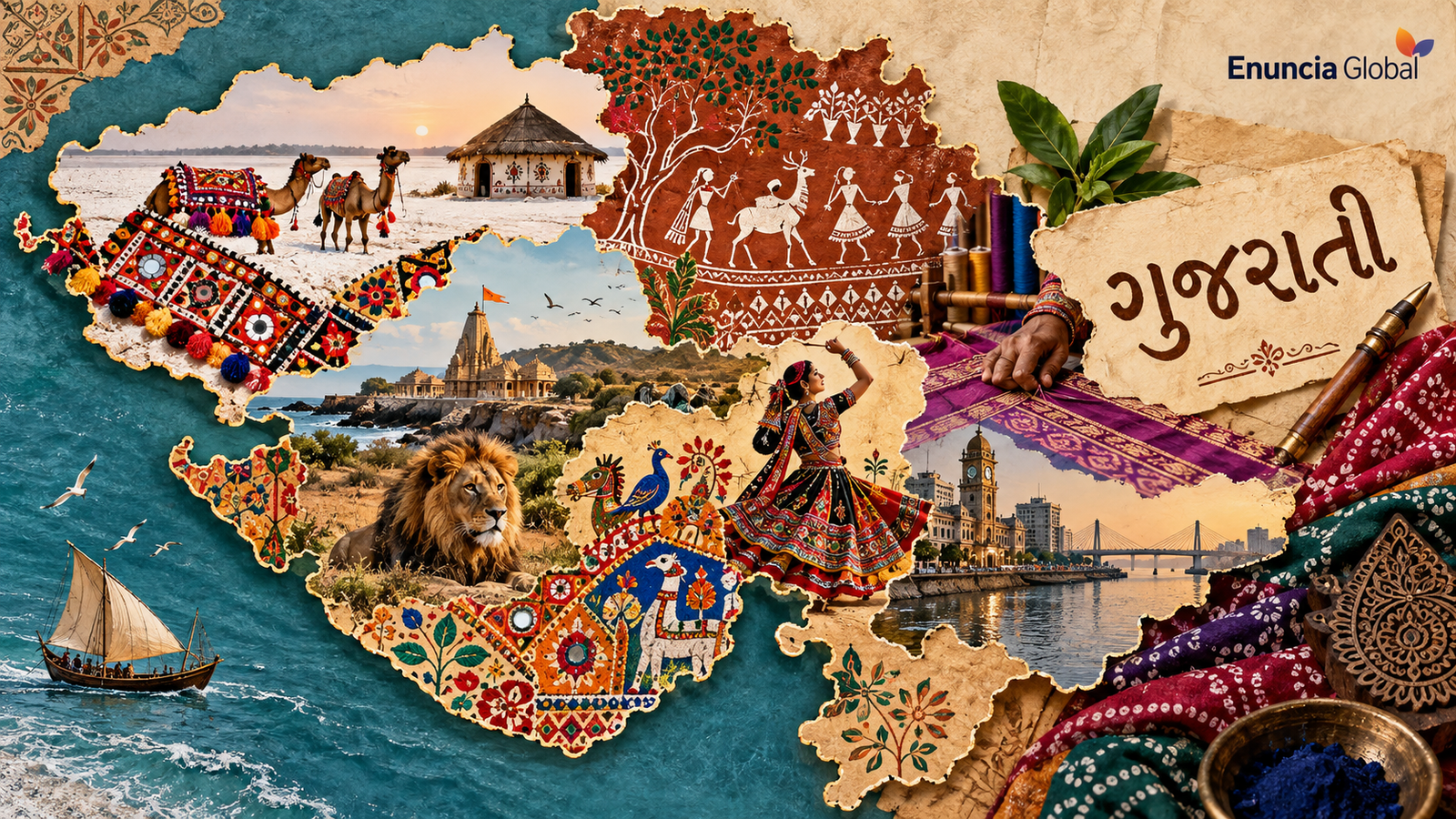
Gujarat is often treated as a single Gujarati-speaking market, but real communication across Kutch, Saurashtra, North Gujarat, Central Gujarat, South Gujarat and tribal belts is more layered. For translation buyers, the question is not only “Gujarati or English?” but which variety, script habit, audience and document purpose the text must serve.
Why Gujarat is not one language situation
Gujarati is the dominant formal language for the state, but Gujarat’s linguistic life includes regional varieties, trading-community speech, tribal language zones, migration languages and cross-border Kutch connections. For SEO and translation planning, treating the state as only one flat “Gujarati” market misses the way people speak, search and trust content.
Official data such as Census mother-tongue tables is useful because it reminds us that language choices are not only literary categories. They show how people describe their own mother tongue across districts, towns and rural areas. For practical translation, that means we should ask where the content will be read and what kind of document or communication it is.
Gujarati and its regional speech zones
Standard Gujarati is the safest choice for formal translation, certificates, business documents and statewide public communication. Within everyday speech, however, regional varieties such as Surti, Charotari, Kathiyawadi and North Gujarat speech patterns affect idiom, tone and vocabulary. A formal document should not be forced into dialect, but marketing, training, field interviews and voice work may need regional sensitivity.
Kutchi, Bhili and other important language realities
| Language or variety | Where it matters | Translation implication |
|---|---|---|
| Gujarati | Statewide documents, education, administration, business and media | Use clear standard Gujarati for formal work. |
| Kutchi | Kutch communities, diaspora communication, oral-history and field work | Do not assume standard Gujarati covers every audience need. |
| Bhili/Bhilodi-related speech | Tribal belts and western Indian language continua | Use speaker review for field content and social-development communication. |
| Surti, Charotari, Kathiyawadi | Regional identity, spoken media, community communication | Useful for adaptation, subtitling, voiceover or campaign localization. |
| Hindi, Marathi, Sindhi, Urdu and migrant languages | Urban, border and business environments | Relevant in multilingual document bundles and local outreach. |
How document translation differs from public communication
A Gujarati birth certificate, school leaving certificate, land paper, affidavit or business registration should be translated according to its written source, not according to a dialect preference. By contrast, an awareness campaign, training module or community interview may fail if it ignores how people actually speak. The right language decision follows the task.
Language planning for Gujarat-facing businesses
Translate the written record faithfully and keep identifiers unchanged.
Choose standard Gujarati unless the audience requires regional adaptation.
Record the speaker’s own language label and use reviewer notes.
Practical checklist for Gujarati content
- Identify document use: official, business, legal, training, public campaign or field interview.
- Ask where in Gujarat the audience is located.
- Confirm whether the task needs standard Gujarati, English translation or local adaptation.
- For Kutchi or Bhili speech, collect audio quality and speaker context before quoting.
- Keep names, addresses, caste/community labels and place names exact in official translation.
Send the file before you submit it anywhere
For translation scope, certification wording, formatting and delivery planning, call +91-931-505-6112, WhatsApp +91-931-505-6112, email info@enuncia.global, or use Get Free Quote.
FAQs
Is Kutchi the same as Gujarati?
Kutchi is closely connected to western Indian language history but should not be casually treated as standard Gujarati in every communication task. Audience, region and purpose matter.
Does a Gujarati document need dialect translation?
Official written documents usually need standard Gujarati-English handling, while outreach, field content and interviews may need regional variety awareness.
Which Gujarat language should businesses use?
For formal documents use the source document language accurately. For public communication, choose standard Gujarati plus regional vocabulary only where the audience and channel justify it.
Document acceptance, apostille, legalization and translation requirements can change by receiving authority. The practical checks above help the reader prepare a file before submission; the receiving authority’s instruction remains decisive.