
Indian language map
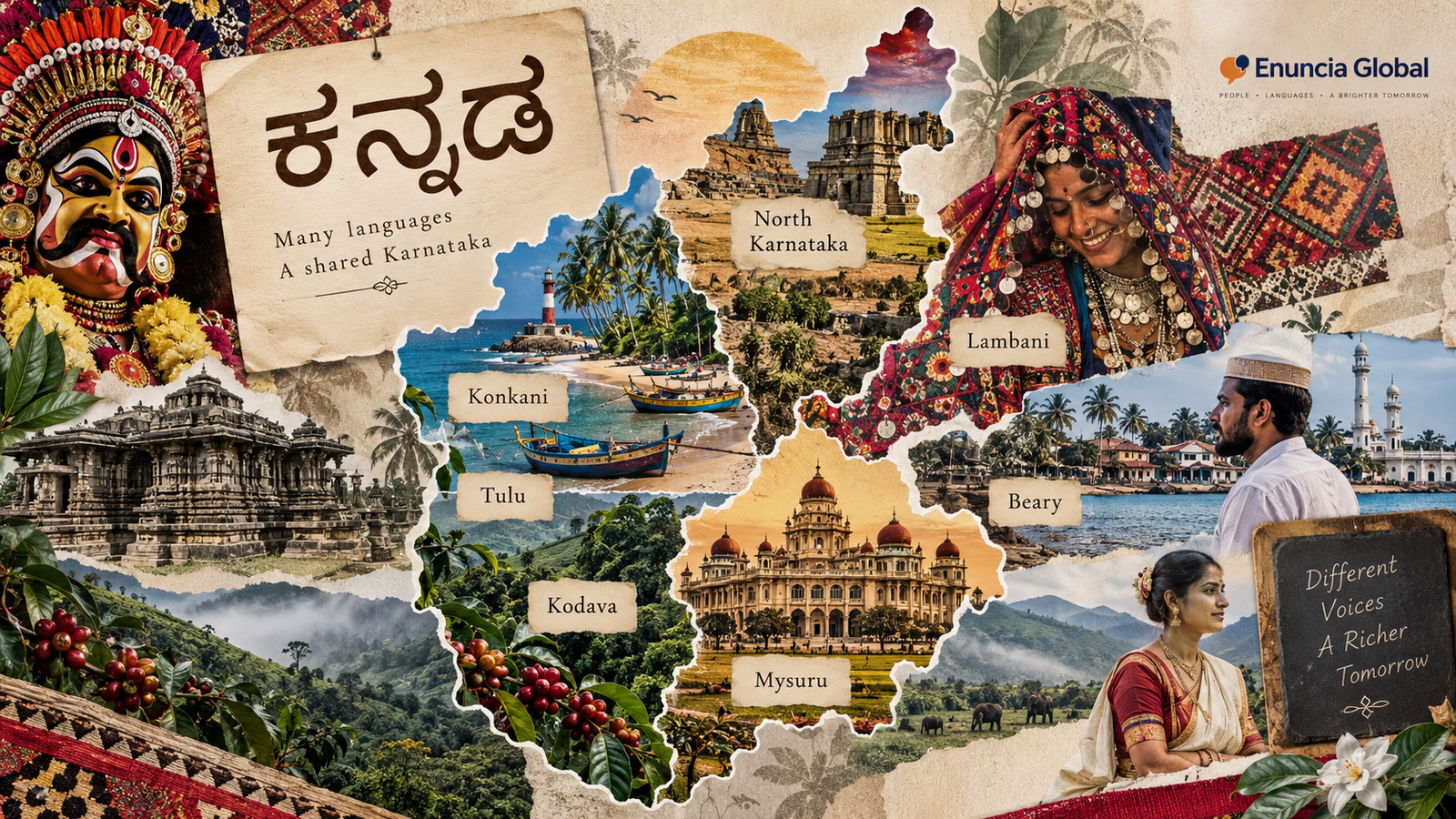
Karnataka is often reduced to Kannada in business planning, but the state has a layered linguistic map. Kannada is central for formal communication, yet Tulu, Kodava, Konkani, Beary, Lambani and other speech communities matter in coastal, hill, urban, field, cultural and community contexts.
Why Karnataka is multilingual
Karnataka contains a powerful Kannada public sphere and several regionally important language communities. Coastal Karnataka, Kodagu, Bengaluru, North Karnataka and border districts do not all communicate in the same way. For translation buyers, the question is not only which language exists, but which audience, file type and channel will use it.
Kannada as the statewide anchor
Kannada is the main formal anchor for statewide communication, government-linked records, education, media and many business contexts. For certificates, HR files, legal papers and official translations, standard written Kannada and English usually carry the formal workload.
Tulu Kodava Konkani Beary and Lambani
| Language/community context | Where it matters | Translation implication |
|---|---|---|
| Tulu | Coastal Karnataka and community communication | Useful for spoken content, interviews, campaigns and cultural files |
| Kodava | Kodagu identity, oral content and cultural material | Needs context-aware language review |
| Konkani | Coastal and community settings | Script and audience should be clarified |
| Beary | Coastal Muslim community communication | Often needs speaker/context review for oral work |
| Lambani | Community and field communication | Useful in outreach, social research and localization planning |
Document translation vs local communication
An official Kannada certificate should be translated according to the written source. A field interview, training video or community campaign may need regional language awareness. Mixing these two tasks creates weak results: formal records need fidelity, while public communication needs audience fit.
Business language planning
Translate the written source accurately.
Choose the language the worker actually uses.
Record the speaker’s own language label and region.
Practical checklist
- Define district, audience and medium.
- Separate document translation from spoken adaptation.
- For coastal or community content, ask whether Tulu, Konkani, Beary or another variety is needed.
- For Kodagu or Lambani contexts, plan reviewer input early.
- Keep official names and identity terms exactly as the source supports.
Send the file before you submit it anywhere
Call +91-931-505-6112, WhatsApp +91-931-505-6112, email info@enuncia.global, or use Get Free Quote. Share the source document, destination country, receiving authority and deadline so Enuncia Global can quote the right translation, formatting and certification scope.
FAQs
Is Kannada enough for all Karnataka communication?
For many official and statewide contexts yes, but regional communication may need Tulu, Kodava, Konkani, Beary, Lambani or other context-aware handling.
Do certificates need dialect translation?
Official records should follow the written source. Dialect awareness matters more for interviews, voice, training, field research and public campaigns.
How should businesses plan language for Karnataka?
Start with the document purpose, district, audience and channel, then decide standard Kannada, English translation or regional adaptation.
Requirements can change by receiving authority, country and document type. Treat this guide as preparation support and confirm final instructions with the authority receiving the file.