
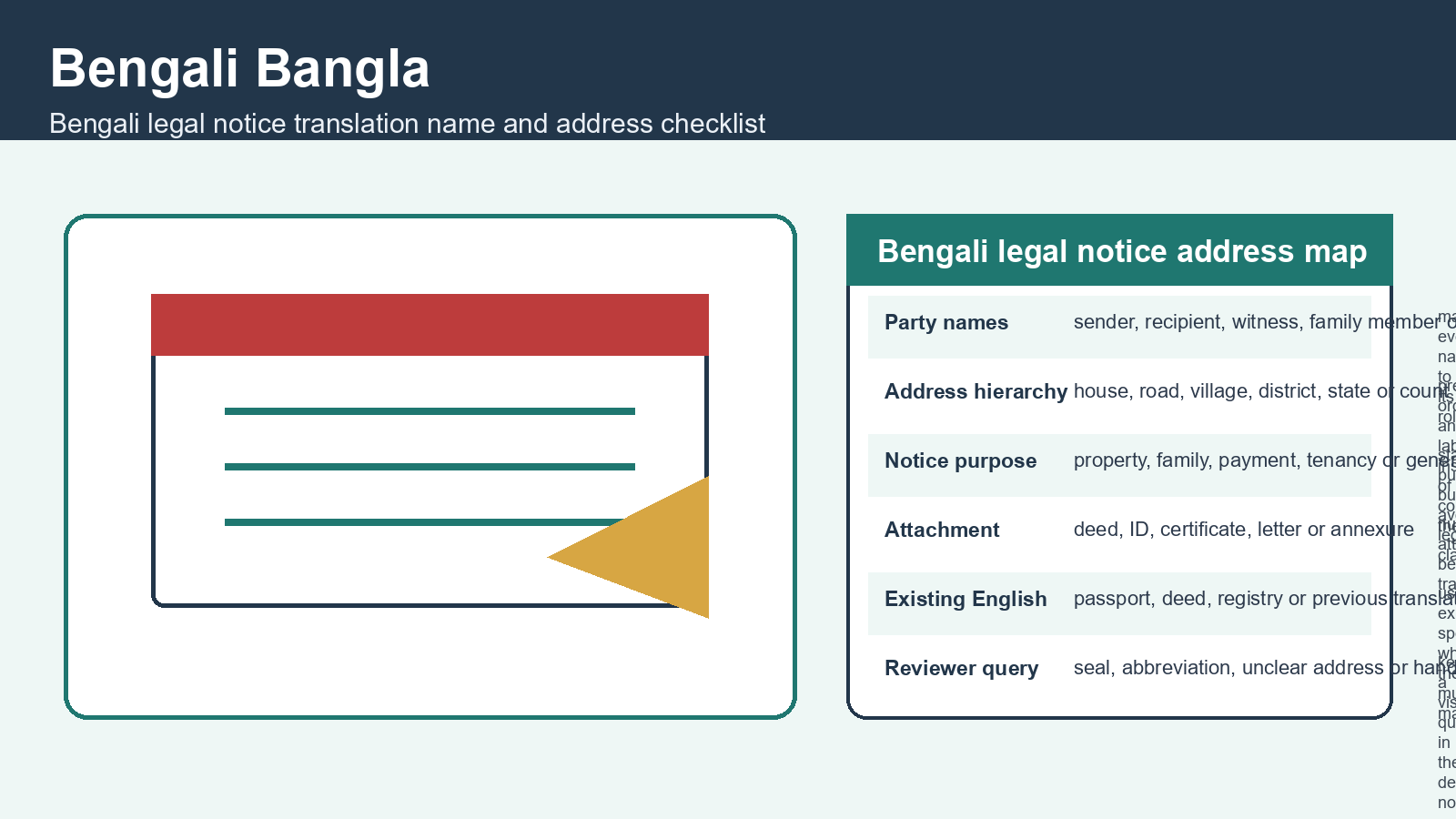
Use this guide when the real need is Bengali legal notice translation name and address checklist, not a broad search for Bengali Bangla translation services. The work starts by fixing the reader, file type, language route and review question before any wording is polished. For this topic, the useful output is a clean handoff around Bengali legal notice address map: it tells the translator what to preserve, what to question and what the final reader must be able to do.
The Narrow Job This Page Solves
The target reader is a law office, property advisor, family-record owner or dispute-document coordinator. That reader is trying to prepare Bengali or Bangla legal notices and civil records so names, addresses, role labels and attachments are clear in English. This page therefore avoids the old blanket topic and stays inside one decision: how to prepare a legal notices, address records, property attachments, affidavits, letters and civil certificates packet so the Bengali legal and civil-document translation workflow can begin with fewer hidden assumptions.
The central risk is specific: a notice can become misleading when address hierarchy, relationship terms, seals, enclosures and existing English names are not checked. A stronger page does not merely say that the language is available. It explains what the requester should send, what the reviewer should check and which uncertainty should remain visible until a qualified person resolves it.
What Changes Before Translation Starts
The first change is route control. For Bengali Bangla, the route is not only source language to English. It is Bengali script, India/Bangladesh wording awareness, name spellings, address hierarchy and attachment order. If those details are absent, the translator has to infer too much from the file. That is where name drift, register drift, layout drift and receiver mismatch usually enter the work.
The second change is asset-first writing. The article is built around Bengali legal notice address map, not around a sales paragraph. The table below is the reusable reader asset. It can be copied into an enquiry email, a project brief or an internal checklist before the file is sent for production.
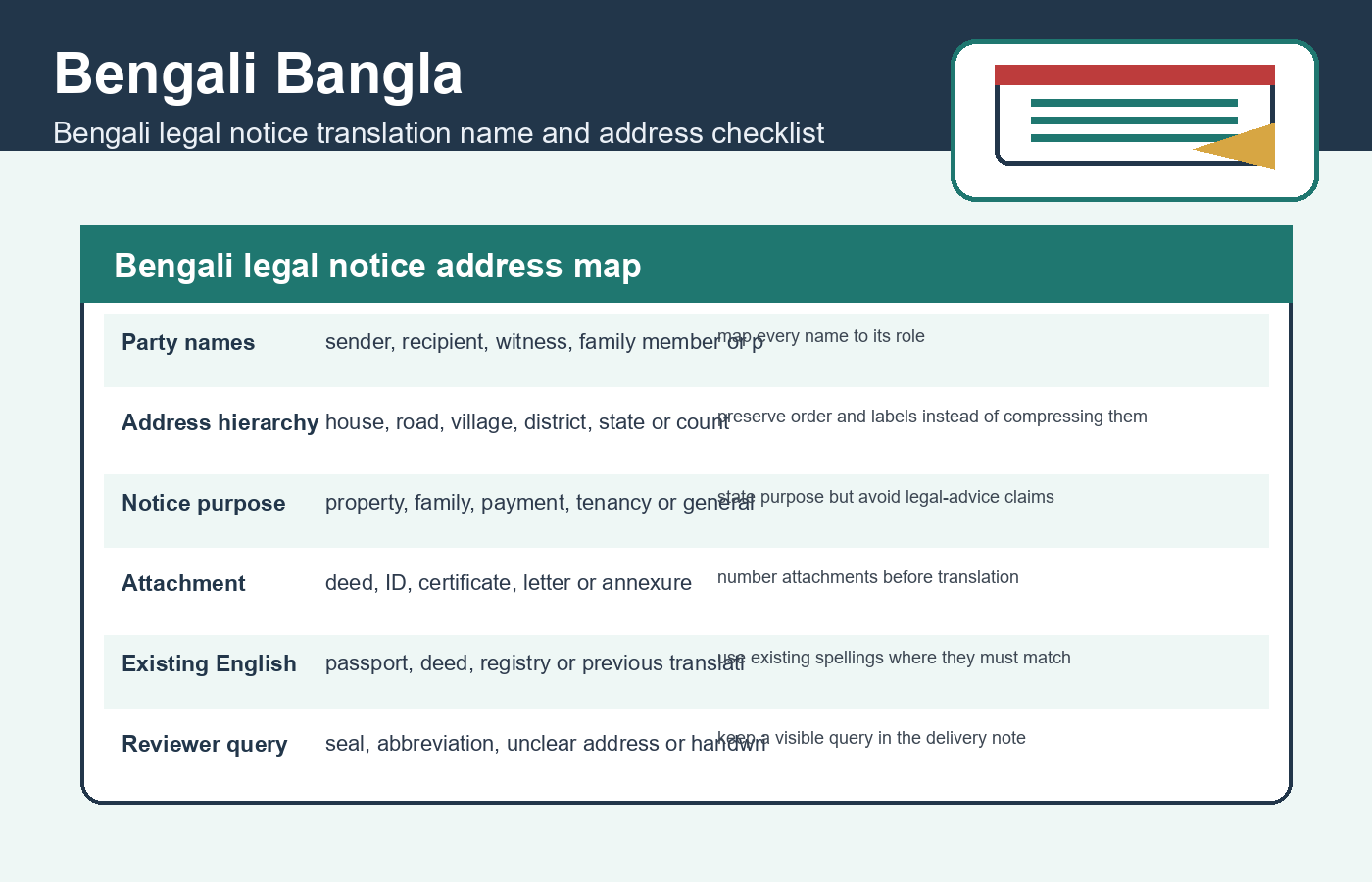
Bengali legal notice address map
| Decision point | What to check | How to prepare it |
|---|---|---|
| Party names | sender, recipient, witness, family member or property holder | map every name to its role |
| Address hierarchy | house, road, village, district, state or country | preserve order and labels instead of compressing them |
| Notice purpose | property, family, payment, tenancy or general record | state purpose but avoid legal-advice claims |
| Attachment | deed, ID, certificate, letter or annexure | number attachments before translation |
| Existing English | passport, deed, registry or previous translation | use existing spellings where they must match |
| Reviewer query | seal, abbreviation, unclear address or handwritten line | keep a visible query in the delivery note |
Topic-Specific Preparation Notes
Party names. In the Bengali legal notice translation name and address checklist workflow, sender, recipient, witness, family member or property holder is not a background detail. It changes who reviews the material, how the legal notices, address records, property attachments, affidavits, letters and civil certificates is grouped and what the English delivery should preserve. The practical preparation step is simple: map every name to its role. That one step reduces the chance that a notice can become misleading when address hierarchy, relationship terms, seals, enclosures and existing English names are not checked.
Address hierarchy. In the Bengali legal notice translation name and address checklist workflow, house, road, village, district, state or country is not a background detail. It changes who reviews the material, how the legal notices, address records, property attachments, affidavits, letters and civil certificates is grouped and what the English delivery should preserve. The practical preparation step is simple: preserve order and labels instead of compressing them. That one step reduces the chance that a notice can become misleading when address hierarchy, relationship terms, seals, enclosures and existing English names are not checked.
Notice purpose. In the Bengali legal notice translation name and address checklist workflow, property, family, payment, tenancy or general record is not a background detail. It changes who reviews the material, how the legal notices, address records, property attachments, affidavits, letters and civil certificates is grouped and what the English delivery should preserve. The practical preparation step is simple: state purpose but avoid legal-advice claims. That one step reduces the chance that a notice can become misleading when address hierarchy, relationship terms, seals, enclosures and existing English names are not checked.
Attachment. In the Bengali legal notice translation name and address checklist workflow, deed, ID, certificate, letter or annexure is not a background detail. It changes who reviews the material, how the legal notices, address records, property attachments, affidavits, letters and civil certificates is grouped and what the English delivery should preserve. The practical preparation step is simple: number attachments before translation. That one step reduces the chance that a notice can become misleading when address hierarchy, relationship terms, seals, enclosures and existing English names are not checked.
Existing English. In the Bengali legal notice translation name and address checklist workflow, passport, deed, registry or previous translation is not a background detail. It changes who reviews the material, how the legal notices, address records, property attachments, affidavits, letters and civil certificates is grouped and what the English delivery should preserve. The practical preparation step is simple: use existing spellings where they must match. That one step reduces the chance that a notice can become misleading when address hierarchy, relationship terms, seals, enclosures and existing English names are not checked.
Reviewer query. In the Bengali legal notice translation name and address checklist workflow, seal, abbreviation, unclear address or handwritten line is not a background detail. It changes who reviews the material, how the legal notices, address records, property attachments, affidavits, letters and civil certificates is grouped and what the English delivery should preserve. The practical preparation step is simple: keep a visible query in the delivery note. That one step reduces the chance that a notice can become misleading when address hierarchy, relationship terms, seals, enclosures and existing English names are not checked.
How To Brief This Work
- Open with the real keyword intent: Bengali legal notice translation name and address checklist. That keeps the work away from broad language-service copy and anchors it to a buyer task.
- Separate the source packet into legal notices, address records, property attachments, affidavits, letters and civil certificates. A single folder is acceptable, but the file names should reveal what each file is for.
- Lock the language route: Bengali script, India/Bangladesh wording awareness, name spellings, address hierarchy and attachment order. This is the point where script, register, audience and file condition are made visible.
- Build the original reader asset, the Bengali legal notice address map, before polishing the article. The asset is the practical value of the page.
- Send reviewer questions forward instead of hiding uncertainty. A careful query is better than a confident but unsupported claim.
Questions To Answer Before Sending Files
- Which names already appear in English on deeds, passports or older records?
- Does the notice need a literal translation, a reader summary or a bilingual comparison table?
- Are attachments part of the same legal packet or separate reference material?
Enuncia Workflow Notes
For this Bengali Bangla topic, Enuncia’s working intake rule is to separate the file condition, intended reader, source route and fixed spellings before production begins. That process note is not a marketing claim; it is the control that makes the article useful for the law office, property advisor, family-record owner or dispute-document coordinator who has to send files correctly.
The second workflow note is to preserve uncertainty. If the legal notices, address records, property attachments, affidavits, letters and civil certificates packet contains an unclear line, sensitive context, mixed script, damaged scan, medical wording, legal wording or regulatory label, the handoff should carry a visible reviewer question. Silent normalization is the wrong outcome for this page.
How This Supports The Main Language Hub
This article supports, but does not replace, the main Bengali Bangla language page. For broader service information, use the hub at https://enuncia.global/bengali-translation-services-in-india/. This article stays focused on Bengali legal notice translation name and address checklist, so it serves a separate reader job instead of competing with the canonical service page.
Source-Linked References
- Unicode 17.0 Character Code Charts (retrieved 2026-09-04): Unicode publishes official character code charts by script, so script handling should be checked at character level rather than treated as a visual style.
- W3C Internationalization: Languages using right-to-left scripts (retrieved 2026-09-04): W3C guidance treats script choice as audience and region dependent when a language can be written in more than one script.
- W3C Internationalization Activity (retrieved 2026-09-04): W3C internationalization resources cover multilingual, script, direction and locale considerations for web and content workflows.
Accuracy Boundaries
This content does not promise acceptance by any authority, does not claim legal or medical advice, does not invent Enuncia outcomes and does not use private client information. Where the topic touches official, medical, legal, regulatory or sensitive community use, the final wording must stay within the source record and reviewer approval.
The intended outcome is a legal-notice handoff that flags names, addresses, roles, attachment order and reviewer questions without promising legal validity. That is the difference between a real page and the earlier repeated post pattern: the reader leaves with a concrete handoff decision instead of a renamed version of the same checklist.