
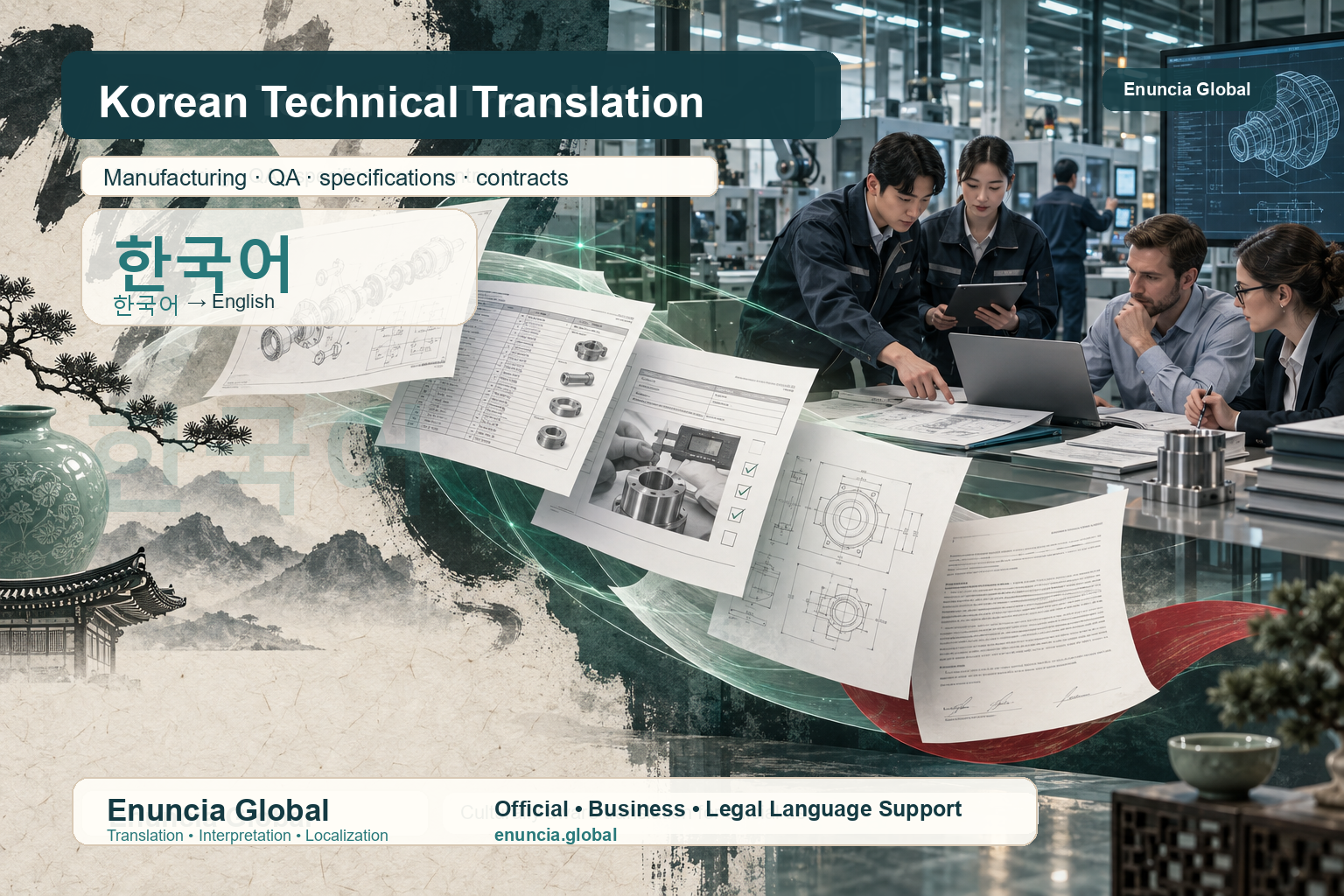
Korean technical translation requires the translator to identify the source country or authority, final reader, document type, formatting route and quality checks before the final file is prepared.
Korean to English technical translation is not only about converting Hangul into English. Manufacturing and business files carry part numbers, tolerances, test methods, safety warnings, supplier roles, drawings, contract clauses and quality records. If those elements are not controlled, the English version may read fluently while still being unsafe for procurement, engineering or management review.
Why Korean manufacturing files need technical alignment
Korea’s standards environment is highly structured. The Korean Agency for Technology and Standards describes its role in Korea’s national standards system and the Korean Industrial Standards framework. For translators, that does not mean every factory document is a formal KS standard. It means technical Korean often sits near a standards, certification, quality or conformity-assessment context, so casual paraphrase can create risk.
A Korean production manual may include process verbs, equipment labels and inspection stages that look repetitive. They should remain repetitive when repetition is part of the workflow. A procurement contract may repeat delivery, inspection and rejection wording because each clause controls a different risk. Removing that structure to make English sound smooth can damage the document.
Files that need Korean-English technical control
| File type | What to preserve | Reviewer to involve |
|---|---|---|
| Manufacturing SOP or work instruction | Step order, warning notes, tool names, torque, temperature, lot and batch references | Production or process engineer |
| Quality and inspection record | Acceptance criteria, sampling method, defect categories and measurement units | QA/QC lead |
| Technical specification | Part numbers, material grades, drawings, tolerances, tables and revision history | Engineering reviewer |
| Supplier or business contract | Delivery terms, penalties, warranty, jurisdiction, confidentiality and definitions | Commercial/legal reviewer |
Hangul, Romanisation and English product names
Korean documents often combine Hangul, English product names, model codes and abbreviated department labels. Do not romanise everything. Proper nouns, product codes and brand terms should follow approved company spelling. Korean-only process terms may need an English term plus a glossary entry. If two Korean terms appear similar but refer to different process stages, the English should keep that distinction.
Tables and drawings are part of the translation
Technical translation often fails in tables rather than paragraphs. Units must be copied correctly. Decimal marks, ranges, greater-than symbols, tolerances and footnotes must be checked after layout. A translated drawing note should be reviewed beside the drawing, not in isolation. When source files are editable, preserve table structure. When the source is scanned, create a clean table rather than burying values inside paragraphs.
Recommended delivery package
- Translated document with original headings and numbering preserved.
- Glossary for recurring Korean technical terms.
- Query log for unclear abbreviations, handwritten notes or missing drawing references.
- Table and unit check before final delivery.
- Separate comments where translation cannot safely resolve a technical ambiguity.
How Enuncia handles Korean technical terminology
For Korean technical translation, Enuncia first builds a working term list from the document itself. Repeated terms, part names, machine labels, inspection words, defect categories, departments and material descriptions are captured before the final English pass. This prevents one Korean term from appearing as three different English terms across a manual, contract and QA sheet. When the client has approved English product names or existing SOP language, those take priority over fresh wording.
The second step is layout-aware checking. Korean technical files often use compact tables, drawing notes, revision blocks and bullet sequences. If a table is translated as prose, the reviewer may lose the relationship between value, unit and condition. If a drawing note is separated from the drawing, a small label can be misunderstood. The final English should remain usable by the engineer, buyer, auditor or legal reviewer who will act on it.
Korean technical translation QA matrix
| Check area | What is reviewed | Why it matters |
|---|---|---|
| Numbers and units | Dimensions, tolerances, weights, temperatures, voltages, percentages and ranges | A single wrong symbol can affect manufacturing, acceptance or safety. |
| Revision references | Version history, drawing numbers, model numbers and date codes | Procurement and QA teams need to know which version is being discussed. |
| Warning language | Safety notes, prohibited actions, inspection cautions and handling instructions | Softening a warning can make the English operationally unsafe. |
| Contract alignment | Definitions, delivery obligations, inspection rights and warranty terms | Business teams need translation that preserves obligations, not just meaning. |
Manufacturing, supplier and contract use cases
A Korean supplier may send specifications, drawings, quotations, certificates of analysis, inspection reports and contract drafts as one package. Translating only the contract can leave the commercial team blind to the technical assumptions behind it. Translating only the manual can leave the production team without the warranty or acceptance language. A strong workflow identifies which files are operational, which are contractual, and which are reference-only.
Best source files for a clean Korean-English job
Editable files are ideal because they preserve tables and revision structure. If only scans are available, the scan should be straight, complete and high resolution. For drawings, include legends and referenced sheets. For contracts, include annexures. For QA files, include any acceptance criteria or standard reference mentioned elsewhere in the package. If abbreviations are internal to a factory or supplier, Enuncia flags them instead of inventing expansions.
Related resources
- Korean translation services
- Factory instruction translation workflow
- Get a Korean technical translation quote
Discuss your Korean technical file
Send the file type, drawings or tables, intended reviewer and deadline. Get Quote · Call +91 93150 56112 · WhatsApp +91 93150 56112 · Email info@enuncia.global
Sources: Korean Agency for Technology and Standards policy overview; KATS Korean Standards certification system; ISO member profile for KATS.
Get this file reviewed before translation
Send Enuncia Global the full file, destination country or authority, required language direction, spelling record for names and deadline. The team can then confirm the translation route before preparing a quote.
Get Quote Call +91 93150 56112 · WhatsApp +91 93150 56112 · info@enuncia.global