
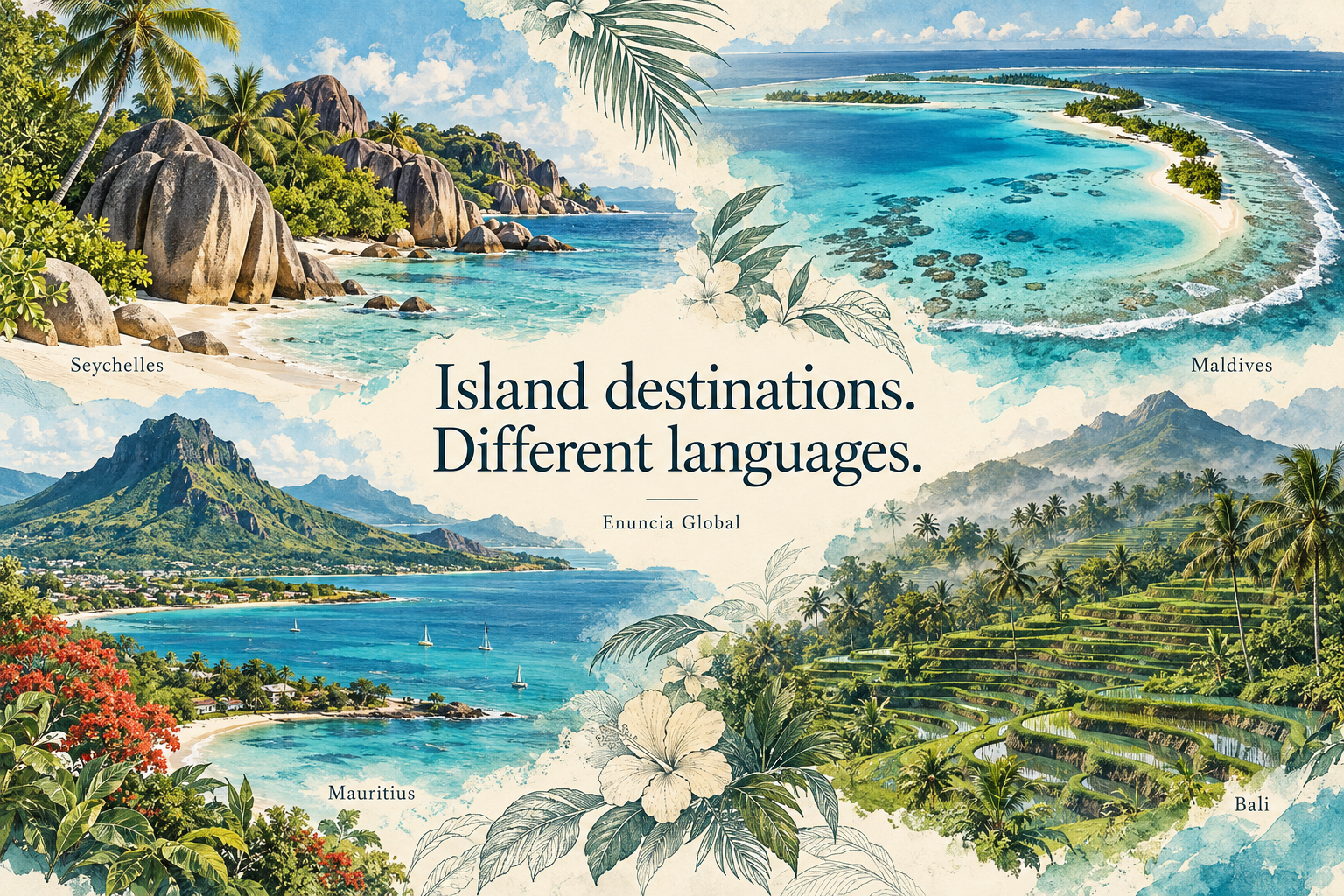
Seychelles, Maldives, Mauritius and Bali have very different language landscapes. Seychelles brings together Seychellois Creole, English and French; Maldives has Dhivehi; Mauritius is multilingual, with Mauritian Kreol, French, English and heritage languages; and Bali combines Balinese with the wider use of Bahasa Indonesia. Bali is an island and province of Indonesia, while the other three destinations are countries.
For a holiday conversation, knowing a commonly used language may be enough to begin. For a local campaign, recorded interview or document, you need a more precise answer: whose language, for which audience, and in what form?
Seychelles: Seychellois Creole, English and French
France Diplomatie’s Seychelles profile lists Seychellois Creole, English and French as official and commonly used languages. Seychellois Creole is also referred to as Kreol Seselwa. It should be specified by name when commissioning work rather than using the undifferentiated label “Creole”.
For a business or visitor-facing document, ask who will receive it and which language they expect. A French version, an English version and a Seychellois Creole version are separate language decisions; they are not three cosmetic styles of the same text. A local audience brief also helps avoid replacing the destination’s voice with generic tropical-tourism wording.
Maldives: Dhivehi and the Thaana writing system
Visit Maldives identifies Dhivehi as the language of the Maldivian people and describes its current writing system, Thaana. The language and script names answer different questions: Dhivehi is what you request as a language; Thaana identifies the writing system involved in written material.
When sending a scanned Dhivehi document, include a readable full-page image rather than a cropped extract. Explain whether you need a translation, a typed source-language copy or both. A person who can converse with a visitor in English may not be the right person to prepare or check a formal written translation. Choose the language professional around the actual task.
For a website or designed leaflet, review the finished layout as well as the wording. Treat names, numbers and any mixed-language text as items to inspect in the final output. A plain-text file cannot show every layout problem introduced when the translation is placed into a design.
Mauritius: a multilingual society, not one language choice
The Mauritius tourism ministry lists English, Creole, French and Indian languages in its overview. Its visitor information also names languages including Hindi, Bhojpuri, Urdu and Chinese. For a practical brief, distinguish Mauritian Kreol from French and English rather than assuming the same material will work for every audience.
The phrase “official language” is not a reliable shortcut for deciding which language belongs in a campaign, interview or customer guide. Identify the institution or audience and ask what is required. This is particularly useful where a spoken conversation, a school document and a business presentation are being prepared for different readers.
Mauritian Kreol and Seychellois Creole should not be treated as one interchangeable deliverable because both are described as Creoles. Name the destination and intended variety in the request, and arrange review by someone familiar with that audience. Do the same when heritage-language content is intended for a particular community.
Bali: Balinese and Bahasa Indonesia have different roles
Indonesia’s tourism portal identifies Bali as a province of Indonesia and names Balinese as its regional language. The portal separately describes the use of Bahasa Indonesia in Bali, including formal contexts. “Balinese” and “Indonesian” therefore should not be used as interchangeable language names.
A request for a “Bali translation” needs clarification. Is the text for a Balinese-speaking local audience, an Indonesian business counterpart or international visitors? Specify Balinese or Bahasa Indonesia as appropriate, and identify any additional language required. If somebody says only “Bahasa”, confirm that they mean Bahasa Indonesia.
Choose by audience and purpose
| Destination | Names to distinguish | Question for your brief |
|---|---|---|
| Seychelles | Seychellois Creole, English, French | Which language does this particular audience expect? |
| Maldives | Dhivehi; Thaana for written material | Do you need translation, transcription, typesetting or a combination? |
| Mauritius | Mauritian Kreol, French, English and relevant heritage languages | Which community or institution is the material for? |
| Bali | Balinese and Bahasa Indonesia | Is the intended audience local, Indonesian-speaking or international? |
A multi-destination project needs separate language decisions
Imagine a travel business creating a welcome guide for all four destinations. Keep the shared information in one controlled source, but make a separate audience and language decision for each destination. A translated greeting does not establish that the rest of the guide uses the right language, terminology or contact instructions.
Give each version a clear destination label, source revision and reviewer. Check place names against the material supplied by the local partner. Keep service details, emergency contacts and any requirements tied to their actual source rather than copying them across destinations. For official documents, obtain the recipient’s instructions instead of relying on languages commonly used in tourism.
When enquiring about language support, provide the destination, audience, sample file, requested output and deadline. That makes it possible to assess the language and the work involved without assuming that all island destinations share one communication model.
Discuss your language requirements
Send the language or locality, intended audience, a sample where available, and your deadline so the scope and availability can be assessed.
Get Quote · Call +91 93150 56112 · WhatsApp +91 93150 56112 · Email info@enuncia.global
Related Island and Tourism Language Resources
Use these pages when island-market language planning connects with travel, document, tourism, website or localization work.
- French translation services in India – for French-linked island and business contexts
- Indonesian translation services in India – for Bali and Indonesia-related content
- Get an island-language translation quote – share destination, audience and file type
Before You Request Island-Destination Language Support
Share the destination, audience, exact language, file type and whether the content is for tourism, documents, websites, subtitles or customer support.