
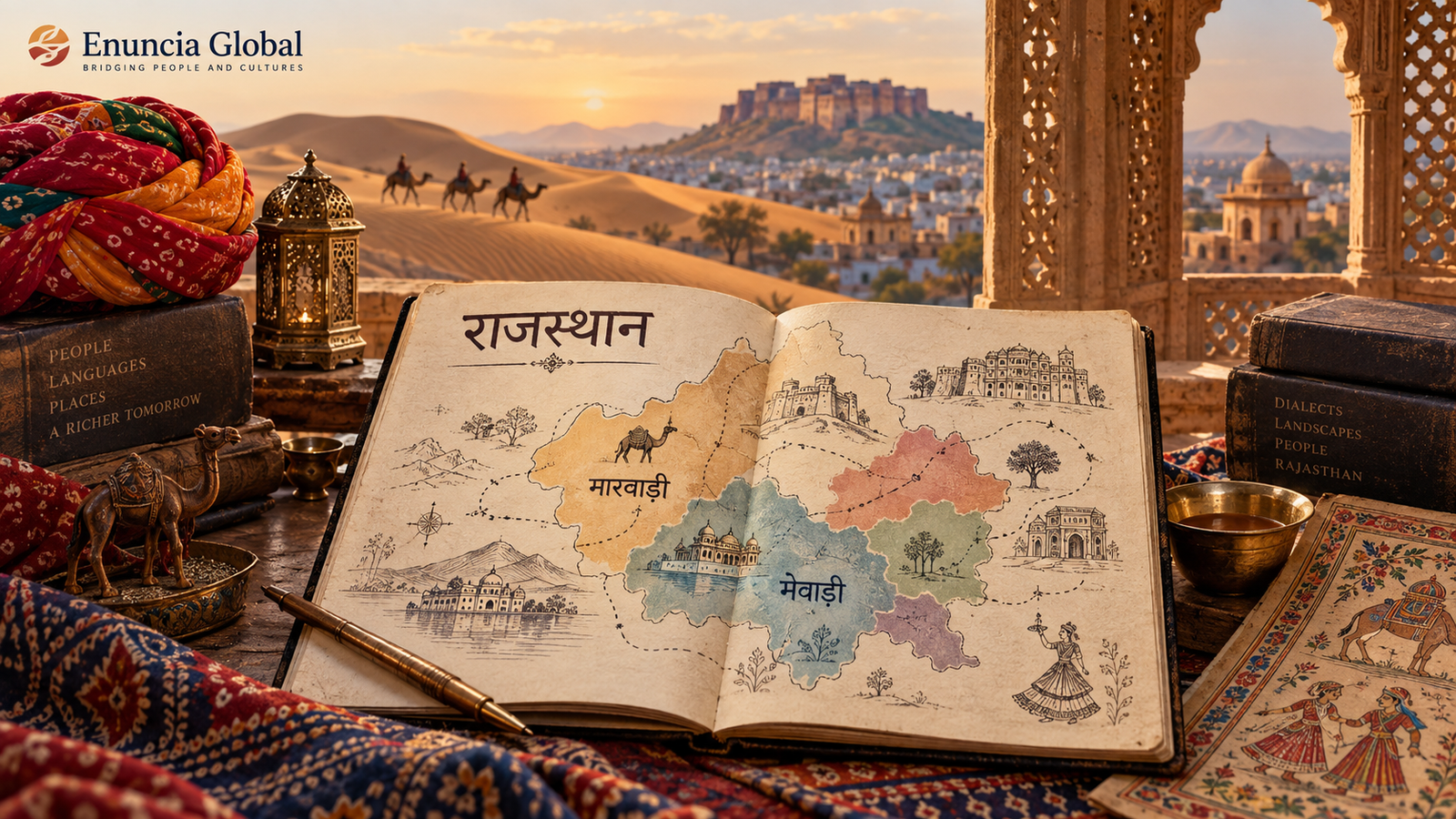
Rajasthan is often introduced through Hindi and Rajasthani, but the spoken reality is much richer. A document, oral recording, folk text, family history, tourism script or court statement from Rajasthan may carry Marwari, Mewari, Dhundhari, Shekhawati, Harauti, Bagri, Mewati, Wagdi or another regional variety. For translation work, the right question is not simply “Is this Hindi?” The better question is: which part of Rajasthan produced the text, which speech variety is visible, and what will the final reader need to understand?
Rajasthan is a language cluster, not a single neat box
The Census of India language tables for Rajasthan and the Linguistic Survey of India material show why the state cannot be reduced to one label. Returned mother tongues and grouped language names vary by census method, self-reporting and classification. Public Rajasthan information sources also describe Rajasthani as having different dialects such as Marwari, Mewari, Dhundhari and Vagadi. That makes Rajasthan a strong example of a state where identity, administration and linguistics do not always use the same boundary.
In everyday work, a client may say the source is Hindi because it is written in Devanagari. Another client may call the same family letter Marwari. A folk-song archive may use “Rajasthani” for convenience, while the performer identifies the speech as Mewari or Shekhawati. A legal file may mix standard Hindi, local place names and regional vocabulary. The translator must preserve the source identity without forcing an artificial label.
Major Rajasthan language varieties and where they appear
| Variety | Common regional association | Translation notes |
|---|---|---|
| Marwari | Western Rajasthan, especially Jodhpur, Barmer, Jaisalmer, Nagaur and surrounding areas | Often used broadly outside Rajasthan to mean Rajasthani speech. Confirm if the file is truly Marwari or another western variety. |
| Mewari | Udaipur, Chittorgarh, Rajsamand and Mewar region | Family records, cultural texts and oral histories may carry local vocabulary that should not be flattened into standard Hindi. |
| Dhundhari / Jaipuri | Jaipur and eastern Rajasthan belt | May appear in local communication, folk content and older records. Urban documents may mix Hindi and local speech. |
| Shekhawati | Sikar, Jhunjhunu and Churu region | Often relevant in business-family records, migration stories and community material. |
| Harauti / Hadauti | Kota, Bundi, Jhalawar and Baran belt | Useful to distinguish in regional audio, witness statements and folk narratives. |
| Bagri | Northern and north-western belt near Haryana and Punjab | Border influence can affect vocabulary and identity labels. Do not assume every Bagri-looking text belongs in the same translation route. |
| Mewati | Alwar, Bharatpur and adjoining Mewat areas | Can be relevant in community records and speech-based work where Hindi, Rajasthani and neighbouring varieties overlap. |
| Wagdi / Vagadi | Vagad region around Dungarpur and Banswara | Often discussed near Bhili/Bhilodi classification in census and survey contexts; requires care in tribal and regional material. |
Why this matters for translation, transcription and interpretation
Rajasthan language work can fail when the service provider treats every Devanagari document as standard Hindi. That is sometimes acceptable for a modern government form, but it can be wrong for oral material, handwritten letters, community certificates, land references, caste/community documents, cultural scripts, tourism interpretation, folk-performance subtitles or research interviews.
The practical risk is not only a wrong word. A place name may be read as a person’s name. A kinship term may be translated too loosely. A proverb may be treated as literal evidence. A regional term in a witness statement may lose its force when converted into polished Delhi Hindi or generic English. For official work, preserve names, numbers, seals, dates and authorities. For cultural work, preserve voice, context and speaker identity.
Rajasthan language identification table for clients
| If your file looks like this | Likely route | What to send |
|---|---|---|
| Modern certificate, form or court paper in standard Devanagari | Hindi to English with Rajasthan office-name checks | Full scan, reverse side, issuing office, purpose of use and spelling references. |
| Handwritten family letter, diary, folk song or oral-history note | Regional Rajasthani identification before translation | Region, speaker/community background if known, clear image/audio and intended audience. |
| Audio from a village interview or witness conversation | Transcription plus translation with region review | Audio, date/place, speaker list, glossary if available and whether timestamps are needed. |
| Tourism, museum or cultural script | Meaning-led translation with cultural explanation | Audience profile, tone, names to preserve and whether subtitles/voiceover are required. |
Checklist before sending a Rajasthan language file
- Tell the translator the district or region if you know it.
- Do not crop seals, handwritten margins, page numbers or reverse-side notes.
- For audio, share speaker names or roles where safe and relevant.
- Say whether the final output is for court, embassy, family use, research, publication, tourism or business.
- Share any preferred spelling for place names, caste/community names and family names.
- If the material is cultural or oral, ask for notes on uncertain regional expressions instead of silent guessing.
Related Enuncia resources
- Rajasthani translation services in India
- Marwadi translation services in India
- Hindi translation services in Delhi
Need help with translation or document preparation?
Send the document, destination authority, language direction and deadline. Enuncia Global can review the route before quoting.
Get Quote Call +91 93150 56112 · WhatsApp +91 93150 56112 · info@enuncia.global
FAQs
Is Rajasthani the same as Marwari?
No. Marwari is one major variety associated with western Rajasthan, while Rajasthani is often used as a broader cluster label for several regional varieties.
Can Rajasthan documents be translated as Hindi?
Many official records are written in standard Hindi and can follow a Hindi-English workflow. Oral, cultural and handwritten material may require regional identification first.
Which Rajasthan language is most common for translation requests?
Marwari is very common in client descriptions, but Mewari, Dhundhari, Shekhawati, Harauti, Bagri, Mewati and Wagdi also appear depending on region and document type.
2 Responses