
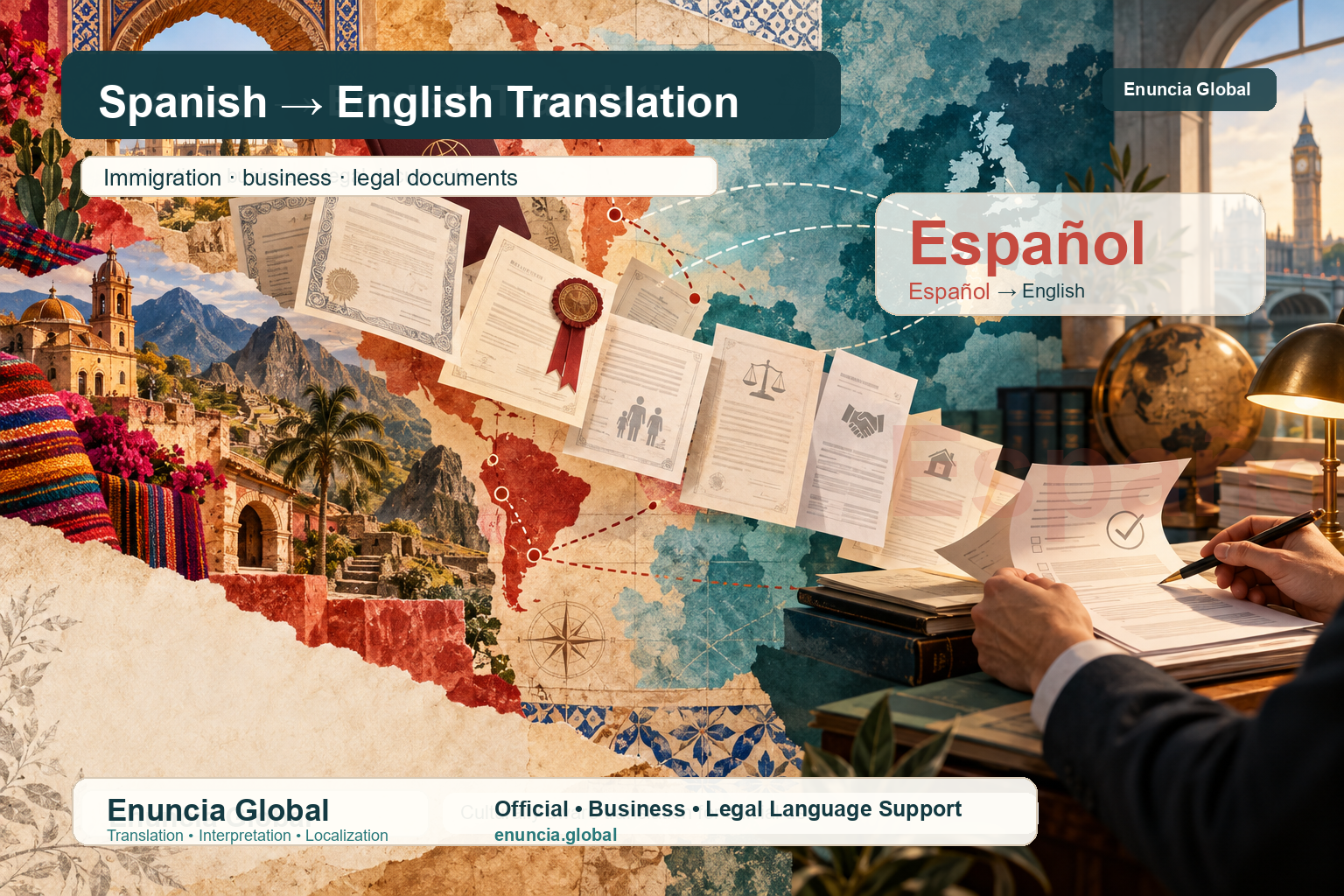
Spanish to English translation requires the translator to identify the source country or authority, final reader, document type, formatting route and quality checks before the final file is prepared.
Spanish to English translation is often treated as a single language pair, but the files that arrive for translation rarely behave that simply. A Colombian birth certificate, a Spanish company extract, a Mexican tax document, a Peruvian academic record and a Spain-facing legal translation can all require different terminology decisions. The translator must know which country issued the document, who will read the English version, and whether the file is for immigration, business, court, education or internal review.
Why Spanish document translation needs country context
Spanish has a wide international footprint. Instituto Cervantes’ 2025 reporting places Spanish among the world’s major languages, with large native-speaker and learner populations. For translation work, that reach matters because document terminology changes by country. Civil registry labels, tax authority names, notarial formulas and company-document wording should not be flattened into generic English.
Spain also has a regulated sworn-translation environment. The Spanish Ministry of Foreign Affairs notes that sworn translations by translators certified by the Ministry are valid in Spain without further legalisation by the Ministry’s Legalisation Service. That is a Spain-specific point; it should not be converted into a global claim for every Spanish-speaking country.
Where Spanish to English translation is usually needed
| Use case | Typical source files | What must be controlled |
|---|---|---|
| Immigration and visa files | Birth, marriage, police, academic, employment and bank documents | Names, dates, place names, issuing authority and supporting-file consistency. |
| Business review | Contracts, powers of attorney, invoices, tax records, company extracts | Parties, registration numbers, legal capacity, clauses, payment terms and jurisdiction references. |
| Legal and court material | Judgments, decrees, pleadings, notices, evidence, notarial records | Do not summarise operative wording; preserve paragraph sequence and exhibit references. |
| Academic and professional files | Degrees, transcripts, certificates, training records | Institution names, grading notes, award title and programme names. |
Spain Spanish and Latin American Spanish are not interchangeable in official files
For general reading, many Spanish documents are mutually understandable. For official translation, small differences matter. A term used for a civil-status office in Spain may not be the correct term for a Latin American registry. A tax form from Mexico may use labels that should not be forced into Spain’s administrative vocabulary. Good Spanish-English translation records the issuing country and uses English terms that explain the source, not English terms that pretend every system is the same.
Legalisation, apostille and translation order
Spain’s foreign ministry explains that Spanish public documents for non-Hague states may require legalisation, while Hague Convention use points toward apostille. It also notes that foreign language documents cannot be legalised unless an official translation is attached in that context. This is a reminder to check the receiving authority before translating. The right order may be original document first, apostille first, translation first, or a translation attached to a legalised document depending on the destination.
What to send for a reliable quote
- The full scan, not cropped photos.
- The issuing country and receiving country.
- The receiving authority’s instruction, if available.
- Passport spelling for names.
- Whether you need certified translation, notarisation, apostille support, or a plain business translation.
How Enuncia separates Spanish legal, civil and business language
Spanish documents often look familiar because many forms share civil-registry and notarial patterns. The risk is assuming that similar-looking terms perform the same function in every country. Enuncia separates the file into issuer, jurisdiction, document type and receiving purpose before drafting the English. A Spain-issued document may require attention to sworn-translation expectations. A Latin American civil record may need careful handling of registry names, marginal notes, folio references and local authority labels.
For business files, the priority changes. A contract, invoice, tax return or company record must preserve the commercial relationship and the legal capacity of each party. Translation should keep clause numbers, payment terms, governing-law references, signatures, annexures and registration identifiers aligned with the source.
Spanish-English terminology control table
| Spanish document element | Translation risk | Practical control |
|---|---|---|
| Civil registry headings | Generic English can hide whether the source is a birth, marriage, death or status record. | Translate the function of the record and preserve office names when they identify the issuing authority. |
| Notarial wording | Over-simplifying can remove capacity, appearance, certification or witnessing language. | Keep the sequence of declarations, notarial capacity and certification language. |
| Tax and company numbers | Wrong expansion of abbreviations may mislead a bank, employer or legal reviewer. | Keep original abbreviations where necessary and explain only when the source supports it. |
| Academic records | Grade labels and course names can be distorted by forced equivalence. | Translate the record faithfully and avoid converting marks unless the receiving body asks for it. |
What makes a Spanish-English translation useful for Indian users
Indian applicants often use Spanish documents for work visas, immigration, university admissions, marriage registration, company compliance or court support. The English translation should help the Indian or foreign authority read the file quickly. That means clear headings, consistent spelling, complete stamps and seals, and no unsupported claim that the translation itself changes the legal status of the source document.
Common Spanish source countries and file patterns
Spain, Mexico, Colombia, Peru, Argentina, Chile and other Spanish-speaking jurisdictions use their own administrative vocabulary. Even when the final target is English, the translator should note whether the source is European Spanish or Latin American Spanish and whether it comes from a civil registry, notary, court, company, university, employer or tax authority. That context improves terminology and reduces unnecessary queries during submission.
Related resources
Discuss your Spanish document
Send the file, issuing country, receiving authority and deadline. Get Quote · Call +91 93150 56112 · WhatsApp +91 93150 56112 · Email info@enuncia.global
Sources: Instituto Cervantes 2025 Spanish report; Spain Ministry of Foreign Affairs legalisation/apostille guidance; European e-Justice legal translators/interpreters Spain.
Get this file reviewed before translation
Send Enuncia Global the full file, destination country or authority, required language direction, spelling record for names and deadline. The team can then confirm the translation route before preparing a quote.
Get Quote Call +91 93150 56112 · WhatsApp +91 93150 56112 · info@enuncia.global