
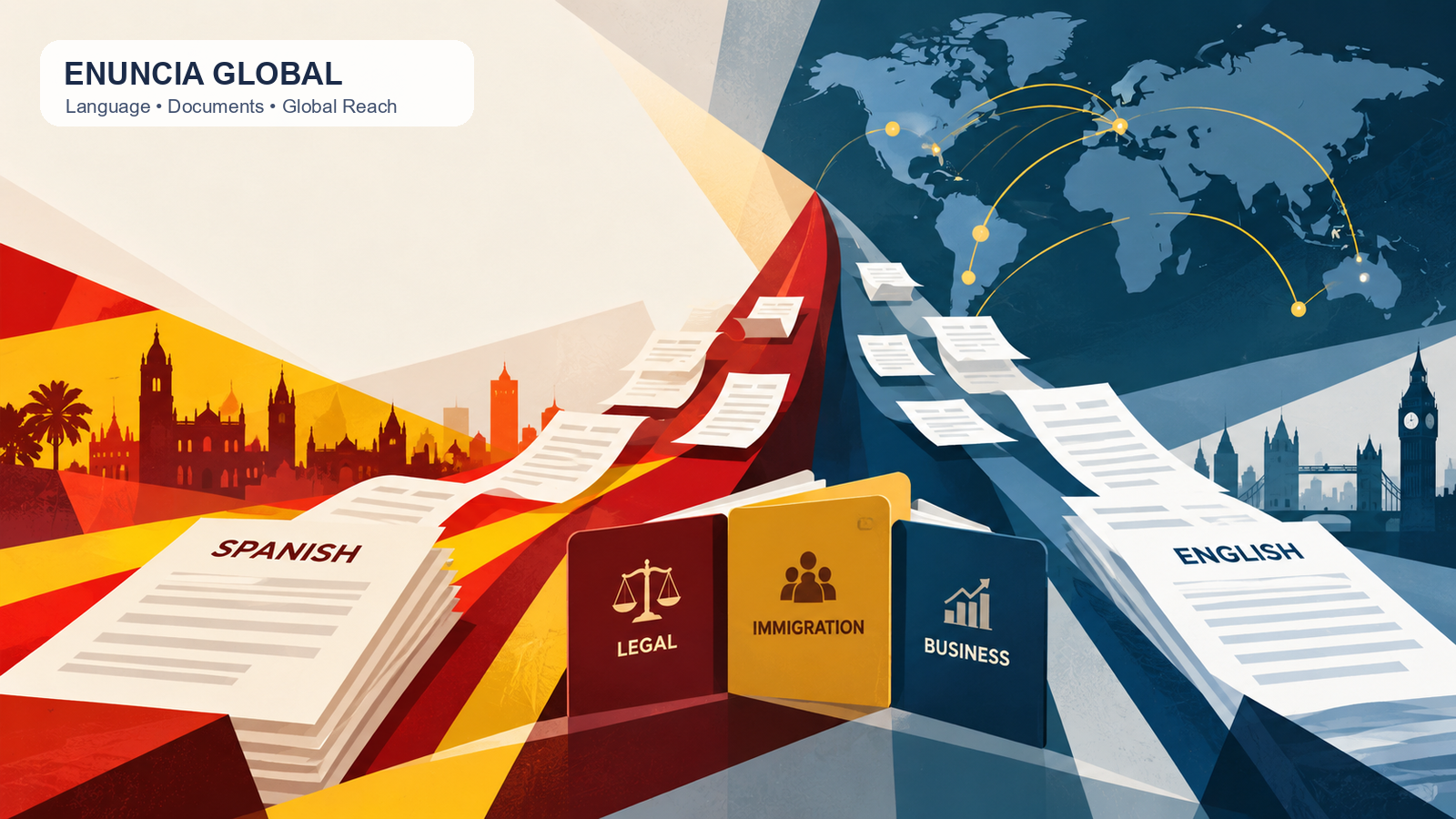
Spanish Translation Services for Legal, Business and Immigration Documents
Spanish translation has become a practical requirement for Indian companies, students, families, lawyers and professionals dealing with Spain, Latin America, the United States and international institutions. The phrase “Spanish translation services” covers many different jobs: a visa file for Spain, a company agreement from Mexico, a university transcript for Argentina, medical records for a hospital abroad, a police certificate for immigration, or a product document for a Spanish-speaking market. Enuncia Global prepares Spanish to English and English to Spanish translation with document discipline, terminology control and a clear understanding of the purpose behind the file.
Spanish is not a single-market language. A document from Spain may use different administrative expressions from a document issued in Mexico, Colombia, Chile, Peru or Argentina. A legal word may have a close English equivalent but a different procedural meaning. A business document may include tax identifiers, corporate forms, signatures, notarized statements or jurisdiction-specific terminology. This is why certified Spanish document translation should be planned around the receiving authority and the country context.
Country context and Spanish variants
Spanish translation must account for the country where the document was issued and the country where it will be used. A civil registry certificate from Spain, a notarial document from Mexico, an academic record from Colombia and a corporate paper from Chile may all be written in Spanish, but their institutional vocabulary can differ. Even where the translation is into English, the translator should preserve the identity of the issuing authority instead of forcing it into a generic English term. For English to Spanish work, neutral formal Spanish is often safest unless the receiver has requested a specific country variety.
Spanish to English translation
Spanish to English translation is commonly required for immigration, education, court, employment, banking, business due diligence and family documentation. Clients often bring birth certificates, marriage certificates, divorce papers, apostilled documents, police certificates, powers of attorney, corporate registrations, contracts, medical files, tax papers and salary documents. A reliable translation keeps names, dates, places, stamp references, notary remarks and registration numbers visible to the reviewer.
For legal and immigration files, the translator must avoid over-smoothing the source. If the original says a document was issued by a civil registry, municipality, notary, court or police authority, the English version should retain that identity. If there is a seal or handwritten remark, it should be represented carefully. If an abbreviation is unclear, the translation should not invent an expansion without evidence.
English to Spanish translation
English to Spanish translation is often requested by exporters, education consultants, legal teams, HR departments and families submitting documents to Spanish-speaking offices. The work may include business profiles, contracts, product documents, affidavits, public notices, academic letters, employment records, training material or website content. For official use, the translation should use formal register, consistent terminology and a certificate when required.
The target variety matters. Spanish for Spain may differ from Spanish for Latin America in vocabulary, official style and business tone. A document for a consulate, court, university or employer should sound neutral, precise and administratively readable.
Legal, business and immigration workflows
For immigration, the receiving officer usually wants identity, family relationship, education, employment, travel history and police status to be easy to verify. For business, the reviewer may focus on the company name, registration, tax identifiers, signatory authority, contract obligations and financial terms. For legal use, the translated document must make it easy to compare the source and target line by line. A Spanish translator who understands these workflows can prevent avoidable rework, especially when the same document package moves between a lawyer, client, embassy and overseas authority.
What makes Spanish translation rank-worthy and submission-ready
A strong Spanish translation service page must help the reader decide what to send, what risks to check and what service type to request. The client should share the country of issue, receiving authority, purpose, deadline, certification requirement and any instructions from the embassy, court, university or company. The translation team should review whether the scan is complete, whether apostille or notarization has to be translated, and whether names match IDs.
Before confirming the final file, clients should check spelling against passports, whether the apostille page is included, whether seals and marginal notes are represented, whether page numbers are complete and whether the certification page follows the receiver’s instruction. This is especially important for Spanish immigration translation, Spanish legal translation and Spanish business translation where the same translated file may be reused across more than one stage.
Enuncia Global supports certified Spanish translation, Spanish legal translation, Spanish business translation, Spanish immigration document translation and English to Spanish translation for India-based and international submissions.
Request a quote
Send your Spanish or English documents by WhatsApp/call at +91 9958625455 or email info@enunciaglobal.com. Share the destination country and receiving authority so the quote can be aligned to the actual submission.
Frequently Asked Questions
Do I need certified translation for every document? Only when the receiving authority asks for it or when the document has legal, immigration, academic, employment or business value.
Can Enuncia Global handle urgent files? Urgency depends on language, length, legibility and certification requirements. Share the scan and deadline before confirming.
What should I send for a quote? Send the document, source language, target language, country of use, receiving authority and deadline.