
Urdu Family Affidavit Translation: Reading Order, Names and Seal-Reference Checklist
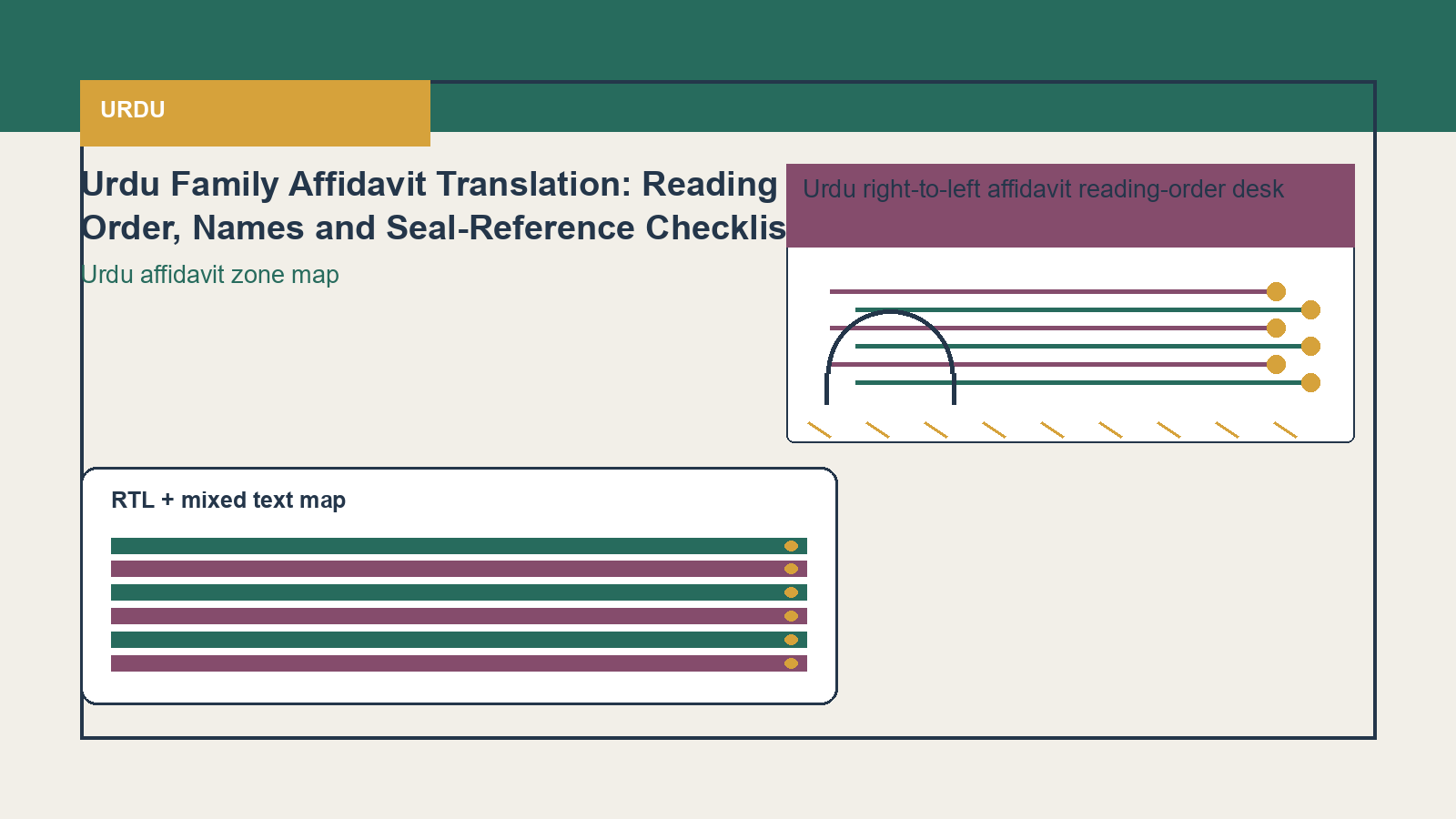
For Urdu family court affidavit translation, begin with reading order, name spelling and seal reference; those fields decide whether the Urdu source can produce a zone map that keeps the source order, seal references, name spellings and translator questions separate.
The reader should leave knowing what to send, what to label, what to hold as a query, and where Urdu RTL layout, mixed English fragments, seal locations and family-name spellings changes the review path.
Affidavits Depend On Reading Order
A family lawyer usually arrives with a file already in hand. They need a preparation path for lawyer, records reviewer or personal documentation user, plus evidence that the Urdu work is being scoped to the actual file.
Keep the evidence sequence intact: reading order, mixed English block and attachment label should not be separated from the source file order. When the file packet leaves a field uncertain, show that uncertainty beside the translated line.
Read, Transliterate Or Query
| Packet case | File evidence | Next evidence route |
|---|---|---|
| Evidence-ready packet | reading order appears in the file sequence and name spelling is tied to the right clause or annexure | Format a zone map that keeps the source order, seal references, name spellings and translator questions separate with clause order, attachments and queries still visible |
| File-order mismatch | reading order conflicts with seal reference in the clause, seal or attachment order | Hold the translated field, collect the file-order proof and keep the evidence note visible |
| Seal or clause risk | mixed English block affects clause context, seal reading, attachment sequence or line-item evidence | Check seals, clauses, attachments and source order before the review packet is formatted |
| Legal reviewer needed | unreadable note still lacks clause, attachment or reviewer support | Return the open evidence point to the legal reviewer before packet formatting |
That is the practical boundary: translate the readable source, preserve the fixed field, and ask before inventing missing context.
Urdu Affidavit Zone Map
For family lawyer and documentation coordinator, the Urdu affidavit zone map is the fastest way to avoid a clean-looking but weak translation packet.
| Urdu control | Clause, seal or attachment evidence | Evidence-packet decision |
|---|---|---|
| Reading Order | Clause, seal, line item or attachment page that carries Reading Order. | Keep this field beside the clause, seal, attachment or line item that supports it. |
| Name Spelling | Name Spelling in the evidence packet, checked against clause, seal, party or attachment context. | Keep the name beside party, clause or seal evidence during review. |
| Seal Reference | Clause, seal, line item or attachment page that carries Seal Reference. | Keep this field beside the clause, seal, attachment or line item that supports it. |
| Mixed English Block | Clause, seal, line item or attachment page that carries Mixed English Block. | Keep this field beside the clause, seal, attachment or line item that supports it. |
| Attachment Label | Attachment number, image or exhibit reference, and the exact field it supports. | Number attachments so no evidence is separated from the translated note. |
| Unreadable Note | Evidence query for lawyer, records reviewer or personal documentation user before packet formatting. | Keep this field beside the clause, seal, attachment or line item that supports it. |
A weak evidence trail keeps the translated line marked for review.
Where Urdu RTL Evidence Can Be Reordered
The evidence risk starts when file order is not visible: right-to-left layout, mixed English text and handwritten notes can change how a family affidavit is understood. The practical failure is a neat English file that breaks the evidence chain between the main text, attachment, seal, clause, line item or identity proof.
The control point is seal reference. When that field is weak, the page should slow the handoff down and make the uncertainty visible.
That makes the article an evidence-order page, where translation follows the file sequence instead of smoothing it away.
Urdu Affidavit Reading Order
The Urdu affidavit page is centered on right-to-left reading order, names, seals and attachment references. The main risk is not style; it is breaking the evidence sequence.
A useful page shows how the source should be read before the English version is polished, especially when handwritten notes or mixed-direction fields appear.
| Evidence choice | File proof to inspect | Risk it prevents |
|---|---|---|
| Reading order | mark RTL sequence and mixed English insertions | keep source logic intact |
| Name field | compare Urdu spelling with ID evidence | show transliteration uncertainty |
| Seal reference | tie stamp or signature to page and clause | avoid detached authority-looking language |
Preserve Names, Seals And Attachments
- Order the file packet: Arrange the clause, seal, annexure or line-item pages around reading order.
- Lock evidence fields: Check name spelling against the file sequence before the translated field is locked.
- Mark the conflict: Keep seal reference beside the clause or attachment that created the conflict.
- Check seals and attachments: Review mixed English block in the Urdu right-to-left source with English review output document order.
- Choose the evidence route: Use attachment label to choose translation, clause review, attachment sequencing or evidence-note review.
- Assign legal questions: Route unreadable note to the requester or legal reviewer before the packet reaches lawyer, records reviewer or personal documentation user.
The packet can then keep clause, seal, line item, identity or attachment evidence in the same order as the source.
Example: Urdu Affidavit Sequence Map In Use
A family lawyer receives the main file, a supporting attachment and one clause or identity field that does not line up. The useful move is to record reading order, compare name spelling, and leave unreadable note as a visible query instead of forcing a neat answer.
For evidence review, keep the file order visible: Record reading order, attach proof for name spelling, and keep unreadable note visible. After the evidence order is clear, the translated packet can move into review.
Family Court File Packet
- Evidence file sequence: affidavit, declaration, identity page, attachment, seal note and handwritten addendum.
- Clause, name or attachment proof for reading order and name spelling.
- File-order note connected to seal reference.
- Review destination: lawyer, records reviewer or personal documentation user.
- Legal packet questions for attachment label and unreadable note.
Keep this handoff evidence-first. If the unreadable note is open, attach the question to the clause or file page; if the attachment label changes review purpose, identify that purpose before formatting.
Evidence Boundaries For The Review Packet
- Unicode Character Code Charts: Script-specific character charts support script-aware translation and layout checks. Use this source for script and character handling in Urdu right-to-left source with English review output. It does not decide how a receiving office will treat affidavit, declaration, identity page, attachment, seal note and handwritten addendum.
- W3C Authoring HTML: Handling Right-to-left Scripts: Supports right-to-left and mixed-direction layout checks for Urdu, Arabic, Persian and Hebrew tasks. Use this source for right-to-left and mixed-direction handling in Urdu right-to-left source with English review output. It does not authorize legal, marketplace or authority claims.
- Library of Congress ALA-LC Romanization Tables: Supports cautious name and title romanization references for non-Roman-script records. Use this as a romanization reference point for names or titles; it does not decide the spelling a customer or authority must accept.
The references below support the practical checks in this guide: file sequence, names, seals, clauses, line items and readable source proof. They help frame the translation workflow without turning general guidance into acceptance, pricing, turnaround or outcome promises.
Legal wording should stay tied to source evidence, with acceptance questions handled by the receiver. Label the packet as Family Court File Packet so names, seals, attachments and unreadable points remain easy to review.