
Why Subtitles Need Timing, Reading Speed and Context Checks
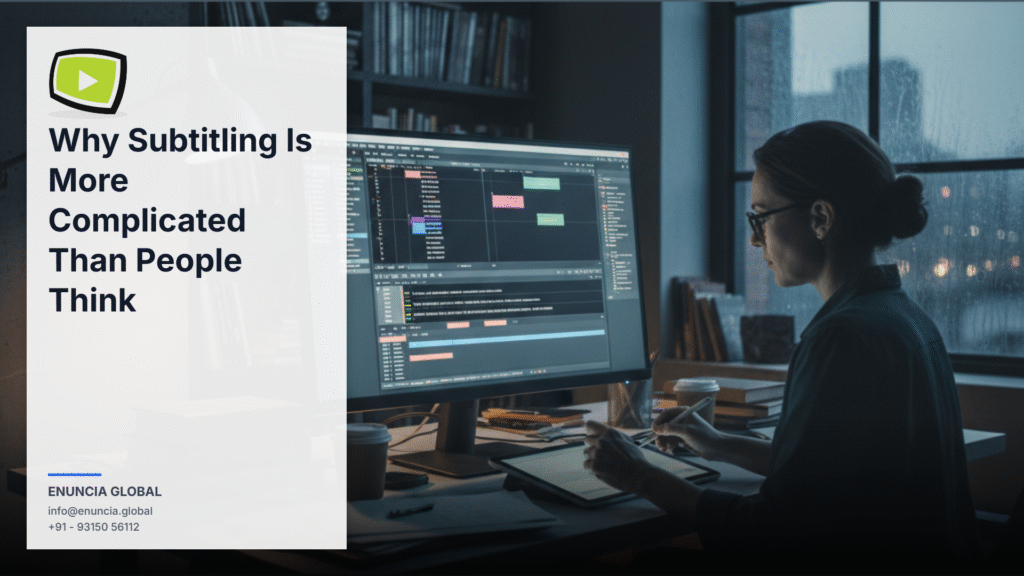
Subtitling looks simple until the first difficult video arrives. A viewer has to read, listen and watch at the same time, which means the subtitle cannot behave like a normal transcript.
This article explains why expert review matters for timing, line breaks, translation choices, speaker changes, sound cues and platform-ready subtitle files.
How To Use This Guide
Use this guide to decide which translation route fits your file, what information to share first and which details need careful checking before Enuncia Global confirms scope, timeline and delivery format.
It is most useful when you already know the document, language pair, destination country or final reader and want a clear next step.
Context Enuncia Confirms First
A transcript can use full sentences. A subtitle may need shorter wording, cleaner breaks and carefully timed entry and exit points. If the line stays too long, the viewer misses the image. If it disappears too fast, the meaning is lost.
When subtitles are translated, the challenge grows. Idioms, product terms, legal disclaimers, training steps and humor may need adaptation while still fitting the timecode.
Where This Route Is Used
Why Subtitling Services Need Expert Review commonly appears in training video, brand film, interview clip, webinar recording, course module and social reel, documentary segment, product demo, conference talk, accessibility caption file.
The correct route changes when the final reader is an authority, lawyer, editor, viewer, platform, university, hospital, company reviewer or website visitor.
subtitling education article Decision Table
| Situation | Review point | What changes the route |
|---|---|---|
| training video | reading speed | fast speech can force condensation |
| brand film | line break | bad line breaks can change meaning |
| interview clip | timecode entry | speaker changes need visual clarity |
| webinar recording | timecode exit | translated subtitles can grow longer than the source |
| course module | speaker change | accessibility captions need sound information |
| social reel | sound cue | platform rules can affect file format |
| documentary segment | translation length | fast speech can force condensation |
| product demo | on-screen text | bad line breaks can change meaning |
Practical Scenarios
- Scenario 1: training video needs reading speed and VTT file before the output route is fixed.
- Scenario 2: for brand film, Enuncia asks whether bad line breaks can change meaning.
- Scenario 3: if interview clip includes training step, the reviewer checks platform format.
- Scenario 4: webinar recording should mention platform so the quote does not miss a practical constraint.
- Scenario 5: course module needs speaker change and fast dialogue before the output route is fixed.
- Scenario 6: for social reel, Enuncia asks whether platform rules can affect file format.
- Scenario 7: if documentary segment includes viewer note, the reviewer checks reading speed.
- Scenario 8: product demo should mention video link so the quote does not miss a practical constraint.
- Scenario 9: conference talk needs platform format and burn-in sample before the output route is fixed.
- Scenario 10: for accessibility caption file, Enuncia asks whether translated subtitles can grow longer than the source.
Checks Before Quoting
Before quoting, Enuncia checks reading speed, line break, timecode entry, timecode exit, speaker change, sound cue and translation length, on-screen text, platform format, mobile viewing, review comments, burn-in decision.
These details reduce rework because the team can see whether the request is translation, transcription, subtitling, legal review, FAQ support or a mixed workflow.
Risks To Avoid
- Risk 1: fast speech can force condensation; check music cue and on-screen text before delivery.
- Risk 2: bad line breaks can change meaning; check screen text and platform format before delivery.
- Risk 3: speaker changes need visual clarity; check fast dialogue and mobile viewing before delivery.
- Risk 4: translated subtitles can grow longer than the source; check training step and review comments before delivery.
- Risk 5: accessibility captions need sound information; check product term and burn-in decision before delivery.
- Risk 6: platform rules can affect file format; check timecode marker and reading speed before delivery.
Detailed Review Notes
- Note 1: subtitle cue matters in brand film; Enuncia checks speaker change because speaker changes need visual clarity.
- Note 2: SRT segment matters in interview clip; Enuncia checks sound cue because translated subtitles can grow longer than the source.
- Note 3: VTT file matters in webinar recording; Enuncia checks translation length because accessibility captions need sound information.
- Note 4: speaker label matters in course module; Enuncia checks on-screen text because platform rules can affect file format.
- Note 5: music cue matters in social reel; Enuncia checks platform format because fast speech can force condensation.
- Note 6: screen text matters in documentary segment; Enuncia checks mobile viewing because bad line breaks can change meaning.
- Note 7: fast dialogue matters in product demo; Enuncia checks review comments because speaker changes need visual clarity.
- Note 8: training step matters in conference talk; Enuncia checks burn-in decision because translated subtitles can grow longer than the source.
- Note 9: product term matters in accessibility caption file; Enuncia checks reading speed because accessibility captions need sound information.
- Note 10: timecode marker matters in training video; Enuncia checks line break because platform rules can affect file format.
- Note 11: burn-in sample matters in brand film; Enuncia checks timecode entry because fast speech can force condensation.
- Note 12: viewer note matters in interview clip; Enuncia checks timecode exit because bad line breaks can change meaning.
- Note 13: reading speed matters in webinar recording; Enuncia checks speaker change because speaker changes need visual clarity.
- Note 14: line break matters in course module; Enuncia checks sound cue because translated subtitles can grow longer than the source.
- Note 15: timecode entry matters in social reel; Enuncia checks translation length because accessibility captions need sound information.
- Note 16: timecode exit matters in documentary segment; Enuncia checks on-screen text because platform rules can affect file format.
- Note 17: speaker change matters in product demo; Enuncia checks platform format because fast speech can force condensation.
- Note 18: sound cue matters in conference talk; Enuncia checks mobile viewing because bad line breaks can change meaning.
- Note 19: translation length matters in accessibility caption file; Enuncia checks review comments because speaker changes need visual clarity.
- Note 20: on-screen text matters in training video; Enuncia checks burn-in decision because translated subtitles can grow longer than the source.
- Note 21: platform format matters in brand film; Enuncia checks reading speed because accessibility captions need sound information.
- Note 22: mobile viewing matters in interview clip; Enuncia checks line break because platform rules can affect file format.
- Note 23: review comments matters in webinar recording; Enuncia checks timecode entry because fast speech can force condensation.
- Note 24: burn-in decision matters in course module; Enuncia checks timecode exit because bad line breaks can change meaning.
What To Share
- video link
- target language
- subtitle or caption need
- platform
- source transcript
- style preference
- deadline
Helpful External References
These references are included only where they help readers understand video accessibility, subtitle formats or search-quality expectations.
FAQs
Why not use automatic captions only?
Automatic captions can help a draft, but timing, names, context and translation choices still need human review.
What makes translated subtitles difficult?
The translated line may be longer than the source, so meaning has to fit the available reading time.
Can Enuncia review existing subtitles?
Yes. Existing SRT, VTT or burned subtitle samples can be checked for timing and readability.
Send Files For Review
Share the source file, final use, target language or output format, deadline and any authority, platform or reviewer instruction. Enuncia Global will confirm the right route before work starts.
https://continent-telecom.com
cheap rent a car baku https://drivelity.com/car-rental-baku-azerbaijan
https://continent-telecom.com
israel virtual number
Absolutely with you it agree. In it something is also idea good, I support.
Your decision table captures the right review points. When subtitles are translated, I separate wording review from a technical pass for line breaks, CPS, overlaps and speaker changes; combining both checks at once often hides timing errors. AllSubConverter supports that subtitle translation and QA workflow in the browser.