

Apostille and attestation are different from translation. They are document-authentication steps. Some files need authentication before translation, some after translation, and some receivers ask for both. That is why Enuncia Global asks for the receiving country, authority and purpose before giving a final route.
The same document can change category depending on use. A degree certificate for a university application, an employment visa file and a professional licence file may look similar, but the risk points are different. The reviewer must pay attention to institution names, course names, stamp text, transcript pages and spelling carried from the passport.
Arabic Work Enuncia Handles From India
Personal paperwork includes birth certificates, marriage certificates, school records, degree certificates, police clearance certificates, medical reports, identity documents and family declarations. These usually need clean formatting, full-page translation and stable spelling across every attachment.
Commercial work includes contracts, invoices, certificates of incorporation, board resolutions, chamber papers, product sheets, proposals, tender responses, websites and catalogues for Arabic-speaking buyers. Here the key problem is not only literal meaning; the translation must preserve obligations, quantities, technical terms and the tone expected by the business reader.
Spoken and media work includes interpretation, transcripts, subtitles, captions, voice scripts and dubbing support. These assignments need a separate brief because Gulf Arabic, Modern Standard Arabic, Egyptian Arabic or mixed English-Arabic speech can change terminology choices and subtitle reading speed.
UAE, Saudi And GCC Use Cases
For UAE-facing files, clients often ask about employment records, visa support, free-zone documents, school admission, medical records, power of attorney papers and commercial attestation. The receiving office may care about the order of notary, state, MEA, embassy or MOFA steps.
For Saudi-facing files, education documents, company papers and family documents need especially careful route checking because the document may move through multiple offices before final acceptance. Saudi processes can also involve Arabic names, English spellings, institutional titles and seal text that must remain consistent.
For Qatar, Oman, Kuwait and Bahrain, the route still depends on the receiving authority. Enuncia Global avoids assuming one GCC rule applies everywhere. The team asks for the exact instruction or screenshot from the authority wherever possible.
Recent File Patterns Worth Checking
The most common Arabic enquiries are not isolated translation requests. They usually arrive as small document sets: a passport copy, a birth certificate, a degree certificate, one employer letter and a note from a consultant. Treating each page separately can create inconsistent spellings, so Enuncia reviews the packet as a connected record.
Another frequent pattern is the half-Arabic, half-English source document. Company seals, bilingual forms, bank lines, visa notes and handwritten Arabic remarks may sit beside English names and numbers. The brief should tell the translator what to preserve, what to translate and what to describe in brackets.
Clients also ask whether a formal Modern Standard Arabic style is enough or whether regional reader expectation matters. For official papers the safer approach is usually a restrained administrative register, while subtitles, interviews and training clips may need dialect notes, speaker labels and timing instructions.
Choose the right Arabic service
Use the Arabic certificate translation page for personal certificates such as birth, marriage, degree, PCC and medical certificates. Use the certified Arabic document page when the receiver has specifically asked for a certified translation statement or signed translator declaration.
Use UAE and GCC apostille or attestation support when the question is authentication. Use MEA attestation support when the India-side authentication route is part of the file movement. Use Arabic business translation when the content is commercial rather than personal.
Arabic service route selector
| Requirement | Best next page | Why it is separate |
|---|---|---|
| Birth, marriage, degree, PCC or medical certificate | Arabic certificate translation | Certificate pages need exact names, seals, dates, registration numbers and receiver-ready formatting. |
| Receiver asks for certified Arabic translation | Certified Arabic document translation | Certification wording, translator declaration, page order and attachment matching matter. |
| UAE, Saudi or GCC authentication route | Apostille, MEA or embassy attestation | Authentication is a legalisation route, not just a language task. |
| Contract, tender, proposal or company paper | Arabic business translation | Commercial wording must preserve risk, pricing, obligations and buyer-facing tone. |
| Visa or immigration document set | UAE visa documentation support | Visa files often combine translation, certification, attestation and checklist review. |
Information To Send For A Reliable Arabic Quote
- Country where the file will be used, such as UAE, Saudi Arabia, Qatar, Oman, Kuwait or Bahrain.
- Receiving authority, including employer, embassy, court, university, ministry, free zone, hospital or business client.
- Source and target language direction, such as Arabic to English, English to Arabic or bilingual formatting.
- Complete scans, including reverse sides, handwritten notes, stamp pages, annexures and any earlier translation.
- Preferred spelling of names from the passport, Emirates ID, iqama, degree record or company registration.
- Deadline, delivery format and whether a physical signed copy is required.
Use The Right Supporting Page
Arabic Document Translation Services
Open this route when the requirement matches this document or service category.
Arabic Certificate Translation Services
Open this route when the requirement matches this document or service category.
Certified Translation for Arabic Documents
Open this route when the requirement matches this document or service category.
Arabic Business Translation Services
Open this route when the requirement matches this document or service category.
UAE Visa Documentation Support
Open this route when the requirement matches this document or service category.
UAE and GCC Apostille Attestation
Open this route when the requirement matches this document or service category.
FAQs
Is Arabic translation enough for UAE or Saudi documents?
Sometimes yes, but not always. The receiver may also ask for certification, apostille, MEA attestation, embassy attestation or a specific sequence. The safest first step is to share the receiver’s instruction.
Do the same requirements apply across GCC countries?
Requirements depend on the document, country and receiving authority. The Enuncia workflow separates UAE, Saudi and broader GCC route checks for that reason.
Does Enuncia Global handle Arabic to English and English to Arabic?
Yes. The team can review both directions for personal, legal, business, academic, medical and media requirements.
Send The Arabic Or GCC Document For Review
Share the file, country of use, receiving authority, language direction, certification need and deadline. Enuncia Global will review whether translation, certification, apostille, attestation or a combined route is relevant.
Related Arabic And GCC Services
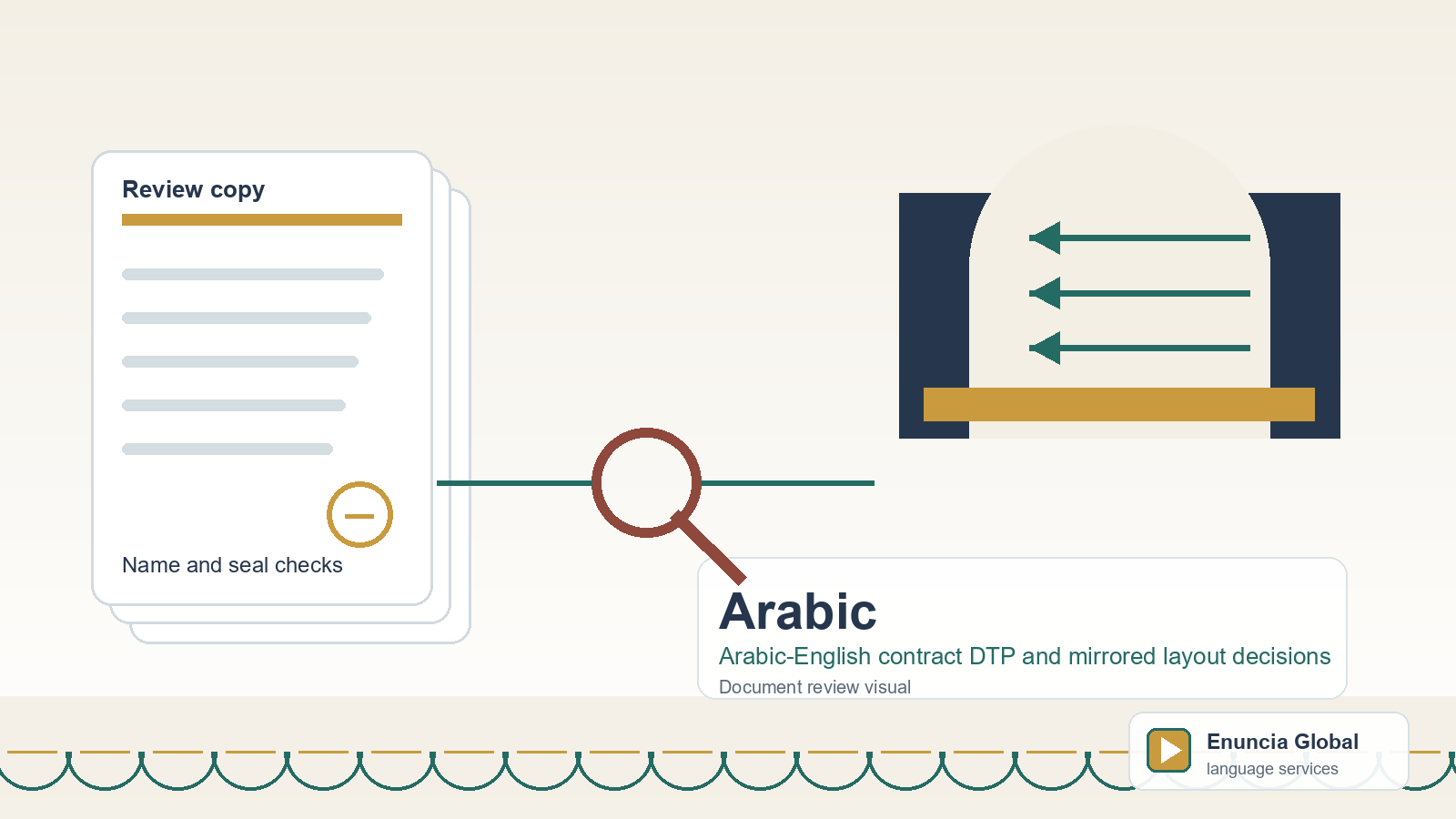
Arabic-English Contract DTP: What To Mirror and What To Keep Fixed
For clients using Arabic translation support, the practical question is how to prepare bilingual Arabic-English contracts for translation, formatting and legal review without breaking comparison flow. The broader service matters, but the success of the job usually depends on the smaller preparation details: which reader will use the file, which fields must remain fixed, which source areas are unclear, and what delivery format the receiving office or team expects.
Field-Level Review Matrix
| Decision area | What the client should send | Control before delivery |
|---|---|---|
| Mirror | Main text direction, aligned bilingual clauses and page flow | Mirror only when it improves reading without damaging reference points |
| Keep fixed | Clause numbers, exhibit labels, signature blocks, company IDs and product codes | Do not reverse identifiers that the reviewer must compare |
| Check separately | Stamps, handwritten initials, seal placement and annexure titles | Mark source uncertainty before final formatting |
| Deliverable | Word file, PDF, bilingual table, certified copy or DTP-ready layout | Choose before translation so formatting effort is quoted correctly |
What To Send Before Quote Approval
- Send editable contract files as well as signed scans when available.
- Identify the governing version, comparison purpose and final signing route.
- Lock company names, legal party names, addresses and reference numbers.
- Show which annexures and schedules must remain comparable page by page.
- Confirm whether certification, notarization or apostille support is separate from translation.
- Review the formatted proof before using it for negotiation or signature.
Reader, Register and Format Decision
Arabic work should be routed by reader expectation, not only by the source language name. A formal tone may be right for a court, university, bank, employer or local authority, while a clearer reader-facing style may be better for product instructions, website labels, training content, family records or support messages. The same contracts, annexures, purchase terms, powers of attorney, tenders, signature pages, stamped copies and bilingual tables can therefore need a different register, layout and explanation level depending on who will reject, approve or rely on the final version.
Before delivery, the client and reviewer should be able to read one compact handoff note covering source order, accepted spellings, unclear areas, receiver purpose, chosen format and any certification or hard-copy need. That note is useful for Arabic certificates, contracts, manuals, transcripts, websites, subtitles, media files and business records because it shows why the final wording follows a particular route.
Practical Outcome For The Client
For the client, the decision path should be clear before Enuncia starts: identify the final reader, confirm the file type, lock names and fixed terms, mark unclear source areas, choose the delivery format and keep receiver instructions visible. That is the practical difference between a request that only mentions a language pair and a file packet that can be reviewed without avoidable back-and-forth.
Responsible wording rule: Enuncia gives English preparation guidance here. Examples in another language, certified wording, official-use promises, prices, timelines and client-specific facts should be added only when the right evidence and reviewer approval are available.