
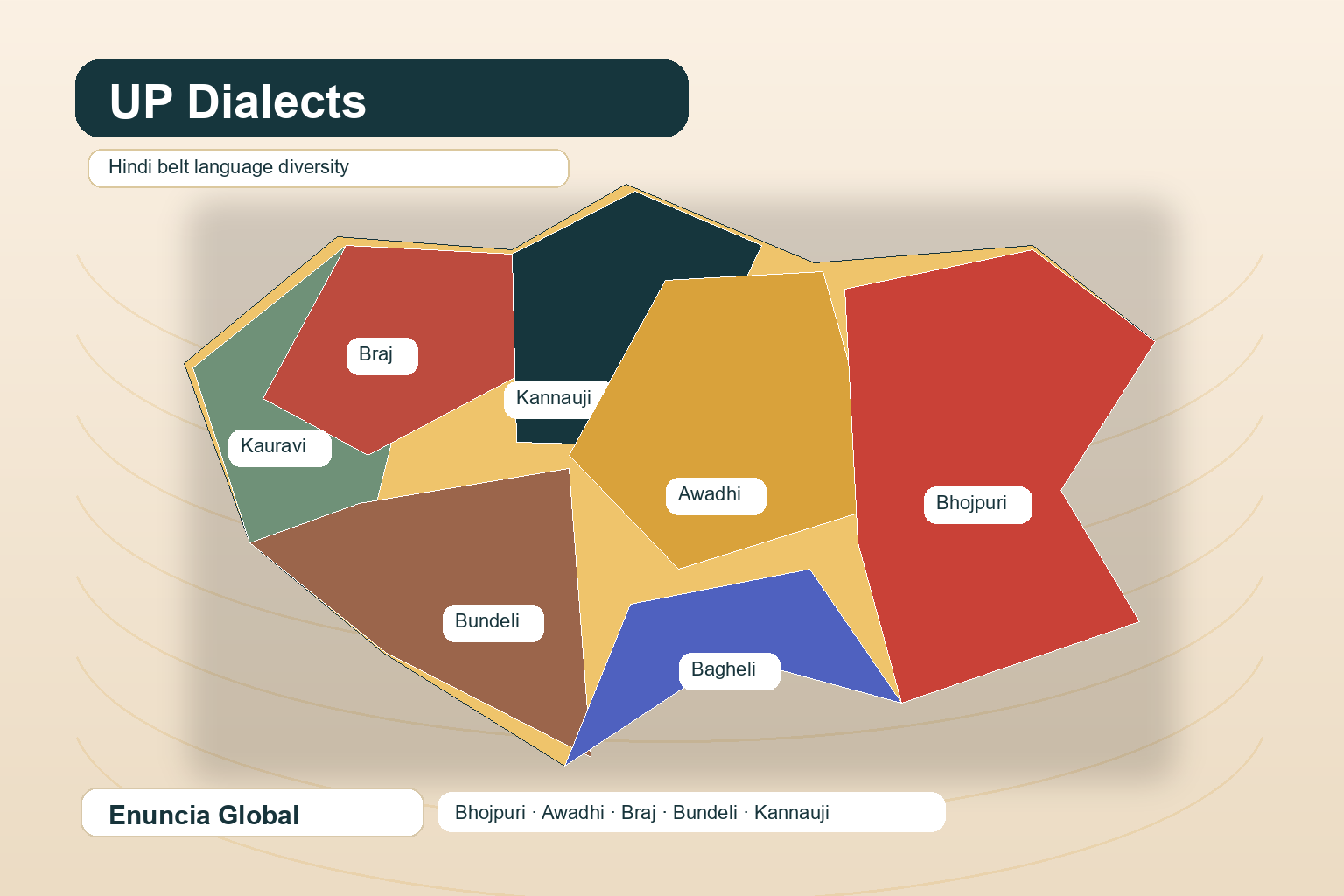
Uttar Pradesh is one of India’s most dialectically diverse states because several Indo-Aryan speech zones meet inside the state: western Hindi varieties, central and eastern varieties, Bundelkhand speech, Purvanchal speech, Urdu-Hindustani registers, and contact varieties shaped by migration and city life. A request for “Hindi from Uttar Pradesh” can therefore be too broad for transcription, dubbing, field interviews, surveys or culturally sensitive translation.
The official and administrative language framework is usually built around Hindi and Urdu, but actual speech changes across regions. The Linguistic Survey of India volume for Uttar Pradesh and state cultural resources record a landscape that includes Awadhi, Bhojpuri, Braj Bhasha, Bundeli, Kannauji, Bagheli and related Hindi-region varieties. A practical language brief should record both the broad language label and the district or community context.
Major dialects and regional varieties of Uttar Pradesh
| Dialect or variety | Broad region in Uttar Pradesh | Why it matters for language work |
|---|---|---|
| Kauravi / Khari Boli | Western Uttar Pradesh and the Delhi-NCR influence belt | Often close to standard Hindi in formal contexts, but local speech, idioms and rural interviews may need regional familiarity. |
| Braj Bhasha / Braj | Mathura, Agra and adjoining western districts | Important in cultural, devotional, folk, tourism and local interview material. |
| Kannauji / Kanauji | Central-western belt around Kannauj, Kanpur-side transition areas and neighbouring districts | Useful for recognising speech that sits between better-known western and central varieties. |
| Bundeli | Bundelkhand areas including Jhansi, Lalitpur, Jalaun, Hamirpur, Mahoba and nearby regions | Needs separate attention in rural recordings, oral histories, local campaigns and voice work. |
| Bagheli | South-eastern contact belt near parts of Mirzapur and adjoining regions | Often missed in broad Hindi briefs; identify locality before assigning a reviewer. |
| Awadhi | Central and eastern-central Uttar Pradesh, including the Awadh cultural region | Common in interviews, folk material, local campaigns, political speech and community-facing audio. |
| Bhojpuri | Eastern Uttar Pradesh and Purvanchal, especially around Gorakhpur, Azamgarh, Ballia, Varanasi-side contexts and adjoining areas | Should be requested by name when the audience or speaker identifies it; do not hide it inside generic Hindi. |
| Urdu / Hindustani registers | Urban, literary, legal, cultural and community contexts across the state | Script, register and audience determine whether Hindi, Urdu, Hindustani or bilingual handling is needed. |
Why Uttar Pradesh dialect identification is difficult
Dialect boundaries do not follow district borders perfectly. Kanpur-side speech may show Kannauji, Awadhi or Bundeli influence depending on locality and family background. Eastern districts can move between Bhojpuri and Awadhi habits. In cities such as Lucknow, Kanpur, Prayagraj, Varanasi, Noida and Ghaziabad, formal Hindi, Urdu, English and regional speech can appear in the same conversation.
This is why a sample matters. A one-line language label on a form is less reliable than a 60-second audio sample, the district, the speaker’s own language name, and the target audience. For written translation, the source may be standard Hindi even when the speaker uses Awadhi or Bhojpuri at home. For transcription and subtitling, the spoken variety is the key issue.
How to brief a translator, transcriber or interpreter
- Share the district, town or village if known.
- Record the speaker’s own language label, even if the form says Hindi.
- Provide a short sample before promising full transcription or interpretation.
- State the output language: verbatim source transcript, Hindi transcript, English translation, subtitles, summary, or bilingual deliverable.
- Flag names, caste/community terms, folk terms, legal terms and place names that must be preserved carefully.
Dialect-sensitive examples
A Bhojpuri field interview for a development study should not be assigned only as “Hindi audio” if the speech is strongly Bhojpuri. A Braj devotional text may need cultural terminology and poetic familiarity. A Bundeli oral-history recording can lose local meaning if the transcriber normalises every sentence into standard Hindi. An Urdu-heavy legal or cultural speech may need a reviewer comfortable with the register and script choices.
For business localisation, the decision is different. A customer-facing campaign for western Uttar Pradesh may use standard Hindi but test local phrases in voiceover. A public-awareness recording for Purvanchal may need Bhojpuri voice talent. A government-style information leaflet may remain in standard Hindi while the outreach audio uses local speech.
Checklist for Uttar Pradesh language projects
| Project type | What to ask before assigning | Best output decision |
|---|---|---|
| Audio transcription | Which dialect is actually spoken in the sample? | Use a dialect-aware transcriber and mark uncertain passages. |
| English translation | Should the source variety be preserved in notes or normalised? | Translate meaning accurately while preserving names and culturally loaded terms. |
| Subtitles | Is the audience local, national or international? | Decide between local speech flavour, standard Hindi, English, or bilingual subtitles. |
| Voiceover or dubbing | Which region should the voice sound natural to? | Choose talent by region and register, not only by “Hindi speaker”. |
Related Enuncia resources
- Hindi document translation services for formal written records.
- Translation services for multilingual document, audio and localisation work.
- Get a Uttar Pradesh language quote with sample, district and output requirement.
Need help with Uttar Pradesh dialect translation, transcription or voice work?
Send a clear scan or brief, the destination country or audience, the receiving authority if known, and your deadline. Enuncia Global can review the language, translation and document-preparation route before quoting.
Get Quote · Call +91 93150 56112 · WhatsApp +91 93150 56112 · Email info@enuncia.global