
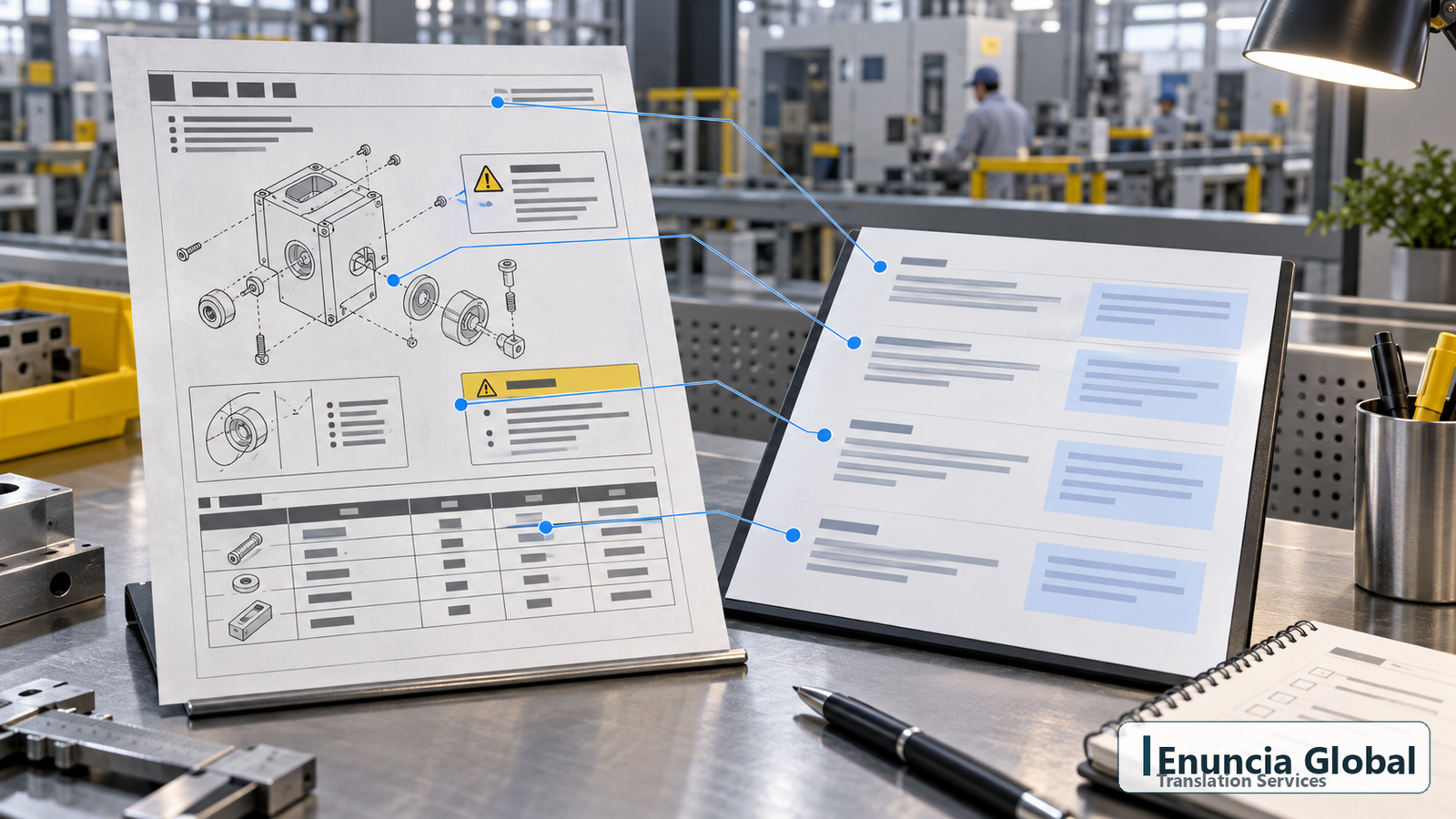
Japanese factory documents often fail in English when the layout is treated as decoration. A line beside a diagram, a short caution box, a revision mark or a table footnote may carry the instruction that a reviewer needs most. The translation has to preserve the work sequence and the source relationship, not only the sentence meaning.
Start With the Manufacturing Document Function
Start with the document function. Is it a shop-floor instruction, supplier handover note, inspection checklist, training sheet, machine operation guide, product table or meeting reference file? Each one needs a different delivery format.
Shop-Floor Instructions: Preserve the Action Sequence
For shop-floor instructions, preserve numbered steps, tool names, part references and action verbs. A verb can change whether the worker should tighten, align, insert, cool, measure, inspect, stop or report. Where the Japanese source distinguishes a required action from a condition or warning, the English version should keep that distinction visible.
Caution Boxes and Safety Notes
For caution boxes and safety notes, keep the warning attached to the correct object or process. Do not move the caution into a general paragraph if the source places it beside a diagram, switch, panel, blade, container or measurement step. If the warning applies before or after a step, the sequence must remain clear.
Technical Tables, Diagrams and Revision Marks
For technical tables, protect model numbers, units, dimensions, material names, quantities, revision codes and drawing references. A table can lose value if columns are merged or if repeated units are removed. The reviewer should be able to move from a Japanese cell to the English cell without hunting.
For diagram-heavy documents, labels and callouts need a separate pass. Figure numbers, arrows, legends, connector labels and note markers should be checked after translation. If the source file is editable, use it. If only a scanned image is available, send the highest-resolution version so the small labels do not become guesswork.
Interpreter Preparation for Factory Meetings
For manufacturing meetings or simultaneous interpretation, the written documents can also become a terminology base. Send product names, model lists, process names, defect categories, agenda points and participant roles before the meeting. A short bilingual term sheet can reduce confusion during supplier calls, audits, plant visits and training sessions.
Japanese Manufacturing File Review Matrix
- Instruction path: step numbers, action verbs, sequence words and required conditions.
- Safety path: caution boxes, prohibited actions, required actions and emergency notes.
- Table path: units, dimensions, tolerances, materials, quantities and revision marks.
- Diagram path: labels, arrows, legends, figure numbers and callout references.
- Meeting path: terminology list, product list, agenda, speaker roles and sample files.
How Enuncia Global Supports Japanese Manufacturing Translation
Enuncia Global can support Japanese to English manufacturing translation and interpreter preparation with terminology control, layout-aware translation, table preservation, diagram-reference checks and formatted delivery.
Request translation support
Call or WhatsApp: +91 93150 56112
Email: info@enuncia.global
Get a quote: https://enuncia.global/get-free-quote/
Related Japanese Manufacturing Translation Resources
Use these resources when Japanese manufacturing files also need interpretation, meeting support or wider language service planning.
- Japanese translation services in India – for documents, technical files and business records
- Japanese interpreters for business meetings – for factory visits, supplier calls and training sessions
- Get a Japanese manufacturing translation quote – share source files, purpose and deadline
Before You Send Japanese Factory Files
Send editable files where possible, complete diagrams, revision notes, product names, model lists and any approved English terminology.
2 Responses